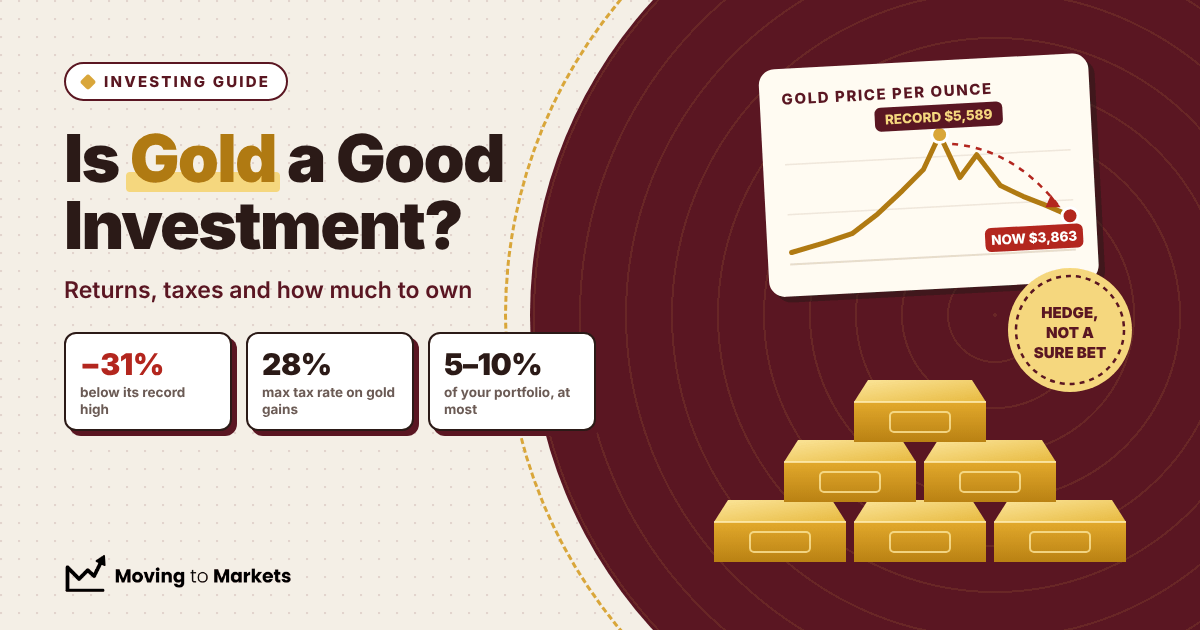
Gold is a decent hedge but a weak main investment. It hit a record $5,589 an ounce on January 28, 2026 and traded near $3,863 on November 16, 2026, about 31% lower. Since 1971 the S&P 500 returned about 11.1% a year with dividends against 8.5% for gold. Holding 5% to 10% of your money in gold can soften stock crashes, but gold pays no income and can stay down for decades.
We all know that one person who texted the family group chat in January saying “gold just hit $5,000, I told you so.” Maybe it was your dad with his little box of coins in the closet, or a coworker who moved half his savings into a gold ETF after watching a few YouTube videos. Now gold is down more than $1,700 an ounce from that peak and the same person has gone very quiet.
So is gold a good investment, or did everyone just get caught up in the hype? The honest answer is somewhere in the middle. Gold has had its moments, and it beat stocks over the last 25 years. But it has also gone 28 years without a new high before. This guide uses late 2026 numbers to show you where gold actually fits, how much it costs to own, how it gets taxed and how much you should hold, if any.
Is gold a good investment right now?
Gold is cheaper than it was in January, but cheaper doesn’t mean it’s done falling. At $3,863 an ounce on November 16, 2026, gold is about 31% below its $5,589 record and roughly back where it was when it first crossed $4,000 in October 2025. It makes sense as a small hedge, not as a bet on a quick rebound.
Here’s where the price has been over the past year:
| Date | Gold price per ounce | Source |
|---|---|---|
| Q3 2025 average | $3,457 | World Gold Council (LBMA PM) |
| October 2025 | First crossed $4,000 | MetalCharts |
| January 28, 2026 | $5,589.38 (record) | Kitco, CBS News |
| February 2, 2026 | About $4,400 | Investing News Network |
| Q3 2026 average | $4,262 | World Gold Council (LBMA PM) |
| November 16, 2026 | $3,862.90 | Kitco |
If you bought one ounce at the January top, you’re sitting on a loss of about $1,726. If you bought in the summer of 2025, you’re still ahead. Timing changed everything for gold buyers this year, which is the main thing to remember before you buy more.
Gold tends to do well when interest rates fall and when people are scared. In November 2026 the opposite is happening. Kitco’s market reports on November 13 pointed to rising Treasury yields and hotter inflation numbers that pushed back expected Fed rate cuts. When a savings account or Treasury bill pays a real return, gold, which pays nothing, looks less attractive.
Why did gold fall so much in 2026?
Gold ran up too far, too fast. It rose from about $2,624 at the start of 2025 to $5,589 in January 2026, more than doubling in 13 months. Then a more hawkish Federal Reserve, rising Treasury yields and fading geopolitical fear pulled it down. It dropped 21% in five days and kept sliding through the year.
The pullback came in stages. Gold fell below $5,000 on January 30, 2026 and hit about $4,400 by February 2, according to the Investing News Network. It bounced back above $5,200 on February 23, then slid most of the year. It closed July 2026 at $4,043 (Money Metals) and dropped under $3,900 in the week of November 13.
Small buyers left first. The World Gold Council’s Q3 2026 report shows US bar and coin demand fell to 8 tonnes, down 40% from a year earlier and the weakest quarter since late 2019. Jewelry demand worldwide dropped 17% to 313 tonnes, the weakest third quarter in the council’s data.
Big buyers did the opposite:
- Central banks added 321 tonnes in Q3 2026, up 42% from Q3 2025.
- Gold ETFs took in 211 tonnes, pushing their holdings to a record 4,256 tonnes.
- Total demand was 1,369 tonnes, worth $188 billion.
So the people with the longest time horizons kept buying while retail buyers backed off. That doesn’t guarantee a rebound, but it tells you the drop was not a mass exit from gold.
How has gold done compared with stocks?
Over most long periods, stocks won. Since August 1971, the S&P 500 returned about 11.1% a year with dividends reinvested against 8.5% for gold. Gold did win over the last 25 years, 11.1% to 9.9%, because it started that stretch near a 20-year low and stocks began it near the dot-com top.
Here are the numbers from Investment Visual, with data through November 13, 2026:
| Period | S&P 500 (dividends reinvested) | Gold | $10,000 in stocks became | $10,000 in gold became |
|---|---|---|---|---|
| Last 10 years | 15.2% a year | 12.2% a year | $41,165 | $31,618 |
| Last 25 years | 9.9% a year | 11.1% a year | $105,911 | $138,948 |
| Since August 1971 | 11.1% a year | 8.5% a year | $3,420,000 | $910,000 |
| Since 1871 | 9.4% a year | 3.3% a year | n/a | n/a |
The 55-year row is the one to look at. A dollar in gold in 1971 grew to $91. A dollar in the S&P 500 grew to $342. Same starting point, almost four times the ending balance, mostly because stocks pay dividends and those dividends compound. Gold just sits there.
Gold still beat stocks in plenty of single years. It came out ahead of the S&P 500 in 24 of the 54 calendar years from 1972 to 2025. That’s why owning a little of both has worked better than picking one.
Warren Buffett made the same point in his 2011 shareholder letter. He noted that all the gold in the world would fit into a cube about 68 feet on each side, and that the cube would never produce anything. You can stare at it forever and it won’t pay you a dividend. If you want the stock side of this, our guide on how to invest in the S&P 500 walks you through it.
Does gold protect you from inflation?
Sometimes. Gold has done well in high inflation years but poorly as a month-to-month hedge. State Street found gold rose an average 15% a year when US inflation was above 3%, but only about 5% a year when inflation stayed below 3% (1970 to 2018). Over shorter periods, the link breaks down often.
The 1980s show the problem. Gold hit $850 in January 1980 during double-digit inflation. Prices kept rising for the next 20 years, but gold didn’t. By 1999 it was trading under $300. If you bought at the 1980 top to protect yourself from inflation, you lost more than half your purchasing power over two decades.
The 2021 and 2022 inflation spike tells a similar story. Consumer prices jumped, and gold actually fell 7.4% between January and October 2022, according to Money Metals. Rising interest rates hurt gold more than rising prices helped it.
Over very long periods gold does keep up with inflation. MetalCharts estimates the $850 1980 peak is worth roughly $3,300 to $3,600 in 2026 dollars, so even after this year’s drop gold is above its old inflation-adjusted high. But “very long” here means 40+ years. If you need inflation protection for money you’ll use in 5 to 10 years, Treasury Inflation-Protected Securities (TIPS) or I bonds track CPI directly.
Does gold hold up when stocks crash?
Gold has held up better than stocks in most big crashes, but it hasn’t always gone up. During the 2007 to 2009 financial crisis, gold rose 25% while the S&P 500 fell 57%. In the 2020 COVID crash and the 2022 bear market, gold still fell, just much less than stocks.
| Crash | Dates | S&P 500 | Gold |
|---|---|---|---|
| 1973 to 1974 bear market | Jan 1973 to Oct 1974 | -48.2% | +143% |
| Dot-com crash | Mar 2000 to Oct 2002 | -49.1% | +15.1% |
| Financial crisis | Oct 2007 to Mar 2009 | -56.8% | +25.0% |
| COVID crash | Feb 19 to Mar 23, 2020 | -33.9% | -3.5% |
| 2022 bear market | Jan 3 to Oct 12, 2022 | -25.4% | -7.4% |
Source: Money Metals, “Gold vs the Stock Market” (August 10, 2026).
This is the best case for owning some gold. Say you have $100,000, all in an S&P 500 fund, and you hit a 2008-style crash. You’d be down about $56,800. Put $10,000 of that in gold and the same crash leaves you down about $48,600 instead ($90,000 x 56.8% loss, minus a $2,500 gain on gold). That’s about $8,000 less damage, and you’d have gold to sell and rebalance into cheap stocks.
How long can gold stay down?
Much longer than most people expect. Gold peaked at $850 in January 1980 and didn’t pass that level again until March 2008, about 28 years later. After its September 2011 peak of $1,921, it fell about 45% to roughly $1,050 by December 2015 and didn’t set a new high until 2020.
| Peak | Peak price | Low after the peak | Drop | Years to a new nominal high |
|---|---|---|---|---|
| January 21, 1980 | $850 | About $252 (1999) | About 70% | About 28 (March 2008) |
| September 6, 2011 | $1,921 | About $1,050 (December 2015) | About 45% | About 9 (2020) |
| January 28, 2026 | $5,589.38 | $3,862.90 so far (November 16, 2026) | About 31% so far | Unknown |
If a dealer tells you gold “always bounces back,” show them this table. JM Bullion’s investing guide literally says “there has never been a time where gold hasn’t rebounded.” It did rebound, eventually, but someone who bought at age 40 in 1980 was 68 by the time they broke even, without collecting a cent of interest along the way.
What are the ways to invest in gold?
You can buy physical bars and coins, a gold ETF that holds bullion, shares of gold mining companies, futures contracts, or gold inside a self-directed IRA. For most people a low-cost gold ETF is the cheapest and easiest option. Physical gold makes sense only if you want metal you can hold.
| Option | Typical cost | How it’s taxed (US) | Good for | Watch out for |
|---|---|---|---|---|
| Coins and bars | 5% to 10% dealer premium on bullion (CFTC) | Collectible, up to 28% | People who want metal in hand | Storage, insurance, buyback spread |
| Physical gold ETFs (GLDM, SGOL, IAU, GLD) | 0.10% to 0.40% a year | Collectible, up to 28% | Most investors | Same tax as coins |
| Gold mining stocks and miner ETFs (GDX, GDXJ) | Normal stock fees | Regular stock rates, 0/15/20% | Higher risk, higher upside | Miners can fall more than gold |
| Futures | Margin and roll costs | 60/40 long/short-term split | Experienced traders | Margin losses can exceed what you put in |
| Gold IRA | Setup, storage and custodian fees | Tax-deferred inside the IRA | Retirement savers who insist on metal | High fees and sales pressure |
The ETF fee gap is bigger than it looks. On $10,000, GLD at 0.40% costs you $40 a year. GLDM at 0.10% costs $10. Both hold physical gold in vaults. Over 20 years that’s a $600 difference before any growth, for basically the same product. SGOL charges 0.17% and IAU 0.25%. GLD is the biggest fund, with more than $132 billion in assets as of June 2026 (ETF.com), and traders like it because it trades a lot. If you’re buying and holding, the cheaper funds make more sense.
Mining stocks are a different bet. Miners make more money when gold rises, so their shares usually swing harder than gold itself in both directions. You also take on company risk: a mine can flood, a government can raise royalties, a CEO can overpay for a rival.
If you’re comparing fund types in general, our explainer on index funds vs mutual funds covers the fee math.
How is gold taxed in the US?
The IRS treats physical gold and most gold ETFs as collectibles. If you hold more than a year, your profit is taxed at your ordinary income rate, capped at 28%, instead of the 0%, 15% or 20% rates on stocks. Held a year or less, it’s taxed like regular income. Gold mining stocks get normal stock rates.
IRS Topic 409 (updated November 9, 2026) says it plainly: “Net capital gains from selling collectibles (such as coins or art) are taxed at a maximum 28% rate.” ETFs like GLD, IAU, GLDM and SGOL hold physical bullion, so the same rule applies to them. Funds that hold mining shares, like GDX, are taxed as normal stock.
Here’s what that means in real dollars. Say you made a $10,000 profit after holding more than a year.
| Your ordinary tax bracket | Tax on $10,000 stock gain (2026) | Tax on $10,000 gold gain | Extra tax on gold |
|---|---|---|---|
| 12% | $0 (if within 0% range) | $1,200 | $1,200 |
| 24% | $1,500 | $2,400 | $900 |
| 32% | $1,500 | $2,800 | $1,300 |
| 37% | $2,000 | $2,800 | $800 |
For 2026, the 0% long-term rate on stocks applies to taxable income up to $49,450 if you’re single and $98,900 if you’re married filing jointly. The 15% rate runs up to $545,500 single and $613,700 joint (Kiplinger, March 2026). Collectibles never get that 0% rate. High earners may also owe the 3.8% net investment income tax on top, once modified AGI passes $200,000 single or $250,000 joint (IRS Publication 550).
A simple way around most of this: hold your gold ETF inside an IRA or 401(k) brokerage window if your plan allows it. Gains inside the account aren’t taxed each year. If you’re not sure which retirement account to use, see our 401(k) vs Roth 401(k) guide.
What does physical gold really cost?
More than the spot price. Dealers charge a premium of about 5% to 10% over spot on common bullion coins and bars, according to the CFTC, and 40% to 200% on numismatic or “collector” coins. You then pay storage and insurance, and when you sell, the dealer usually pays you spot or a bit less.
Let’s do the math on a 1 ounce American Gold Eagle on November 16, 2026:
- Spot price: $3,862.90.
- Add a 5% premium: you pay about $4,056.
- Add a 10% premium: you pay about $4,249.
- If you sell back at spot, gold has to rise 5% to 10% just for you to break even.
- Add the yearly cost of a safe deposit box or home safe plus insurance, and the coin needs to climb even more.
Numismatic coins are where people get hurt. A coin sold at a 100% premium has to double in gold value before you’re even. The CFTC says it has seen fraud cases with spreads of more than 300%.
Physical gold does have one thing an ETF can’t give you: you hold it, and there’s no fund company between you and the metal. If that matters to you, stick to common bullion coins (American Eagle, American Buffalo, Canadian Maple Leaf) or bars from known refiners, and compare the “buy” and “sell” prices at two or three dealers before you order.
Are gold IRAs a good idea?
Usually not. A gold IRA lets you hold approved bullion inside a retirement account, but setup, custodian and storage fees are high and the sales tactics can be aggressive. Federal regulators say they’ve charged dealers with selling more than $500 million in overpriced metals, mostly to retirees. A gold ETF in a regular IRA is cheaper.
Under tax code section 408(m), buying a collectible inside an IRA counts as a taxable distribution. The law makes exceptions for American Eagle gold coins, certain state-issued coins and bullion that meets set purity standards, as long as a trustee or approved depository holds it. You can’t keep IRA gold at home.
On March 20, 2024 the CFTC, FINRA and the North American Securities Administrators Association launched a joint warning about precious metals fraud aimed at retirees. Their bulletin gives an example of a $300,000 IRA rollover where the dealer allegedly took $150,000 in fees and commissions. Victims in these cases lost “one-third to one-half of their savings” to markups and fees.
Red flags to watch for:
- A cold call, email or radio ad urging you to “protect your retirement” by moving it to gold.
- Pressure to buy “rare” or “semi-numismatic” coins instead of plain bullion.
- No clear written price for the spread, commissions and yearly storage fees.
- Claims that the government is about to seize your 401(k) or bank account.
If you want gold in a retirement account, buy a gold ETF like GLDM or IAU through your existing IRA at a normal brokerage. You’ll pay a fraction of the fees and can sell any day the market is open.
How much of your portfolio should be in gold?
Most guides land on 5% to 10%, and the math backs that up. At 5%, a 31% gold drop like 2026’s costs you about 1.5% of your total portfolio. At 25%, the same drop costs you almost 8%. Keep gold small enough that a bad year for gold doesn’t wreck your plan.
Here’s what different amounts would have meant this year on a $100,000 portfolio, if you bought at the January peak:
| Gold allocation | Gold position | Loss from a 31% gold drop | Hit to total portfolio |
|---|---|---|---|
| 5% | $5,000 | $1,545 | 1.5% |
| 10% | $10,000 | $3,089 | 3.1% |
| 25% | $25,000 | $7,722 | 7.7% |
A few rules that work in practice:
- Get your basics right first. Pay off credit card debt, build an emergency fund in a high-yield savings account and take any 401(k) match. Gold comes after that.
- Pick a percentage and stick to it. If gold runs up and your 5% becomes 9%, sell some. If it drops and becomes 3%, buy some. That forces you to buy low and sell high.
- Buy in steps. Splitting a purchase over 6 to 12 months means you won’t put it all in at a top like January 2026.
- Don’t count gold as income. Retirees who need cash flow are better served by bonds, dividend stocks or CDs.
Who should and shouldn’t buy gold?
Gold suits people who already have stocks and bonds and want something that often moves differently in a crisis. It doesn’t suit people who need income, who might need the money within a few years, or who are buying because the price is in the news.
Gold might make sense for you if:
- You have a long-term stock portfolio and want a small hedge for crashes like 2008.
- You worry about the dollar losing value over decades and accept that gold can lag for years.
- You can hold for 10 years or more without needing to sell.
Gold probably isn’t for you if:
- You don’t have an emergency fund yet.
- You’re buying because a friend made money on it in 2025.
- You need your investments to pay you income now.
- You’re being pitched a gold IRA by someone who called you first.
Frequently asked questions
Is gold a good investment in 2026?
Gold dropped about 31% from its January 28, 2026 record of $5,589 to about $3,863 on November 16, 2026. It’s cheaper now, but rising yields are still pushing it lower. As a 5% to 10% hedge it’s reasonable; as a quick rebound bet it’s risky.
Is gold better than stocks?
Not over most long periods. Since August 1971, the S&P 500 returned about 11.1% a year with dividends versus 8.5% for gold (Investment Visual, November 2026). Gold won over the last 25 years and does better in most stock crashes.
Is gold a good hedge against inflation?
Over 40+ years, yes. Over shorter periods, not reliably. Gold fell from $850 in 1980 to under $300 by 1999 while prices kept rising, and it fell 7.4% in 2022 during high inflation.
What is the cheapest way to invest in gold?
A low-cost physical gold ETF. GLDM charges 0.10% a year, or $10 on every $10,000. Physical coins carry 5% to 10% dealer premiums plus storage costs.
How much gold should I own?
Most investors keep 5% to 10% of their portfolio in gold. At 5%, a 31% gold drop costs you about 1.5% of your total portfolio, which is easy to recover from.
Do you pay taxes when you sell gold?
Yes. Physical gold and gold ETFs like GLD and IAU are collectibles. Long-term profits are taxed at your ordinary rate up to a 28% maximum, higher than the 15% or 20% rate on stocks for most people.
Are gold IRAs worth it?
For most people, no. Fees are high and regulators have charged dealers with selling over $500 million in overpriced metals. Buying a gold ETF inside a regular IRA is cheaper and easier to sell.
What was the highest price of gold ever?
Gold’s record is $5,589.38 an ounce, set on January 28, 2026. It dropped below $5,000 two days later.
Gold works as a hedge and works poorly as a wealth builder. It has cushioned you in most stock crashes and beat stocks over the past 25 years, but over the past 55 it turned $1 into $91 while stocks turned it into $342. And 2026 just showed you how fast it can drop 31%.