We all know that one coworker who says “just put it in the S&P 500” every time money comes up. They’re not wrong. The problem is nobody tells you what that actually means. Which fund? Which account? How much do you need? And what happens when the market drops 30% the month after you buy?
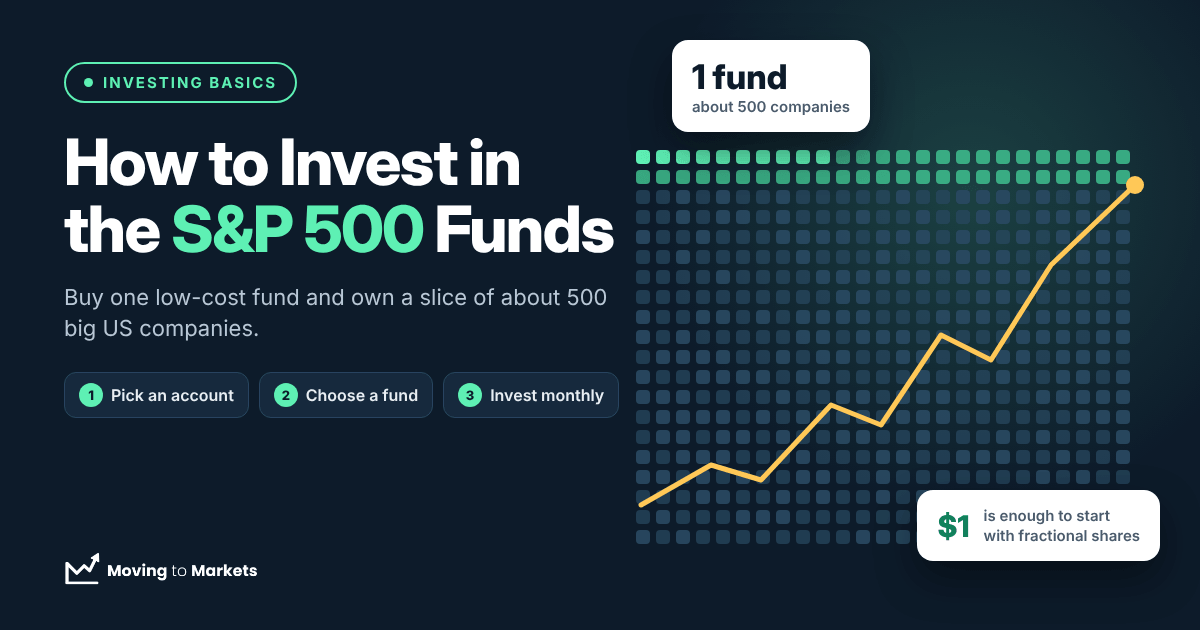
Here’s the short answer. You can’t buy the S&P 500 itself. You buy a fund that holds all of its roughly 500 stocks, like VOO, IVV, SPYM, FXAIX or SWPPX. You buy it through your 401(k), an IRA or a brokerage account, and with fractional shares you can start with $1. The cheapest funds charge 0.015% to 0.03% a year, which is $1.50 to $3 on $10,000.
On November 13, 2026, the S&P 500 closed at 7,561.67. It’s up 10.5% this year (11.5% with dividends) and sits 3.3% below its record close of 7,818.93 on October 6, 2026.
This guide takes you through the whole thing in order, with real tickers, real fees and real dollars.
Can you buy the S&P 500 directly?
No. The S&P 500 is an index, a list of about 500 large US companies kept by S&P Dow Jones Indices. “SPX” is the index’s symbol, and you can’t own it. You invest by buying an index fund or ETF that holds every stock on the list, in the same proportions, so your money moves with the index.
The fund does the work for you. When S&P adds or drops a company (it reviews the list every quarter), the fund buys or sells to match. A company needs a market value of at least $22.7 billion to join, plus positive earnings in its latest quarter and over its last four quarters combined, among other rules.
Together, these 500 companies make up about 80% of the value of the whole US stock market.
How to invest in the S&P 500 in 6 steps
To invest in the S&P 500, pick the right account, open it, add money, choose a low-cost S&P 500 fund, place a buy order and set up automatic monthly investing. Most people finish the first five steps in under 30 minutes online. The sixth step is what builds real money.
- Pick your account. Check your 401(k) first. If your employer matches contributions, start there. Next comes a Roth IRA, then a regular brokerage account. The next section explains why.
- Open the account. For an IRA or brokerage account, Fidelity, Charles Schwab and Vanguard all have $0 account minimums and no commissions on US stocks and ETFs. You’ll need your Social Security number, your address and your bank details.
- Add money. Link your checking account and transfer money in. ACH transfers usually take one to three business days, though many brokers let you invest part of it right away.
- Choose your fund. Search for the ticker. VOO, IVV and SPYM are ETFs you can buy at any brokerage. FXAIX is Fidelity’s mutual fund and SWPPX is Schwab’s. The fund table below compares them.
- Place the order. For an ETF, enter a dollar amount (if your broker allows fractional shares) or a number of shares. A market order buys right away at the current price. A limit order buys only at your price or lower. For most long-term buyers, a market order during trading hours (9:30 a.m. to 4 p.m. ET) is fine. Mutual fund orders fill at the 4 p.m. price, so you won’t see your exact price until after the close. Trades settle in one business day.
- Automate it. Turn on dividend reinvestment (often called DRIP) so your dividends buy more shares. Then set up an automatic deposit and buy every month or every paycheck.
Which account should you use first?
For most US workers, the order is: 401(k) up to the full employer match, then a Roth IRA up to $7,500 for 2026, then more 401(k), then a regular taxable brokerage account. The match is free money, and the IRA and 401(k) shelter your gains from yearly taxes.
| Order | Account | 2026 limit | Why it comes here |
|---|---|---|---|
| 1 | 401(k) up to the match | Whatever gets the full match | A 50% or 100% match beats any market return |
| 2 | Roth IRA | $7,500 ($8,600 if 50 or older) | Withdrawals in retirement are tax-free; you pick your own fund |
| 3 | More 401(k) | $24,500 total ($32,500 if 50 or older) | Higher limit, taxes deferred or tax-free in a Roth 401(k) |
| 4 | Taxable brokerage | No limit | Withdraw any time, but you pay tax on dividends and gains |
Most 401(k) plans already offer an S&P 500 index fund. Look in your plan’s fund list for a name with “500 Index” in it, like “Fidelity 500 Index” or “Vanguard Institutional Index.” Check the expense ratio next to it. Anything under 0.10% is fine.
Not sure whether to go traditional or Roth in your 401(k)? Our 401(k) vs Roth 401(k) guide runs the numbers on both.
Which S&P 500 fund should you buy?
VOO, IVV, SPYM, FXAIX and SWPPX all track the same index and return almost the same amount. Pick based on where you hold your account and how much you’re starting with. Fees run from 0.015% to 0.03%. SPY costs about three times more and mainly suits active traders.
| Fund | Ticker | Type | Expense ratio | Cost per $10,000 a year | Minimum | Best for |
|---|---|---|---|---|---|---|
| Fidelity 500 Index Fund | FXAIX | Mutual fund | 0.015% | $1.50 | $0 | Fidelity accounts and 401(k)s |
| Schwab S&P 500 Index Fund | SWPPX | Mutual fund | 0.02% | $2 | $0 | Schwab accounts |
| SPDR Portfolio S&P 500 ETF | SPYM | ETF | 0.02% | $2 | 1 share (about $90) or $1 fractional | Small, regular buys at any broker |
| Vanguard S&P 500 ETF | VOO | ETF | 0.03% | $3 | 1 share (about $690) or $1 fractional | Any broker |
| iShares Core S&P 500 ETF | IVV | ETF | 0.03% | $3 | 1 share or $1 fractional | Any broker |
| Vanguard 500 Index Admiral | VFIAX | Mutual fund | 0.04% | $4 | $3,000 | Vanguard accounts |
| SPDR S&P 500 ETF Trust | SPY | ETF | 0.0945% | $9.45 | 1 share or $1 fractional | Traders who use options |
SPYM used to trade as SPLG. State Street changed the ticker at the end of October 2025, so older articles still use the old name. It’s the same fund.
A few rules of thumb:
- At Fidelity? Buy FXAIX. It has the lowest fee on the list and no minimum.
- At Schwab? SWPPX lets you buy any dollar amount.
- At Robinhood or another app? Stick to the ETFs. VOO, IVV or SPYM.
- Taxable account? An ETF usually gets you fewer taxable capital gains distributions than a mutual fund. Our index funds vs mutual funds guide explains why.
How much money do you need to start?
You can start with $1. Fidelity and Robinhood let you buy ETFs like VOO in dollar amounts from $1, and Schwab’s SWPPX mutual fund takes any amount. If your broker doesn’t offer fractional shares, SPYM is the cheapest ETF to buy whole, at about $90 a share.
The amount matters less than doing it every month. Put $100 a month into an S&P 500 fund and assume a 10% average yearly return. You’d have about $226,000 after 30 years. You put in $36,000. The rest is growth.
Schwab’s Stock Slices feature lets you buy fractional shares of individual S&P 500 stocks, not ETFs. So at Schwab, small amounts go into SWPPX.
How much could you make in the S&P 500?
Since 1957 the S&P 500 has returned about 10% a year with dividends reinvested, or about 7% after inflation. At 10%, $500 a month grows to about $102,000 in 10 years, $380,000 in 20 years and $1.13 million in 30 years. Those are averages, and no single year looks average.
Here’s what $500 a month adds up to:
| Years | You put in | At 7% a year | At 10% a year |
|---|---|---|---|
| 10 | $60,000 | $86,500 | $102,400 |
| 20 | $120,000 | $260,500 | $379,700 |
| 30 | $180,000 | $610,000 | $1,130,200 |
Use the 7% column if you want the answer in today’s dollars. Use 10% for the number on your statement.
Real years swing hard. The index lost 18% in 2022, then gained 26% in 2023 and 25% in 2024 (all with dividends), and 16% in 2025 on price alone. This year it’s up 10.5% so far.
Lump sum or monthly? If you already have a pile of cash, investing it all at once beat spreading it out about 68% of the time in Vanguard’s research, because markets rise more often than they fall. But most people invest from each paycheck anyway, and that’s monthly investing by default. Both work. Sitting in cash waiting for a dip usually doesn’t.
What are the risks of investing in the S&P 500?
The S&P 500 can drop 25% to 57% in a bad market and take months or years to recover. It fell about 57% from 2007 to 2009 and needed about five and a half years to reach its old high. Only put money here that you won’t need for at least five years.
| Drop | Peak to bottom | How far it fell | Time to a new high (from the peak) |
|---|---|---|---|
| Financial crisis | Oct 2007 to Mar 2009 | 57% | About 5.5 years (Mar 2013) |
| COVID crash | Feb 2020 to Mar 2020 | 34% | About 6 months (Aug 2020) |
| 2022 bear market | Jan 2022 to Oct 2022 | 25% | About 2 years (Jan 2024) |
| 2026 dip | Into Mar 30, 2026 | 9.1% | Records again by summer |
The people who got hurt worst in those years were the ones who sold near the bottom. If you’d bought at the October 2007 peak and kept going, you were back to even in 2013, and the index is now nearly five times that 2007 peak.
So the rule is simple. Money for next year’s tuition, a house down payment in two years or your emergency fund doesn’t belong in the S&P 500. Keep that in a high-yield savings account instead.
How concentrated is the S&P 500 right now?
Very. The 10 largest companies make up about 38% of the index, and Nvidia alone is about 7.2%. So $1,000 in an S&P 500 fund puts about $72 in Nvidia and less than $1 in each of the smaller companies near the bottom of the list.
Top 10 by weight (Slickcharts, November 14, 2026):
| Company | Weight |
|---|---|
| Nvidia | 7.2% |
| Apple | 6.0% |
| Microsoft | 5.4% |
| Alphabet (two share classes) | 6.4% |
| Amazon | 4.1% |
| Broadcom | 2.6% |
| Meta | 2.5% |
| Tesla | 2.3% |
| Berkshire Hathaway | 1.7% |
| Top 10 total | About 38% |
That’s how the index is built. It weights companies by market value, so the biggest ones count the most. When big tech does well, you win big. When it falls, it drags the whole index.
If that bothers you, you have two options. The Invesco S&P 500 Equal Weight ETF (RSP) holds the same 500 companies at about 0.2% each, for a 0.20% fee. A total market fund like VTI or FSKAX adds about 3,000 smaller companies. You don’t have to switch. Lots of people hold the regular S&P 500 and add a slice of one of these.
How are S&P 500 funds taxed?
Inside a 401(k) or IRA, you pay nothing while the money stays in. In a taxable account, you pay tax on dividends every year and on gains when you sell. Most S&P 500 dividends count as qualified, so you’ll pay 0%, 15% or 20%, depending on your income.
Here’s how it works in a regular brokerage account:
- Dividends. The S&P 500 yields about 1.1% right now. On $20,000, that’s about $220 a year. At the 15% rate, you’d owe about $33, even if you reinvest it. Your broker sends you a 1099-DIV.
- Selling after more than a year. You pay long-term capital gains rates. For 2026, single filers pay 0% on taxable income up to $49,450 and married couples filing jointly pay 0% up to $98,900. Most people above that pay 15%.
- Selling within a year. The gain gets taxed as regular income, up to 37%.
- Fund distributions. ETFs like VOO and IVV rarely pass capital gains on to you. Mutual funds sometimes do, which is one reason to hold ETFs in a taxable account.
Watch the wash sale rule. If you sell at a loss and buy the same or a “substantially identical” fund within 30 days before or after, the IRS disallows the loss for now. The IRS has never said whether two S&P 500 funds, like VOO and IVV, count as substantially identical. If you’re harvesting a loss, swapping into a total market fund for 31 days is the safer move.
S&P 500 vs total market vs Nasdaq-100
The S&P 500 holds about 500 large US companies. A total market fund holds those plus about 3,000 smaller ones. The Nasdaq-100 holds 100 large non-financial companies listed on the Nasdaq and leans much harder into tech. None of the three owns international stocks.
| S&P 500 | Total US market | Nasdaq-100 | |
|---|---|---|---|
| Example funds | VOO, FXAIX, SPYM | VTI, FSKAX | QQQ, QQQM |
| Number of stocks | About 500 | About 3,500 | About 100 |
| Includes banks and insurers | Yes | Yes | No |
| Includes small companies | No | Yes | No |
| Typical fee | 0.015% to 0.03% | 0.015% to 0.03% | 0.15% to 0.20% |
| Who it fits | Most beginners | People who want every US stock | People who want extra tech exposure and can handle bigger swings |
Since the S&P 500 is about 80% of the total market, VOO and VTI have moved almost together for years. Either one is a fine core holding.
What should you do after you buy?
Keep buying every month, leave dividend reinvestment on and check your account about once a quarter. Don’t sell during drops. Once a year, check whether your mix of stocks and bonds still fits your age and plans, and rebalance if it has drifted more than 5 percentage points.
A few practical habits:
- Raise your monthly amount when you get a raise. Even $25 more a month adds up to about $57,000 over 30 years at 10%.
- Don’t check daily. Daily swings of 1% to 2% are normal and mean nothing for a 20-year plan.
- Keep buying during drops. At the October 2022 low, your $500 bought shares about 25% cheaper than at the start of that year.
- Ignore the add and drop news. The fund handles index changes every quarter. You don’t have to do anything.
- Think about international and bonds later. The S&P 500 is US-only. As you get closer to retirement, many people add bonds so a 30% drop doesn’t wreck their plans.
Frequently asked questions
Can I invest $100 in the S&P 500?
Yes. Fidelity and Robinhood let you buy S&P 500 ETFs from $1, and Schwab’s SWPPX takes any amount. $100 a month at a 10% average return grows to about $226,000 in 30 years.
Is now a good time to invest in the S&P 500?
Nobody knows what the next month will bring. The index is up 10.5% this year and 3.3% below its record. Over 20-plus years, time in the market has mattered more than timing. Monthly investing takes the guessing out of it.
Can you lose money in the S&P 500?
Yes. It fell 57% from 2007 to 2009 and 34% in 2020. Over any 20-year period since 1957, though, it has never lost money with dividends reinvested. That’s why money you need within five years doesn’t belong here.
Does the S&P 500 pay dividends?
Yes. The companies in it pay dividends, and your fund passes them to you, usually every quarter. The yield is about 1.1% right now, which is low by historical standards.
Should I buy VOO or SPY?
VOO for most people. Both track the same index, but VOO charges 0.03% a year and SPY charges 0.0945%. On $50,000, that’s $15 vs $47 a year. SPY trades more shares and has the busiest options market, which matters to traders, not long-term investors.
Should I invest a lump sum or monthly?
A lump sum beat monthly investing about 68% of the time in Vanguard’s research, because markets rise more often than they fall. If investing it all at once would keep you up at night, spread it over three to six months.
How long should I hold an S&P 500 fund?
At least five years, ideally 10 or more. The 2022 drop took about two years to recover and the 2008 drop took about five and a half. Longer holding periods give you more time to ride out a bad stretch.
Is the S&P 500 enough on its own?
For many beginners, yes, as a first holding. It has no small companies, no international stocks and no bonds. As your account grows, you can add a total international fund and, closer to retirement, a bond fund.
The bottom line
Investing in the S&P 500 comes down to three choices: the account, the fund and the monthly amount. Start with your 401(k) match, then a Roth IRA, and buy a fund that charges 0.03% or less, like FXAIX, SWPPX, SPYM, VOO or IVV. Then set up a monthly buy and leave it alone through the drops.