We all know that one friend who keeps telling you to “just move your savings to a high-yield account.” You nod, you mean to do it, and then your emergency fund sits in the same big-bank savings account for another year earning almost nothing. Part of the reason is that nobody explains how these accounts actually work, where the extra money comes from, and what the catch is.
Here’s the short answer. A high-yield savings account is a savings account, usually at an online bank, that pays a variable interest rate around 10 times the national average. The bank figures your interest every day, adds it to your balance once a month, and then pays interest on that interest. Your money stays FDIC or NCUA insured up to $250,000, and you can move it to checking in one to three business days.
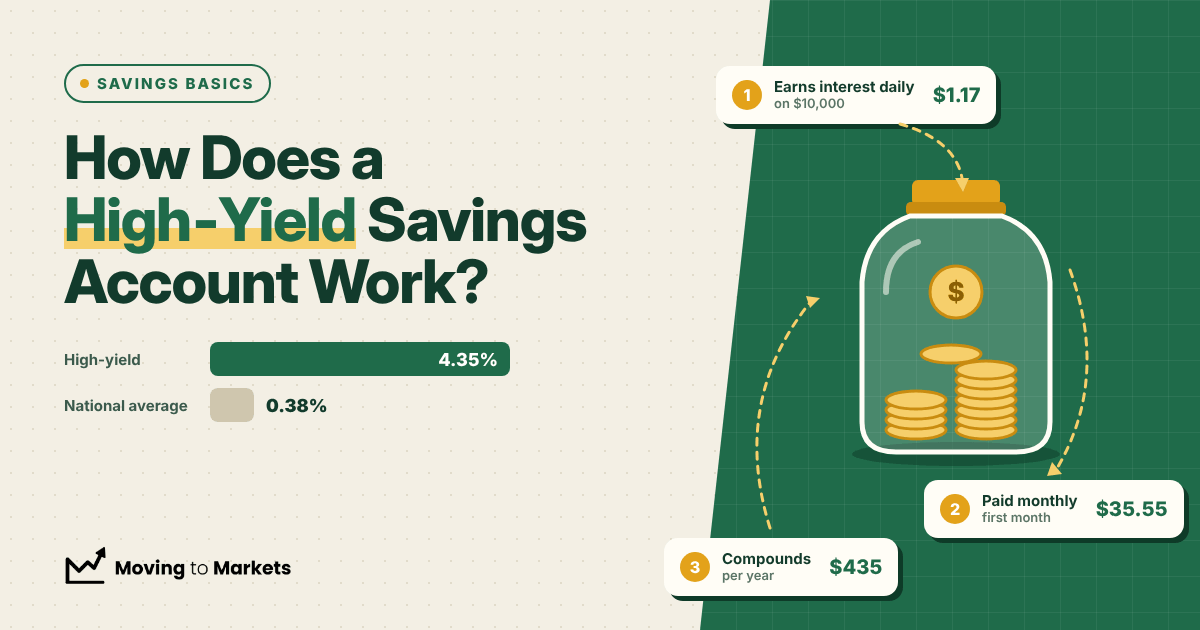
Right now the best high-yield savings accounts pay 4.35% to 4.40% APY (Pibank, SoFi, CIT and Western Alliance, rates as of November 13, 2026). The FDIC’s national average for savings is 0.38%. On $10,000, that’s $435 a year vs $38.
This guide walks you through the whole thing with real dollars, so you know what you’re signing up for.
High-yield savings vs regular savings at a glance
| High-yield savings | Regular savings | |
|---|---|---|
| Typical APY (Nov 2026) | 4.00% to 4.40% at top online banks | 0.38% national average (FDIC) |
| $10,000 earns in a year | About $435 at 4.35% | About $38 |
| Where you find it | Mostly online banks, some credit unions and fintech apps | Big branch banks |
| Insurance | FDIC or NCUA, $250,000 per depositor, per bank, per ownership category | Same |
| Rate fixed? | No, the bank can change it any time | No |
| Getting cash out | Transfer to checking, 1 to 3 business days; few have ATM cards | Often same day at a branch or ATM |
| Minimum deposit | Often $0 to $100; some need $5,000 for the top rate | Often $25 to $300, with fees below a balance |
How does a high-yield savings account earn interest?
A high-yield savings account earns interest every day on your balance. The bank adds up those daily amounts and pays them into your account once a month. Next month, you earn interest on the bigger balance. At 4.35% APY, $10,000 earns about $1.17 a day, about $35.55 in the first month and $435 over a year.
Here’s the cycle with $10,000 at 4.35% APY:
- Every day, the bank calculates interest. It uses a daily rate based on the account’s interest rate (about 4.26% for a 4.35% APY that compounds daily). On $10,000, that’s about $1.17 a day.
- The interest piles up behind the scenes. You won’t see it in your balance yet. Banks call this “accrued” interest.
- Once a month, the bank credits it. Most banks add it on the last day of your statement cycle. Your first month brings in about $35.55.
- The cycle repeats on a bigger balance. Month two starts at $10,035.55, so you earn a few cents more. That’s compounding.
- Your statement shows “APY earned.” This is what you actually got that month, turned into a yearly rate. If it’s lower than the advertised APY, check whether the bank cut the rate or your balance dropped below a tier.
Leave the $10,000 alone for five years and it grows by about $2,373 at 4.35%. At the 0.38% national rate it grows by about $191. Same money, same five years.
If you want the formula behind APY or how daily vs monthly compounding changes the number, our guide on APY vs interest rate runs through it step by step.
Why do high-yield savings accounts pay more than regular savings?
High-yield savings accounts pay more because most come from online banks with no branches to pay for, and those banks compete hard for deposits to fund their loans. Big branch banks already hold trillions in deposits from customers who rarely leave, so they have little reason to raise their rates.
Think about where your bank’s money goes. Chase, Bank of America and Wells Fargo run thousands of branches, ATMs and tellers. They also have millions of customers who keep their savings there out of habit. Paying those customers 0.01% to 0.05% costs the bank almost nothing.
Online banks like CIT, Pibank and SoFi don’t have branches. They need your deposits to make car loans, mortgages and credit card loans, and the easiest way to get them is to post a higher rate. If they stop paying a top rate, money leaves fast, because moving it takes five minutes online.
How do Fed rate changes affect your rate?
Your high-yield savings rate follows the Federal Reserve. When the Fed raises its target rate, banks usually raise savings APYs within a few weeks. When the Fed cuts, they lower them, often faster. The Fed’s current target range is 3.75% to 4.00%, set on September 16, 2026, and held on October 28, 2026.
Your rate is variable, which means the bank can change it any day, even with no Fed meeting. Most banks don’t need to warn you first, although many send an email.
Here’s what a cut costs you in dollars. Say your bank drops your APY from 4.35% to 4.10% after a Fed cut. On $10,000, your monthly interest falls from about $35.55 to about $33.55. That’s $2 a month, or about $24 a year. Small, but if your bank keeps lagging behind others, those dollars add up and it might be time to move.
If you want a rate that can’t change, look at a CD. You lock the rate for the term, but you pay a penalty to take money out early.
How do deposits, withdrawals and transfers work?
You move money in and out of a high-yield savings account by electronic transfer, usually to and from a linked checking account. Transfers take one to three business days. The federal limit of six withdrawals a month ended in April 2020, but many banks still set their own limits or fees.
Here’s how it works day to day:
- Linking your checking account. You connect your checking account at another bank by logging in through the app (instant verification) or by confirming two small test deposits, which takes a day or two.
- Putting money in. You can push money from checking, set up an automatic weekly transfer (say, $100 every Friday) or send part of your paycheck by direct deposit.
- Taking money out. You start a transfer back to checking. Standard ACH transfers take one to three business days. Some banks offer same-day or next-day transfers, sometimes for a fee.
- ATM cards. Most online savings accounts don’t come with one. Plan a few days ahead for big expenses.
- Transfer limits. Many banks cap how much you can move in one day or one transfer. Check this before you need the money for a closing or a car purchase.
About the six-withdrawal rule: the Federal Reserve dropped it from Regulation D on April 24, 2020. Some pages still describe it as federal law. It isn’t. But many banks kept a similar limit in their own account rules, and some charge an “excessive withdrawal” fee or move you to a different account if you go over. Read the fee schedule before you open the account.
Is a high-yield savings account safe?
Yes, as long as your money sits at an FDIC-insured bank or NCUA-insured credit union and stays under $250,000 per depositor, per institution, per ownership category. If the bank fails, the government pays you back up to that limit. You can’t lose your deposit in the market, because a savings account doesn’t hold investments.
That coverage works by ownership category, not by account. Here’s how much one bank covers:
| How you own the account | FDIC coverage at one bank |
|---|---|
| In your name only | $250,000 total across all your single accounts at that bank |
| Joint account with your spouse | $250,000 per owner, so $500,000 for two people |
| Individual account with payable-on-death beneficiaries (a trust account) | $250,000 per beneficiary, up to $1.25 million per owner with five or more beneficiaries |
| IRA held in savings or CDs | $250,000, separate from the categories above |
Credit unions work the same way through the NCUA. They call the account “share savings” and the interest “dividends,” but it’s taxed the same way.
Watch out with fintech savings apps
Many savings apps aren’t banks. They hold your money at one or more partner banks, and FDIC coverage only “passes through” to you if the records show exactly how much of that money is yours. If the app or a company in the middle fails and the records are a mess, the FDIC can’t pay you.
It already happened once. In April 2024, Synapse, a company that sat between fintech apps like Yotta and their partner banks, went bankrupt. Thousands of customers couldn’t get to their money for months, and NBC News reported that many got back only a small part of their savings. FDIC insurance didn’t cover them, because no bank failed.
Before you open an app-based account, find the partner bank’s name in the app’s disclosures. Then look it up on the FDIC’s BankFind tool to confirm it’s insured.
How is the interest taxed?
The IRS taxes savings interest as ordinary income in the year the bank credits it, even if you never withdraw it. Your bank sends you Form 1099-INT if you earn $10 or more. In the 22% federal bracket, $435 of interest costs you $95.70, which turns a 4.35% APY into about 3.39% after federal tax.
State income tax takes a bit more unless you live in a state without one, such as Texas or Florida. You owe tax on interest under $10 too; the bank just isn’t required to send the form.
Prices rose 3.7% over the 12 months to September 2026, according to the BLS. So even a top account, after tax, roughly keeps pace with inflation rather than beating it. An account paying the 0.38% national average loses buying power every year. Our APY vs interest rate guide shows the full inflation math.
High-yield savings vs money market, CDs and T-bills
A high-yield savings account is the best fit for money you might need any week. A money market account works the same way but may add checks or a debit card. A CD locks your rate for a set term. A Treasury bill pays a similar rate right now, skips state income tax and locks your rate for up to a year.
| High-yield savings | Money market account | CD | 6-month Treasury bill | |
|---|---|---|---|---|
| Rate today | Up to 4.40% APY | Often close to high-yield savings | Fixed for the term | About 4.30% (Nov 12, 2026) |
| Can the rate change? | Yes, any time | Yes, any time | No, locked for the term | No, locked until it matures |
| Getting money out | Transfer, 1 to 3 days | Transfer, checks or debit card | Penalty if you leave early | Sell before maturity at the market price, or wait |
| State income tax on interest | Yes | Yes | Yes | No |
| Protection | FDIC or NCUA | FDIC or NCUA | FDIC or NCUA | Backed by the US government |
| Where you get it | Banks, credit unions | Banks, credit unions | Banks, credit unions | TreasuryDirect or a brokerage, from $100 |
The T-bill comparison matters most if you pay state income tax. Say your state rate is 5%. A 4.35% savings APY works out to about 4.13% after state tax, while a T-bill at 4.30% keeps all 4.30% from your state. Both still owe federal tax. The trade-off is access: a T-bill ties up your money for weeks or months, and a savings account doesn’t.
Brokerage accounts also hold cash, and some pay a lot less on it by default than a money market fund in the same account would. If you keep cash at a brokerage, check what your “sweep” option pays.
Promo rates, balance caps and other fine print
The rate in big letters isn’t always what you’ll earn. Some banks pay a top rate only for a few months, only up to a certain balance, or only if you also have their checking account. Before you open one, check three things: how long the rate lasts, how much of your balance earns it, and what you have to do.
Here are real examples from November 2026:
- Time limit. Axos ONE pays up to 5.00% APY for new customers, but only for the first six months. If the rate drops to 4.35% after that, $10,000 earns about $467 for the year, not $500.
- Balance cap. Go2bank pays 4.50% only on savings up to $5,000, and only while your checking account is active. Anything above $5,000 earns less.
- Minimum balance. CIT Platinum Savings pays up to 4.35% when you keep $5,000 or more. Below that, the rate drops.
- Bundles. SoFi’s top rate includes a boost on top of the base rate, and U.S. Bank’s Smartly Savings pays more if you hold its checking account or credit card.
- Fees. Most online accounts charge no monthly fee, but read the list for excessive withdrawal fees, paper statement fees and outgoing wire fees.
None of these are bad deals. You just need to know the real number before you move your money.
What should you use a high-yield savings account for?
Use a high-yield savings account for money you’ll need within about two years or might need without warning: an emergency fund, a down payment, a car, a wedding or next year’s tax bill. Don’t use it for retirement money you won’t touch for 20 years. Over long periods, stocks have historically grown much faster.
Here’s what it’s worth on a real emergency fund. Say your monthly expenses run $5,000 and you keep three months saved, so $15,000. At 4.35%, that earns about $652 a year. At the 0.38% national rate, it earns about $57. That’s an extra $595 for doing nothing other than picking a different bank.
Good fits:
- Emergency fund (three to six months of expenses)
- A house down payment you plan to use in one to two years
- Saving for a car, so you can buy with cash or put more down
- Next year’s insurance premium, tuition or property tax bill
- Holding money between jobs or before you invest it
For long-term money, look at your 401(k), IRA or HSA instead. Our guides on 401(k) vs Roth 401(k) and does an HSA roll over cover those.
How to open a high-yield savings account in 5 steps
You can open a high-yield savings account online in about 10 minutes. You need your Social Security number, a government ID, your address and a checking account to fund it. Most banks don’t run a hard credit check for a savings account.
- Compare rates and fine print. Look at the APY, any minimum balance, balance caps, promo end dates and fees.
- Confirm the insurance. Look the bank up on the FDIC’s BankFind tool, or the credit union on the NCUA’s Research a Credit Union tool. For an app, find and check its partner bank.
- Apply online. Enter your name, address, date of birth, SSN and ID. Approval is often instant.
- Link and fund it. Connect your checking account and move your first deposit. Many banks have no minimum.
- Set up an automatic transfer. Pick an amount and a day, like $100 every payday. Then you don’t have to think about it.
After that, check your rate every few months. If your bank falls well behind the top rates, moving takes one transfer.
Frequently asked questions
Can you lose money in a high-yield savings account? Not your deposit, as long as the bank is FDIC insured (or the credit union is NCUA insured) and you stay under the $250,000 limit. Fees can eat into small balances, and inflation can lower what your money buys.
How often is interest paid on a high-yield savings account? Most banks calculate interest daily and credit it once a month. A few credit it quarterly. The account terms tell you which.
Can the bank lower my rate? Yes. High-yield savings rates are variable, so the bank can lower them any time, usually after a Fed rate cut.
How much will $10,000 earn in a high-yield savings account? About $435 in a year at 4.35% APY, compared with about $38 at the 0.38% national average. You’ll owe income tax on that interest.
Is there a limit on withdrawals? There’s no federal limit anymore. The Fed removed the six-a-month rule in April 2020. Many banks still set their own limits or charge a fee for extra withdrawals.
Do I need a minimum deposit? Many online banks need $0 to $100 to open. Some pay their top rate only above a balance, like $5,000 at CIT Platinum Savings.
Does opening a high-yield savings account affect my credit score? Usually no. Most banks use a soft check or a ChexSystems report, not a hard credit pull.
Is a high-yield savings account worth it right now? Yes, for short-term and emergency money. Top accounts pay about 11 times the 0.38% national average, so $10,000 earns about $397 more a year than it would in a regular savings account.
A high-yield savings account works like your regular savings account. It just pays you a lot more for the same money. The bank calculates your interest every day, pays it once a month, and your balance grows on top of itself. The catches are a rate that can drop, transfers that take a few days, and fine print on promo rates and balance caps.