We all know that moment. You’re comparing two savings accounts, and one bank’s rate sheet says “Interest rate: 4.27%” and right next to it “APY: 4.35%.” Another bank just says “4.30%” in big letters. Which one pays you more? Most people pick the bigger number and move on, and most of the time they get it right by luck.
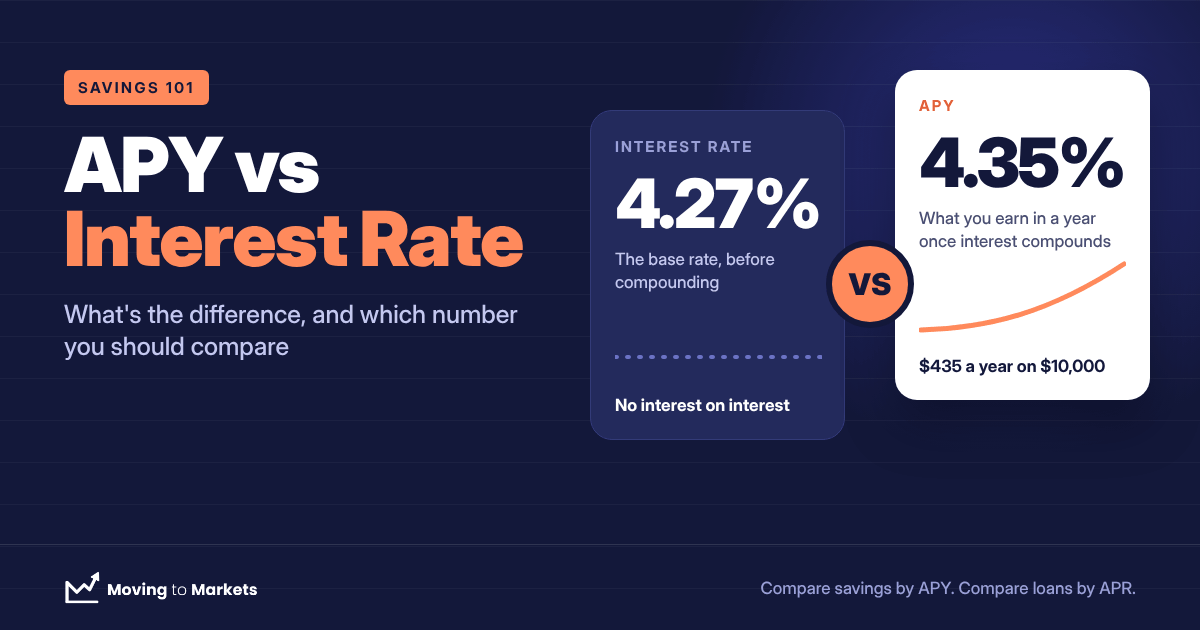
Here’s the short answer. The interest rate is the base rate a bank pays on your money. APY (annual percentage yield) is what you actually earn in a year once interest starts earning interest. When you compare savings accounts, CDs or money market accounts, compare APY. When you compare loans or credit cards, compare APR, which is a different number again.
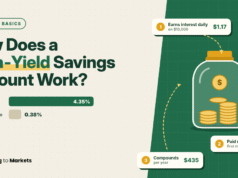
Right now the best high-yield savings accounts pay around 4.35% APY (CIT Bank and Openbank, per Bankrate on November 13, 2026), while the national average sits at 0.56% APY. That gap matters far more than anything else in this article, and we’ll show you why with real numbers.
Interest rate vs APY vs APR at a glance
| Interest rate | APY | APR | |
|---|---|---|---|
| What it tells you | The base yearly rate, before compounding | What your money earns in one year, with compounding | The yearly cost of borrowing |
| Includes compounding? | No | Yes | No |
| Includes fees? | No | No | Yes for mortgages and most loans; no for credit cards |
| Where you see it | Rate sheets, account terms | Savings, CDs, money market, checking | Mortgages, auto loans, personal loans, credit cards |
| Which law requires it | None by itself | Truth in Savings Act (Regulation DD) | Truth in Lending Act (Regulation Z) |
| Who wants it higher | You, when you save | You, when you save | The lender (you want it low) |
What an interest rate is
The interest rate is the simple yearly percentage a bank pays you. If you put $10,000 in an account at 4% and the bank pays interest once at the end of the year, you get $400. Done.
That’s simple interest. You earn on the money you put in, and nothing else. The interest rate on its own doesn’t tell you how often the bank adds interest to your balance, and that detail changes what you take home.
Read More: Does an HSA Roll Over? Yes, Here’s How It Works
What APY is and how to calculate it
APY counts compounding. When the bank adds interest to your account every day or every month, the next round of interest is figured on a slightly bigger balance. Over a year, those small amounts add up, so your APY ends up a bit higher than the interest rate.
The formula looks like this:
APY = (1 + r ÷ n)^n − 1
- r is the interest rate as a decimal (4% = 0.04)
- n is how many times a year the bank compounds (12 for monthly, 365 for daily)
Take 4% compounded monthly: (1 + 0.04 ÷ 12)^12 − 1 = 0.0407, or 4.07% APY. Put $10,000 in and you’ll have $10,407.42 after a year, not $10,400.
Regulation DD, the federal rule that governs savings disclosures, spells out its own version of the same formula and says banks must base APY on a 365-day year. That’s why APY is always a yearly number, even when the bank pays interest monthly. Every bank uses the same math, so you can line up a credit union’s APY against an online bank’s APY and trust the comparison.
Does compounding frequency matter?
Less than you think. Here’s $10,000 at a 4.00% interest rate for one year:
| Compounding | Interest earned | APY |
|---|---|---|
| Yearly | $400.00 | 4.00% |
| Quarterly | $406.04 | 4.06% |
| Monthly | $407.42 | 4.07% |
| Daily | $408.08 | 4.08% |
Daily compounding beats monthly by 66 cents a year. That’s it. Now look at what happens when you change the rate instead:
- $10,000 at the top APY of 4.35%: $435 in a year
- $10,000 at the national average of 0.56%: $56 in a year
That’s a $379 difference from picking a better account. So don’t spend time choosing between daily and monthly compounding. Spend it finding a higher APY, because the APY already includes the compounding for you.
The Rule of 72 makes the gap even easier to see. Divide 72 by the APY to get roughly how many years it takes your money to double. At 4.35%, that’s about 16.6 years. At 0.56%, it’s about 129 years.
How to convert APY to an interest rate (and back)
Banks often show both numbers, and sometimes you only get one. You can switch between them with this formula:
Interest rate = n × [(1 + APY)^(1 ÷ n) − 1]
So CIT’s 4.35% APY works out to:
- about 4.27% if the bank compounds monthly
- about 4.26% if it compounds daily
That explains the two numbers on the rate sheet from the start of this article. They describe the same account. The APY is higher because it counts the compounding, and the interest rate is the base number the bank uses to figure your daily or monthly interest.
APY vs APR on loans and credit cards
When the bank pays you, it shows APY. When you pay the bank, it shows APR. That’s no accident. APY is the higher of the two numbers for the same rate, so it makes savings look better. APR leaves out compounding, so it makes borrowing look cheaper.
Credit cards are where this costs you the most. Most cards compound daily. A card with a 24% APR that compounds daily works out to about 27.1% a year if you carry the balance. On $3,000 left unpaid for a full year with no new charges, you’d owe about $813 in interest instead of the $720 the APR suggests.
Mortgages work a bit differently. A mortgage APR includes the interest rate plus points and most lender fees, spread over the loan. Say you borrow $400,000 at 6.50% for 30 years and pay $8,000 in points and fees. Your APR comes out around 6.70%. That’s why the Truth in Lending Act makes lenders show APR: it lets you compare a low-rate loan with high fees against a higher-rate loan with no fees.
So the rule is simple: compare savings by APY, compare loans and cards by APR.
Why banks have to show APY
The Truth in Savings Act passed in 1991, and the Consumer Financial Protection Bureau enforces it through Regulation DD. It requires banks and credit unions to:
- show the APY in every ad that quotes a rate on a deposit account
- use the same 365-day formula
- tell you if the rate can change, and list any minimum balance or fee that affects your yield
Regulation DD also puts a second number on your monthly statement, called APY earned. It shows what you actually earned that month, based on your average daily balance, turned into a yearly figure. If your APY earned comes in lower than the advertised APY, check three things: whether the bank cut its rate, whether your balance dropped below a tier, or whether you moved money out during the month.
When your real return is lower than the APY
The APY assumes you leave every dollar alone for a full year at the same rate. Real life doesn’t work that way. Here’s what can shrink what you take home.
Promo rates. SoFi advertises up to 4.40% APY, but that’s a 3.30% base rate plus a 1.10% boost for six months. On $10,000, you’d earn roughly $220 in the first six months and about $165 in the next six, so around $385 for the year. That’s closer to a 3.85% yield than 4.40%.
Minimum balances and tiers. CIT pays 4.35% only if you keep $5,000 or more in the account. Drop below that and you earn a lower rate. Some banks pay their top APY only up to a cap, like the first $25,000.
Taking the interest out. APY counts interest earning interest. If you move your interest to checking each month, you earn the interest rate, not the APY. At CIT’s rate, that’s about $427 on $10,000 instead of $435.
Monthly fees. A $5 monthly fee costs $60 a year. On a $2,000 balance at 4.35% APY, you earn $87 and keep $27. Your real yield falls to about 1.35%.
Taxes. The IRS taxes savings interest as ordinary income, and your bank sends you a 1099-INT once you earn $10 or more. If you’re in the 22% federal bracket, $435 in interest costs you $95.70 in tax, leaving $339.30. That turns a 4.35% APY into about 3.39%. State income tax takes more, unless you live in a state like Texas or Florida with no income tax.
Inflation. Prices rose 3.7% over the 12 months to September 2026, according to the BLS. Put that next to your after-tax yield of 3.39% and your money lost a little buying power, even in one of the best accounts in the country. At the 0.56% national average, you’d fall behind by about $314 on every $10,000 before tax. A high APY won’t always beat inflation, but it cuts the loss a lot.
APY on CDs vs high-yield savings
A high-yield savings account has a variable APY. The bank can change it any time, and it usually moves within a few weeks of a Fed decision. The Fed cut rates in late 2025, then raised its target range to 3.75% to 4.00% on September 17, 2026, and savings APYs followed.
A CD locks your APY for the full term. That helps when rates are falling and hurts when they’re rising. The catch is the early withdrawal penalty.
Say you put $10,000 in a 12-month CD at 4.25% APY, and the bank charges 90 days of interest if you cash out early. You need the money after four months. You’ve earned about $140, the penalty takes about $103, and you walk away with roughly $37. So only use a CD for money you know you won’t touch, and read the penalty before you open one.
Crypto APY vs bank APY
Crypto exchanges advertise APYs on staking, often 5% or more. The math is the same, but almost nothing else is.
- A bank APY pays you in dollars. A staking APY pays you in tokens, and the token price can drop.
- The FDIC insures bank deposits up to $250,000 per depositor, per bank, per ownership category. Crypto staking has no FDIC coverage.
- Staking rewards are taxed as income when you receive them, and you may owe tax again when you sell.
A 5% staking APY on a token that drops 20% leaves you with less money. Treat it as an investment, not a savings account.
How to compare savings accounts in 4 steps
- Line up the APYs. Ignore the interest rate and compounding frequency. The APY already covers both.
- Check the fine print. Look for minimum balances, rate caps, and whether the APY is a promo that ends after a few months.
- Look at fees. A no-fee account at 4.00% beats a 4.35% account that charges $5 a month on any balance under about $17,000.
- Confirm the insurance. Make sure the bank is FDIC-insured, or the credit union is NCUA-insured.
Frequently asked questions
Is APY the same as the interest rate? No. The interest rate is the base rate. APY adds compounding, so it’s equal to or higher than the interest rate. They’re only the same when the bank compounds once a year.
Is a higher APY always better? For the same type of account, yes, as long as the fees and minimums don’t eat the difference. Compare a 4.35% account with a $5,000 minimum against a 4.20% account with no minimum if your balance is smaller.
Is APY monthly or yearly? Yearly. APY is always the yield over 365 days, even if the bank pays interest monthly.
Can APY change? On savings, money market and checking accounts, yes. Banks change them whenever they want, usually after a Fed move. On a CD, the APY stays fixed for the term.
How much will $10,000 earn at 4.35% APY? About $435 in one year if you leave the interest in and the rate stays put. Over five years at the same rate, $20,000 would grow by about $4,745.
Is 4% APY good right now? Yes. As of November 2026, the top savings accounts pay around 4.35% and the national average is 0.56%, so 4% puts you well above most accounts.
Is APY taxed? The interest you earn is taxed as ordinary income in the year you earn it, whether or not you withdraw it.
What is APY earned? It’s a number on your bank statement showing the yield you actually got that period, based on your average daily balance. It can be lower than the advertised APY if your balance or the rate changed.
What’s the difference between APY and APR? APY counts compounding and applies to money you save. APR doesn’t count compounding and applies to money you borrow. Mortgage and loan APRs include fees; credit card APRs don’t.
The bottom line
The interest rate tells you the base rate. APY tells you what you’ll actually earn. When you save, compare APY. When you borrow, compare APR. And don’t lose sleep over daily vs monthly compounding, because the rate gap between banks is worth hundreds of dollars a year while compounding is worth pennies.