We all know someone who gets a brand new car every three years and somehow pays less each month than you do on your five-year-old sedan. Most of the time, that person leases. And most of the time, they couldn’t tell you exactly how the payment got calculated, because the dealer handed them one number and a pen.
Here’s the short answer. When you lease a car, you pay for the part of the car’s value you use up while you drive it, plus a finance charge and sales tax. You don’t pay for the whole car. At the end of the lease, usually 36 months, you give the car back, buy it for a price set in your contract, or trade it in for a new lease.
That’s why leases cost less per month. According to Experian, the average new car lease payment in 2026 is $619 a month, compared with $770 a month for the average new car loan. About 24.1% of new vehicles were leased in the first quarter of 2026. The catch is that at the end of a lease you own nothing, and a few rules (miles, damage, ending early) can cost you thousands if you don’t know them going in.
This guide walks you through the whole thing with one real example, so you can check any lease offer yourself.
Car lease vs car loan at a glance
| Lease | Loan | |
|---|---|---|
| What you pay for | The car’s drop in value over the term, plus rent charge, fees and tax | The full price of the car, plus interest and tax |
| Typical term | 24 to 48 months, most often 36 | 36 to 84 months |
| Average new car payment (2026, Experian) | $619 a month | $770 a month |
| Who owns the car | The leasing company | You (the lender holds the title until it’s paid off) |
| Mileage limit | Yes, usually 10,000 to 15,000 miles a year | No |
| Charges for dents and wear | Yes, at turn-in | No, but damage lowers resale value |
| Can you modify the car? | Not without the lessor’s OK | Yes |
| At the end | Return it, buy it or trade it in | You keep a car with no payment |
| Federal car loan interest deduction (2025 to 2028) | No, leases are excluded | Yes, up to $10,000 a year on qualifying new cars |
How does leasing a car work, step by step?
Leasing a car works in seven steps: you pick a car, negotiate its price, get approved through a credit check, agree on the term and mileage, sign a lease disclosure, drive the car for the term, then return it or buy it. The leasing company owns the car the whole time and you pay to use it.
- Pick the car and check lease deals. Carmakers run lease specials through their own finance arms (Toyota Financial Services, Honda Financial Services, GM Financial, Ford Credit). These deals often have a lower money factor or a higher residual, which lowers your payment.
- Negotiate the price of the car. You negotiate a lease the same way you negotiate a purchase. The price you agree on becomes the capitalized cost, and every dollar you knock off lowers the payment.
- Apply and get a credit check. The leasing company checks your credit and puts you in a tier. Better tiers get a lower money factor.
- Choose the term and mileage. Most leases run 36 months. You pick a yearly mileage limit, usually 10,000, 12,000 or 15,000 miles.
- Sign the lease and pay at signing. You pay the first month’s payment, fees, taxes and any down payment. Federal law makes the dealer give you a written disclosure with every number (more on that below).
- Drive and maintain the car. You keep it insured, follow the maintenance schedule, and stay under your miles.
- Turn it in, buy it, or trade it. At the end you hand back the keys and pay any end-of-lease charges, buy the car for the price in your contract, or roll into a new lease.
Read Also: 401(k) vs Roth 401(k): Which Is Better for You
Car lease terms you’ll see in the contract
Most people get lost at the paperwork, because a lease uses words a loan doesn’t. Here’s what each one means in plain English.
| Term | What it means | Can you negotiate it? |
|---|---|---|
| Capitalized cost (cap cost) | The price of the car in the lease, plus any fees or add-ons rolled in. Think of it as the lease’s purchase price. | Yes |
| Capitalized cost reduction | Anything that lowers the cap cost: a down payment, trade-in value or rebate. | Yes |
| Adjusted capitalized cost | Cap cost minus the cap cost reduction. Your payment is based on this number. | Through the two above |
| Residual value | What the leasing company expects the car to be worth at the end of the lease, set as a percentage of MSRP. | No, the lender sets it |
| Money factor | The lease’s interest rate, written as a small decimal like 0.0025. Multiply by 2,400 to get the APR (0.0025 × 2,400 = 6%). | Yes, if the dealer marked it up |
| Rent charge | The finance cost you pay each month, worked out from the money factor. | Through the money factor |
| Acquisition fee | A bank fee for setting up the lease. Bankrate, citing Edmunds, puts it at $595 to $1,095. | Sometimes |
| Disposition fee | A fee to return the car at the end, often $300 to $400. Many lenders waive it if you lease another car from the same brand. | Sometimes |
| Mileage allowance | The miles you can drive per year without a charge. | Yes, before you sign |
| Excess mileage charge | What you pay per mile over the limit, usually 15 to 25 cents, more on some luxury brands. | Before you sign |
| Purchase option price (buyout) | The price to buy the car at lease end: the residual value plus any purchase fee. | Rarely |
How are car lease payments calculated?
A car lease payment has three parts: a depreciation charge (the value the car loses, spread across the months), a rent charge (the finance cost, based on the money factor), and sales tax. Add the first two together, then add tax, and you get your monthly payment.
Here’s the formula:
- Depreciation charge = (adjusted cap cost − residual value) ÷ number of months
- Rent charge = (adjusted cap cost + residual value) × money factor
- Monthly payment = (depreciation charge + rent charge) + sales tax
Example: leasing a $35,000 car for 36 months
Let’s run one car all the way through. Say you lease a compact SUV with an MSRP of $35,000.
| Step | Number |
|---|---|
| MSRP | $35,000 |
| Price you negotiated | $33,000 |
| Acquisition fee, rolled into the lease | +$650 |
| Gross capitalized cost | $33,650 |
| Down payment (cap cost reduction) | −$2,000 |
| Adjusted capitalized cost | $31,650 |
| Residual value (58% of MSRP after 36 months) | $20,300 |
| Money factor | 0.0025 (6% APR) |
| Term | 36 months, 12,000 miles a year |
Now the math:
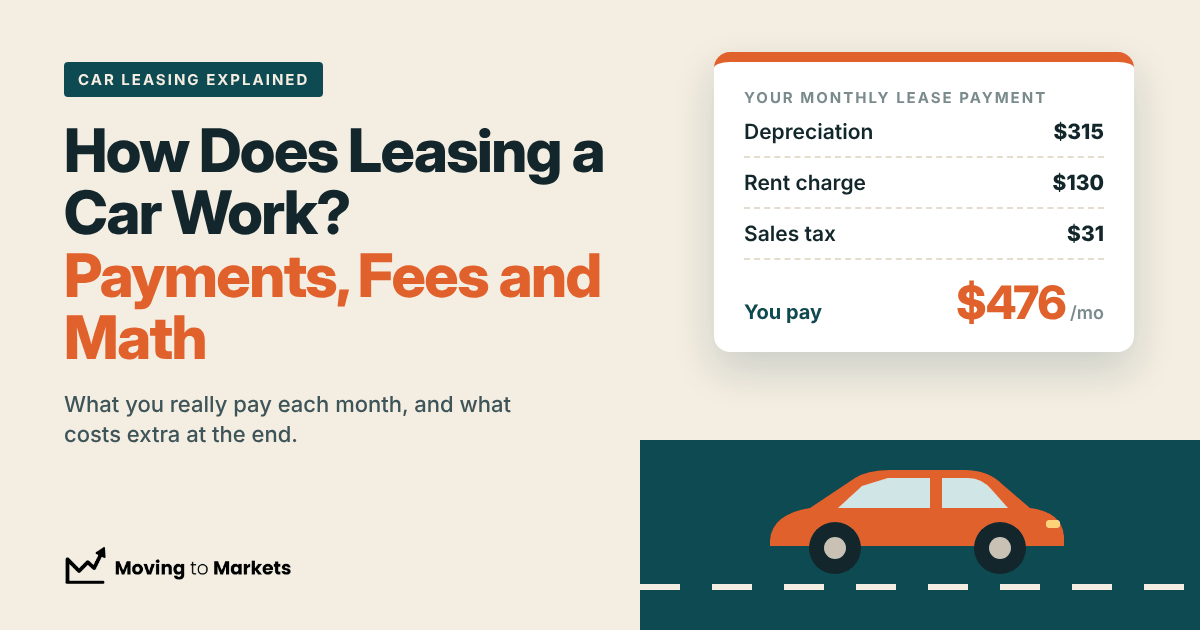
- Depreciation charge: ($31,650 − $20,300) ÷ 36 = $315.28 a month
- Rent charge: ($31,650 + $20,300) × 0.0025 = $129.88 a month
- Base payment: $315.28 + $129.88 = $445.15 (rounded)
- Sales tax at 7%: $31.16
- Monthly payment: $476.31
Over the full lease, you pay $2,000 down, $17,147 in monthly payments and about $395 for the disposition fee. That’s roughly $19,540 to drive a $35,000 car for 36,000 miles, and then you hand it back.
Why does the rent charge add the residual instead of subtracting it? Because you’re paying a finance charge on the money tied up in the car the whole time, and the lender averages it out. The formula (cap cost + residual) × money factor equals the average balance multiplied by the monthly rate. Every leasing company uses this same math, so you can check any quote with a calculator.
What can you negotiate on a car lease?
On a car lease you can negotiate the price of the car, any markup on the money factor, some fees, add-ons and the mileage limit. You can’t negotiate the residual value or the lender’s base money factor, because the leasing company sets those for every dealer.
Here’s what each part is worth in dollars, using the example above:
- The price. Every $1,000 off the negotiated price saves you about $30 a month ($27.78 less depreciation and $2.50 less rent charge), or about $1,090 over 36 months.
- The money factor markup. The lender sets a base money factor, called the buy rate, and dealers are often allowed to add to it and keep the difference. If the dealer bumps 0.0025 up to 0.0030, your rent charge rises by $25.98 a month, or $935 over the lease. Ask the dealer to show you the buy rate, and check the carmaker’s current lease offers online before you go in.
- Add-ons. Paint protection, nitrogen tires and VIN etching often get rolled into the cap cost. Every $500 of add-ons adds about $15 a month.
- Fees. Some dealers mark up the acquisition fee. The doc fee varies by state and dealer.
- Mileage. Buying miles at signing is almost always cheaper than paying for them at turn-in (see below).
Should you put money down on a lease?
Most of the time, no. A down payment on a lease only lowers your monthly payment; it doesn’t buy you any ownership. If the car is stolen or totaled early in the lease, gap coverage pays off the lease balance, but you usually lose the money you put down.
Look at the numbers from our example. With $0 down, the same lease runs $541.11 a month instead of $476.31. Over 36 months, the $2,000 down payment saves you $2,180 before tax. So you gain $180 for tying up $2,000 for three years. Now picture the car getting totaled in month four. The insurer and gap coverage clear the lease, and your $2,000 is gone.
A better move: pay only the first month, fees and taxes at signing (often called “sign and drive”), and keep your $2,000 in a savings account. If you want a lower payment anyway, ask whether the lender takes refundable security deposits. Some lenders lower the money factor in exchange, and you get that money back at the end, which you don’t with a down payment.
How does sales tax work on a car lease?
In most states, you pay sales tax on each monthly payment, not on the full price of the car. That’s one reason a lease payment can look cheap. A handful of states tax the lease differently, so the same deal can cost hundreds more depending on where you live.
Here’s how it works in practice:
- Most states: sales tax applies to each monthly payment. On our example, that’s $31.16 a month at a 7% rate.
- Texas: you pay tax on the full price of the car up front, whether you buy or lease, according to Capital One. At the state’s 6.25% motor vehicle tax rate, that’s $2,062.50 on a $33,000 car, often rolled into the lease.
- Massachusetts: taxes the down payment on a lease as well as the monthly payments.
- No sales tax: Alaska, Delaware, Montana, New Hampshire and Oregon don’t charge state sales tax on vehicles. Alaska has local sales taxes in some towns.
Some states also tax your down payment, rebates and fees at signing. Ask the dealer for the tax line on the lease disclosure and check it against your state’s rule.
What’s in a lease disclosure form?
Every consumer car lease in the US comes with a federal lease disclosure, required by the Consumer Leasing Act and the CFPB’s Regulation M. It lists the amount due at signing, the monthly payment, total of payments, gross and adjusted capitalized cost, residual value, rent charge, mileage limit, excess mileage rate, early termination terms and the purchase option price.
Read this box before you sign. Here’s what to look for:
- Amount due at signing: should match what you agreed to, line by line.
- Gross capitalized cost: this is where hidden add-ons show up. If it’s higher than the price you negotiated plus the acquisition fee, ask why.
- Rent charge: divide it by the number of months, then work backward to find the money factor. If it doesn’t match what you were told, ask.
- Residual value: should match the lender’s published residual for that model and term.
- Purchase option price: the buyout price at the end. Write it down; you’ll need it in three years.
How do mileage limits and wear-and-tear charges work?
If you drive more miles than your lease allows, you pay a per-mile charge at turn-in, usually 15 to 25 cents a mile. If the car comes back with more than normal wear, such as large dents, cracked glass or bald tires, you pay for those repairs too.
The miles add up fast. Say you sign a 12,000-mile-a-year lease but drive 15,000. After 36 months you’re 9,000 miles over. At $0.25 a mile, you owe $2,250 when you hand back the keys. The average American drives about 13,500 miles a year, according to the Federal Highway Administration, so a 10,000-mile lease is too tight for most people.
Edmunds says buying extra miles when you sign will likely cost less than paying the overage at the end. So if you know you drive 15,000 miles a year, ask for a 15,000-mile lease from day one. It raises the payment a little, but you pay less overall than settling up at turn-in.
Wear and tear catches people out because “excessive” sounds vague. Common items lessors charge for:
- Dents or scratches larger than a credit card
- Cracked or chipped windshield
- Tires with less than 1/8 inch of tread, or mismatched tires
- Scraped or bent wheels from curbs
- Burns, stains or tears in the seats and carpet
- Missing keys, floor mats or owner’s manual
Most leasing companies offer a free inspection 60 to 90 days before your lease ends. Book it. You’ll get a list of what they’d charge, and an independent body shop or tire store can often fix those items for less than the lessor would bill you.
What happens at the end of a car lease?
At the end of a car lease you have three choices: return the car and pay any mileage, damage and disposition charges; buy the car for the purchase option price in your contract; or trade it in, either for a new lease or toward another car. You can also check if your car is worth more than the buyout price.
That last part is called lease equity, and almost nobody mentions it. If your contract says you can buy the car for $20,300 but Carvana or CarMax offers $23,000 for it, you have $2,700 of equity. That happened to a lot of people in 2021 and 2022, when used car prices jumped and leased cars were suddenly worth more than their buyout prices.
Before you turn the car in, get a free online offer from Carvana, CarMax or a local dealer and compare it with your purchase option price. Then call your leasing company and ask two things: what’s my payoff amount, and can a third-party dealer buy the car from you? After the 2022 price spike, some leasing companies stopped letting outside dealers buy their cars, or only let their own brand’s dealers do it. If yours blocks it, you can usually buy the car yourself and then sell it, though you may owe sales tax on the buyout.
If you have no equity (the car is worth less than the buyout), just turn it in. The leasing company takes the loss, not you. That’s one of the real upsides of leasing.
Can you get out of a car lease early?
Yes, but it usually costs money. You can end the lease early through the leasing company, transfer it to someone else, trade it in to a dealer who pays off the lease, or sell the car for its payoff amount. Ending early through the lessor is usually the most expensive choice.
Your options, cheapest first in most cases:
- Sell or trade it for the payoff. Call the leasing company and ask for the payoff quote. If a dealer will pay more than that number, the dealer pays off the lease and you walk away, sometimes with cash. If it’s less, you pay the difference.
- Transfer the lease. Sites like Swapalease and LeaseTrader match you with someone who takes over your payments. Expect to pay a listing fee plus the lender’s transfer fee, and know that not every leasing company allows transfers. Check your contract first.
- Early termination with the lessor. You typically owe the remaining payments (minus some unearned rent charge), an early termination fee, and the disposition fee. On our example lease, ending a year early could cost well over $5,000.
What credit score do you need to lease a car?
There’s no single minimum, but a FICO score of about 670 or higher usually gets you approved at a decent rate, and the best “tier 1” lease deals often require 700 to 720 or more. Lessors set their own tiers. With a score in the low 600s you can still lease, but expect a higher money factor and a bigger amount due at signing.
You’ll see advice online saying you need a 750 score to lease. That isn’t how lessors work. Each finance company sorts applicants into tiers, and each tier gets its own money factor. Ask the dealer which tier you landed in, and if it’s not the top one, ask what the money factor would be one tier up so you know what your credit costs you.
What insurance do you need when you lease a car?
You need more than your state’s minimum. Leasing companies require liability coverage, collision and comprehensive, and they set the limits in the contract. Your contract lists the exact liability limits and the highest deductible you’re allowed to carry, and both are usually stricter than what your state requires. The leasing company gets named on the policy, and it can buy insurance for you (at a much higher price) if your coverage lapses.
That extra coverage costs money, so get an insurance quote on the exact car before you sign. A lease that looks $50 cheaper than buying can lose that edge on the insurance bill.
Gap coverage pays the difference between what your insurance pays for a totaled car and what you still owe on the lease. Many leases already include it, either built into the contract or as a waiver from the lender. Check your contract before you buy gap from the dealer or your insurer, so you don’t pay for it twice.
Is leasing a car better than buying in 2026?
Leasing costs more over time than buying and keeping a car, but it gives you a lower monthly payment and a new car every few years. Two changes in 2025 make buying look a bit better: EV leases lost their $7,500 federal credit, and the new car loan interest deduction covers loans but not leases.
Lease twice vs buy once: six years of driving
Here’s the same $35,000 car over six years, using the lease above and a 60-month loan at 7% with $2,000 down.
| Two 36-month leases | Buy with a 60-month loan | |
|---|---|---|
| Paid at signing | $2,000 + $2,000 | $2,000 |
| Monthly payments | $476.31 × 72 = $34,295 | $672.45 × 60 = $40,347 |
| Disposition fees | about $790 | $0 |
| Total paid over six years | about $39,085 | about $42,347 |
| What you have at the end | Nothing | A six-year-old car, worth roughly $14,000 to $16,000 |
| Net cost of driving | about $39,085 | about $26,300 to $28,300 |
The loan assumes you pay sales tax on the full $33,000 price plus the acquisition fee, and borrow $33,960. The second lease assumes a similar deal three years later, which isn’t guaranteed. Car values at six years vary a lot by model, so check KBB for the car you’re looking at. Even so, the gap is wide: owning saves you around $11,000 over six years, and year seven is payment-free.
The car loan interest deduction doesn’t cover leases
Under the One Big Beautiful Bill Act, you can deduct up to $10,000 a year of interest on a loan for a new car with final assembly in the US, for cars bought from 2025 through 2028. You don’t need to itemize. The deduction phases out starting at $100,000 of modified adjusted gross income for single filers and $200,000 for joint filers. Leases are excluded, as Edmunds analyst Ivan Drury told NPR in March 2026.
On the loan above, you’d pay about $2,191 in interest in year one. In the 22% bracket, that’s about $480 off your federal tax bill in the first year, and a bit less each year after. A lease gets you nothing here. (If you lease for a business, you can still deduct the business share of your lease payments, which is a separate rule.)
EV leases lost their $7,500 discount
From 2023 until September 30, 2025, leasing companies claimed the $7,500 commercial clean vehicle credit on EVs and passed it to you as a lease discount, even on EVs that didn’t qualify for the buyer’s credit. The One Big Beautiful Bill Act ended both credits for vehicles acquired after September 30, 2025. Some EV leases got more expensive right away. Tesla’s Model Y lease used to run $479 to $529 a month. Once the credit ended, it ran $529 to $599, according to Axios on October 1, 2025. GM, Ford, Hyundai and Stellantis kept offering $7,500 on EVs already on dealer lots for a while, per Bloomberg, but those were short-term deals. If you’re shopping for an EV lease now, compare the payment with what the same car costs to buy, since the old lease advantage is gone.
Who should lease a car?
Leasing works best if you drive under 12,000 to 15,000 miles a year, want a new car every three years, keep your car in good shape, and care more about a low monthly payment than owning something long term. It works badly if you drive a lot, haul kids or dogs, or want years with no car payment.
You’re a good fit for a lease if:
- You commute a short, predictable distance
- You like having the newest safety tech and a car under factory warranty the whole time
- You’d rather not deal with selling or trading in an older car
- You use the car for business and can deduct part of the lease
You’ll probably do better buying if:
- You drive 15,000+ miles a year
- You keep cars for 7 to 10 years
- Your kids, pets or job are rough on interiors
- You want to modify the car
- You’d qualify for the car loan interest deduction
Frequently asked questions
Is leasing a car a good idea? It’s a good idea if you drive under about 12,000 to 15,000 miles a year and want a lower payment and a new car every few years. It costs more over the long run than buying a car and keeping it for 7 to 10 years.
Can you lease a car with bad credit? Yes, but you’ll pay more. Lessors put lower scores in lower tiers, which means a higher money factor and often a larger payment at signing. Scores around 670 and up usually get approved at decent rates.
What happens if you go over the miles on a lease? You pay a per-mile charge when you return the car, usually 15 to 25 cents a mile. Going 9,000 miles over at $0.25 costs $2,250. Buying extra miles at signing is cheaper.
Can you buy your car at the end of the lease? Yes. Your contract lists a purchase option price, which is the residual value plus any purchase fee. You can pay cash or get a lease buyout loan from a bank or credit union.
Can you end a car lease early? Yes. You can sell or trade the car for its payoff amount, transfer the lease to someone else if your lender allows it, or pay the lessor’s early termination charges, which are usually the most expensive option.
Does leasing a car build credit? Yes. Lessors report your lease payments to the credit bureaus like a loan, so on-time payments help your credit history and late ones hurt it.
Is gap insurance included in a car lease? Often, yes. Many leasing companies build gap coverage into the lease. Check your contract before you buy gap from the dealer or your insurer.
What is a good money factor on a lease? A good money factor matches the lender’s base rate for your credit tier. Multiply it by 2,400 to compare it with a loan APR: 0.0025 equals 6%. If the dealer’s number is higher than the carmaker’s advertised rate, ask why.
Can you negotiate a car lease? Yes. You can negotiate the car’s price, any markup on the money factor, add-ons, some fees and your mileage limit. The residual value is set by the lender and doesn’t change.
Do you need full coverage insurance on a leased car? Yes. Leasing companies require liability, collision and comprehensive coverage, usually with higher limits than your state’s minimum and a cap on your deductible.
Can you put a leased car in someone else’s name? Only through a formal lease transfer, and only if your leasing company allows transfers. The new person has to pass a credit check.
The bottom line
A car lease charges you for the value a car loses while you drive it, plus a finance charge and tax. On a $35,000 car, that came to $476.31 a month in our example. You can negotiate the price, the money factor markup and the add-ons, and you should skip the big down payment. Watch your miles, book the pre-turn-in inspection, and check whether your car is worth more than the buyout before you hand back the keys.