We all know that moment. You start a new job, HR sends you the 401(k) enrollment link, and the screen asks you one question: traditional or Roth? There’s no “help me decide” button. Most people pick whatever is already ticked, or ask a coworker who picked whatever was already ticked.
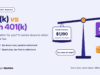
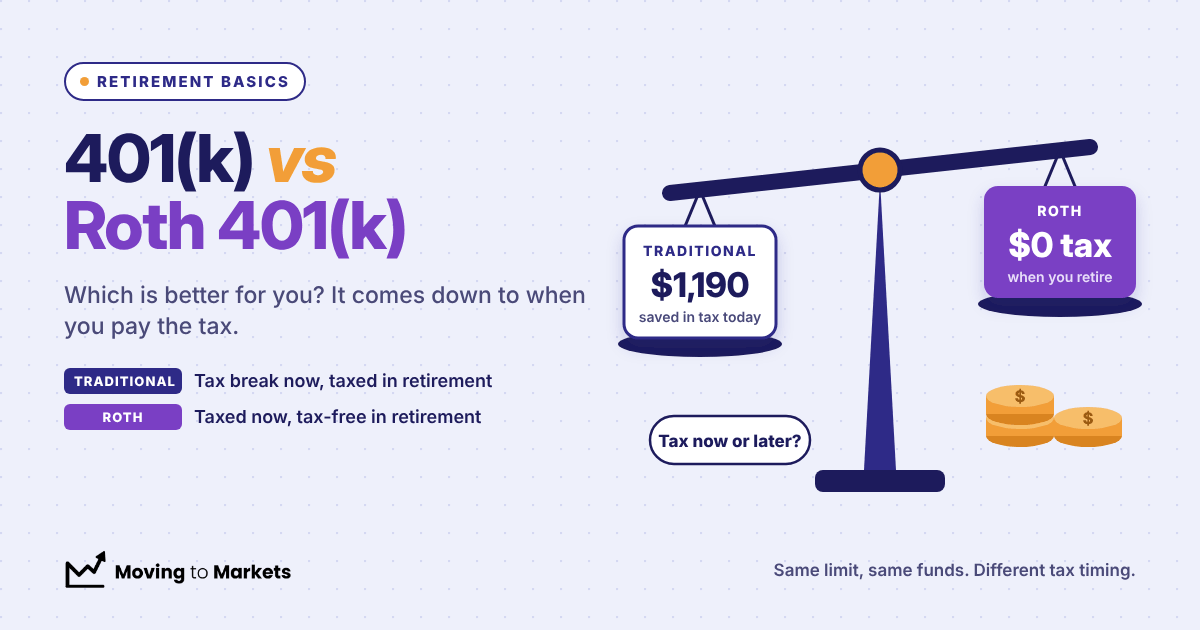
Here’s the short answer. A traditional 401(k) gives you the tax break now: your contribution comes out before income tax, and you pay tax when you withdraw in retirement. A Roth 401(k) flips it: you pay tax today, and your withdrawals in retirement come out tax-free. If your tax rate today is higher than the one you expect in retirement, traditional usually wins. If it’s lower, Roth usually wins. And if you don’t know, you can split your money between both.
For 2027, you can put up to $25,500 into a 401(k), traditional and Roth combined, up from $24,500 in 2026. Below we’ll run the actual numbers so you can see which one leaves more money in your pocket.
Traditional vs Roth 401(k) at a glance
| Traditional 401(k) | Roth 401(k) | |
|---|---|---|
| When you pay income tax | When you withdraw | When you contribute |
| Lowers your taxable income today | Yes | No |
| Withdrawals in retirement | Taxed as ordinary income | Tax-free if you’re 59½ and the account is 5 years old |
| Employee limit 2026 / 2027 | $24,500 / $25,500 (shared with Roth) | Same limit, shared |
| Catch-up at 50+ (2026 / 2027) | $8,000 / $8,500 | Same |
| Catch-up at ages 60 to 63 (2026 / 2027) | $11,250 / $11,750 | Same |
| Income limit to contribute | None | None |
| Required minimum distributions | Yes, at 73 (75 if born in 1960 or later) | None since 2024 |
| Employer match | Pre-tax by default | Can go in as Roth if your plan allows it |
| What your heirs pay | Income tax on every dollar | Nothing, if the account passed the 5-year test |
One thing both have in common: the same fund menu. Your plan offers the same index funds and target-date funds whichever option you pick, so fees don’t change the decision.
Same $10,000, both accounts: the math
Here’s the part most people never see. Say you have $10,000 of salary to put away, you’re in the 22% bracket, and the money grows 7% a year for 30 years.
Traditional: the full $10,000 goes in because you haven’t paid tax on it yet. It grows to $76,123. When you withdraw it, you pay 22%, so you keep $59,376.
Roth: you pay 22% tax first, so only $7,800 goes in. It grows to $59,376, and you withdraw all of it tax-free. You keep $59,376.
Same answer, to the dollar. When your tax rate is the same now and later, the two accounts tie. The whole choice comes down to one question: will your tax rate in retirement be higher or lower than it is today?
Change that rate and you get a winner:
| Your tax rate in retirement | Traditional keeps | Roth keeps | Winner |
|---|---|---|---|
| 12% | $66,988 | $59,376 | Traditional by $7,612 |
| 22% | $59,376 | $59,376 | Tie |
| 24% | $57,853 | $59,376 | Roth by $1,523 |
If you max out, Roth holds more
There’s a twist when you hit the limit. The $24,500 cap counts dollars, not after-tax dollars. Put $24,500 in a Roth and you’ve already paid the tax on it, so it’s worth the same as about $31,410 sitting in a traditional account for someone in the 22% bracket. If you can afford to max out, Roth lets you shelter more money from tax.
What each choice does to your paycheck
Say you’re single, you earn $70,000, and you put 10% ($7,000) into your 401(k) in 2026.
After the $16,100 standard deduction, your taxable income is $53,900. The 12% bracket ends at $50,400, so your top $3,500 is taxed at 22%.
- Traditional: your $7,000 contribution pulls that top $3,500 out of the 22% bracket and another $3,500 out of the 12% bracket. You save $770 + $420 = $1,190 in federal income tax this year. That’s about $46 more in every paycheck if you’re paid every two weeks.
- Roth: you save nothing on this year’s tax bill. Your take-home pay is about $46 smaller per paycheck, and you get the money back later as tax-free withdrawals.
Neither choice changes your Social Security and Medicare payroll tax. Both come out of your full salary either way.
Which one fits you
There’s no single right answer, but your tax bracket gives you a good starting point. Here’s how we’d think about it with 2026 single-filer brackets:
- 10% or 12% bracket (taxable income up to $50,400): lean Roth. You’re paying very little tax now, and it’s hard to retire into a lower bracket than 10% or 12%. This covers most people early in their careers.
- 22% bracket ($50,401 to $105,700): split, or decide based on what you expect in retirement. If you’ll have a pension, rental income or a large traditional balance, lean Roth. If your 401(k) will be most of your retirement income, lean traditional.
- 24% bracket ($105,701 to $201,775): lean traditional for most of it, but keep some Roth money for flexibility.
- 32% and up (over $201,775): lean traditional. Few retirees pay 32% or more, unless they built up millions in traditional accounts and face large required withdrawals.
A few things can push you the other way:
- You plan to move states. Working in California at a 9.3% state rate and retiring to Texas, which has no income tax, favors traditional. A $10,000 contribution saves you $930 in California tax, and you’ll pay $0 state tax when you withdraw it in Texas. Working in Florida and retiring to Oregon is the reverse, so Roth makes more sense.
- You’re in a low-income year. A gap between jobs, a sabbatical or your first year after school all lower your bracket. Roth contributions in those years cost you very little tax.
- You have student loans. Income-driven repayment plans set your payment from your adjusted gross income (AGI). Traditional contributions lower your AGI, so they lower your loan payment too. On a plan that takes 10% of your discretionary income, a $7,000 traditional contribution can cut your payment by about $700 a year. Roth contributions do nothing for it.
- You buy health insurance on the ACA marketplace. Premium tax credits shrink as your income grows. Lower AGI from traditional contributions can get you a bigger credit.
- You earn under the Saver’s Credit limit. In 2026, single filers with AGI up to $40,250 ($80,500 married filing jointly) can get a tax credit for saving. Traditional contributions lower your AGI and can help you qualify. From 2027, the government’s Saver’s Match replaces the credit for retirement contributions.
Read More: APY vs Interest Rate: What’s the Difference
Can you split between both?
Yes, and plenty of people should. Most plans let you choose a percentage for each. You could put 5% into traditional and 5% into Roth, as long as the total stays under the yearly limit.
Take the $70,000 earner from above. If you put $3,500 in traditional and $3,500 in Roth, the traditional half pulls your income out of the 22% bracket and saves $770 in tax. The Roth half costs you 12% tax now, about the lowest rate you can expect to pay in retirement. You get the most valuable part of the tax break today and still build a tax-free bucket for later.
Having both gives you options in retirement. In a year you need extra cash for a new roof, you can take it from the Roth so the withdrawal doesn’t push you into a higher bracket. In a quiet year, you draw from traditional and fill up the 10% and 12% brackets cheaply.
What changed under SECURE 2.0
SECURE 2.0, the retirement law Congress passed in December 2022, changed four things that many articles still get wrong.
- No more required withdrawals from Roth 401(k)s. Starting in 2024, your Roth 401(k) has no required minimum distributions, the same as a Roth IRA. Your traditional 401(k) still does. RMDs start at 73 if you were born between 1951 and 1959, and at 75 if you were born in 1960 or later. Miss one and the penalty is 25% of the amount you should have taken, or 10% if you fix it within two years.
- Your employer match can go into Roth. For years, employer money always went in pre-tax. Now your plan can let you take the match as Roth. The catch: the match counts as taxable income in the year you get it, and it must be fully vested. A $4,000 Roth match adds $4,000 to your taxable income, which costs you $880 at the 22% rate. Many plans haven’t added this option yet, so check with HR.
- High earners must make catch-ups as Roth. From 2026, if you earned more than $150,000 in Social Security wages (box 3 of your W-2) from your employer in 2025, any catch-up contributions you make in 2026 must go in as Roth. For 2027, the threshold rises to $155,000, based on your 2026 wages. Your regular $24,500 can still go in as traditional. The rule only counts wages from the employer that sponsors the plan, so investment income or a spouse’s salary doesn’t count. If your plan doesn’t offer a Roth option, you can’t make catch-up contributions at all.
- A bigger catch-up at ages 60 to 63. If you turn 60, 61, 62 or 63 during the year, you get a larger catch-up. In 2026 that’s $24,500 + $11,250 = $35,750. In 2027 it’s $25,500 + $11,750 = $37,250. At 64, you drop back to the regular catch-up ($8,500 in 2027).
Taking money out early
Both accounts charge a 10% penalty on early withdrawals before 59½, with a few exceptions. The tax works differently, though, and almost nobody explains it.
Traditional: every dollar you take out early is taxed as income, plus the 10% penalty.
Roth 401(k): a withdrawal that isn’t qualified is split between your contributions and your earnings in proportion to the balance. Say your Roth 401(k) holds $20,000, made up of $15,000 you put in and $5,000 of growth. You withdraw $4,000. A quarter of your balance is earnings, so $1,000 of that withdrawal is taxable, and you owe a $100 penalty on it. The other $3,000 comes out tax-free.
A Roth IRA is friendlier. It pays out your contributions first, tax-free and penalty-free, before it touches earnings. That’s one reason to roll your Roth 401(k) into a Roth IRA when you leave a job.
The 5-year rule, and how a rollover can reset it
To withdraw Roth 401(k) earnings tax-free, you need to be 59½ and your account needs to be at least 5 years old. Each Roth 401(k) has its own 5-year clock, starting January 1 of the year you made your first Roth contribution to that plan.
Here’s the trap. When you roll a Roth 401(k) into a Roth IRA, the money takes the Roth IRA’s clock, not the 401(k)’s. If you open your first Roth IRA at 60 to receive a Roth 401(k) you’ve funded for 10 years, the IRA’s clock starts fresh, and your earnings aren’t tax-free until 65.
The fix is cheap: open a Roth IRA now and put even $100 in it. That starts the clock, so it’s already run out by the time you roll money in.
Retirement taxes most people miss
Your tax bracket isn’t the only thing your retirement income affects.
Social Security. Part of your Social Security benefit becomes taxable once your “provisional income” (your other income plus half your benefit) goes over $25,000 for a single filer or $32,000 for a married couple. Above $34,000 single or $44,000 married, up to 85% of it can be taxed. Congress never adjusted those numbers for inflation, so more retirees cross them every year. Traditional 401(k) withdrawals count toward provisional income. Roth withdrawals don’t.
Here’s how much that can matter. Say you’re single, you get $24,000 a year from Social Security, and you need $30,000 more from your 401(k). Take it from traditional and your provisional income is $42,000, which makes $11,300 of your Social Security taxable. In the 12% bracket, that’s about $1,356 in extra federal tax. Take the same $30,000 from a Roth and none of your Social Security is taxable.
Medicare premiums. Medicare charges higher Part B and Part D premiums, called IRMAA, once your income passes about $109,000 for a single filer or $218,000 for a couple in 2026. Medicare looks at your tax return from two years earlier. A big traditional withdrawal or an RMD can push you over, while Roth withdrawals don’t count.
Leaving it to your kids
Most adult children who inherit a 401(k) or IRA have to empty it within 10 years. With a traditional account, every dollar they take out is taxed at their rate, often during their highest-earning years.
Say your daughter earns $120,000 a year and inherits your $500,000 traditional 401(k). If she spreads it over 10 years, that’s $50,000 a year added to her income at a 24% rate, or roughly $12,000 a year in federal tax. If the same $500,000 sits in a Roth 401(k) that passed the 5-year test, she still has to empty it within 10 years, but she pays no income tax on it.
Spouses get more choices. A surviving spouse can roll an inherited 401(k) into their own account and treat it as theirs.
Converting, and the mega backdoor Roth
In-plan Roth conversion. Many plans let you move money from your traditional 401(k) to your Roth 401(k). You pay income tax on the amount you convert, in that year. It makes the most sense in a low-income year: after you retire but before Social Security starts, or a year you were out of work. Converting $20,000 when you’re in the 12% bracket costs $2,400 in federal tax and makes that money tax-free for good.
Mega backdoor Roth. This one is for people who already max out. The total that can go into your 401(k) from all sources, including your employer, is $72,000 in 2026 and $75,000 in 2027. If your plan allows after-tax contributions (a separate bucket from Roth) and lets you convert them to Roth, you can fill the gap. Say you put in $24,500 and your employer matches $8,000. You have $39,500 of room left in 2026. Put it in as after-tax money and convert it to Roth right away, and the growth on it is tax-free. Ask HR whether your plan allows “after-tax contributions” and “in-plan Roth conversions.” If it doesn’t offer both, this won’t work.
Roth 401(k) vs Roth IRA
People mix these up all the time. Here’s how they differ in 2026:
| Roth 401(k) | Roth IRA | |
|---|---|---|
| Who offers it | Your employer | Any brokerage, you open it yourself |
| Contribution limit | $24,500 ($25,500 in 2027) | $7,500 |
| Income limit | None | Phases out between $153,000 and $168,000 for single filers ($242,000 to $252,000 married filing jointly) |
| Employer match | Yes, if your plan offers Roth matching | No |
| Investment choices | Your plan’s fund menu | Almost any stock, ETF or fund |
| Early withdrawals | Pro-rata: part contributions, part earnings | Contributions come out first, tax-free |
| RMDs | None since 2024 | None |
If you earn too much for a Roth IRA, the Roth 401(k) is your way in. You can contribute $24,500 to it at any income.
Frequently asked questions
Can I have both a traditional and a Roth 401(k)? Yes. Most plans let you split your contributions between the two. The $24,500 limit in 2026 ($25,500 in 2027) covers both combined, not each one.
Does my employer match go into my Roth 401(k)? Usually not. Most plans still put the match in pre-tax, even if you contribute to Roth. SECURE 2.0 lets plans offer a Roth match, but the match then counts as taxable income that year.
Is a Roth 401(k) better if I’m young? Usually, yes. Most people in their 20s earn less than they will later, so they’re in a low bracket now. Paying 12% on contributions today to avoid 22% or more later is a good trade.
Can I switch from traditional to Roth later? Yes. You can change your choice for future paychecks at any time in most plans. Money you already put in stays where it is, unless you do an in-plan Roth conversion and pay the tax on it.
What happens if I earn more than $150,000? You can still make regular contributions to either option. Only your catch-up contributions (age 50 and older) have to go in as Roth in 2026, and the threshold rises to $155,000 for 2027.
Does a Roth 401(k) have income limits? No. Anyone whose employer offers one can use it, at any income. Only the Roth IRA has income limits.
Which is better if I want to retire early? Many early retirees use both. Traditional contributions save tax during your high-earning years. Then you convert traditional money to Roth in the low-income years after you stop working and before Social Security starts.
How much can I put in a 401(k) in 2027? $25,500, plus $8,500 if you’re 50 or older, or $11,750 if you’re 60 to 63. The total from you and your employer can’t go over $75,000.
Can I lose money in a Roth 401(k)? Yes. The Roth part only changes how the money is taxed. Your balance still rises and falls with the funds you pick.
The bottom line
Traditional and Roth 401(k)s use the same funds and the same limits. The only difference is when you pay the tax. If you’re in a low bracket now, Roth usually wins. If you’re in a high bracket now and expect less income later, traditional usually wins. If you can’t tell, split it, and you’ll have both kinds of money to work with in retirement.
So log in to your 401(k) today and check which box you ticked when you signed up. If you’re in the 10% or 12% bracket and you’re putting everything in traditional, try switching some of it to Roth. If you’re 50 or older and earned over $150,000 last year, check that your plan offers a Roth option so you don’t lose your catch-up. And take your employer’s full match whichever you choose, because you lose that money if you don’t.