We all know that moment. You’re reading a car insurance quote, or a study guide for the insurance license exam, or a bill from the hospital, and you see the words “medical expense insurance”. It sounds simple enough. Then you look it up and half the pages talk about health plans and the other half talk about car accidents.
Both are right, and that’s the confusing part.
Here’s the short answer. Medical expense insurance pays all or part of your bills for doctors, hospital stays, surgery, tests and prescriptions when you get sick or hurt. Most of the time the phrase means health insurance. But car and home policies also carry a smaller “medical payments” coverage that insurers sometimes call medical expense insurance too.
This guide covers every meaning, how the money actually moves when you get a bill, and what changed under the Affordable Care Act (ACA), with 2026 numbers.
What are the different meanings of medical expense insurance?
Medical expense insurance can mean four different things in the US: health insurance, medical payments coverage on a car policy (MedPay), medical payments coverage on a home or renters policy, and travel medical insurance. Health insurance is the most common meaning. If you saw the phrase on a car or home policy, it means MedPay.
| Type | Who it pays for | What triggers it | Typical limit | Deductible? |
|---|---|---|---|---|
| Health insurance | You and your family | Any illness or injury, plus preventive care | No dollar cap on covered care in ACA plans | Yes, plus coinsurance |
| Auto MedPay | You and your passengers | A car accident, no matter who caused it | $1,000 to $5,000 is common, some insurers sell more | Usually no |
| Homeowners or renters medical payments | Guests hurt on your property | A visitor slips, trips or gets bitten by your dog | $1,000 to $5,000 | No |
| Travel medical | You, while on a trip | Illness or injury away from home, mostly abroad | Set per policy | Sometimes |
A quick way to tell which one you’re looking at: if the phrase sits on a declarations page with your car or your house listed, it’s medical payments coverage. Everywhere else, it almost always means health insurance.
What does medical expense insurance cover?
A health insurance policy pays for doctor visits, specialist visits, emergency room care, hospital stays, surgery, lab tests, X-rays, prescription drugs, mental health care, maternity care and preventive care like vaccines and screenings. ACA plans must cover 10 categories of care called essential health benefits, and many preventive services cost you $0.
Those 10 essential health benefits are:
- Outpatient care (doctor visits without a hospital stay)
- Emergency services
- Hospital stays
- Pregnancy, maternity and newborn care
- Mental health and substance use treatment
- Prescription drugs
- Rehab and habilitative services, like physical therapy
- Lab services
- Preventive and wellness care, plus chronic disease management
- Pediatric care, including dental and vision for kids
Every plan sold on Healthcare.gov or a state marketplace covers all 10. Employer plans from large companies don’t have to include every category, but most do.
What doesn’t medical expense insurance cover?
Health insurance usually won’t pay for cosmetic surgery, most adult dental and vision care, long-term custodial care in a nursing home, experimental treatment, care that isn’t medically necessary, or out-of-network care in an HMO except emergencies. Each plan lists its exclusions in the Summary of Benefits and Coverage.
A few real examples of where people get caught:
- A nose job for looks isn’t covered. The same surgery to fix a broken nose or a breathing problem usually is.
- Adult teeth cleanings and glasses need separate dental and vision plans.
- If you have an HMO and see a doctor outside its network for a sore knee, you pay the whole bill.
One protection worth knowing: the No Surprises Act, in effect since January 1, 2022, bans most surprise bills from out-of-network doctors at an in-network hospital and from out-of-network emergency care. You pay your normal in-network share.
How does medical expense insurance work?
You pay a monthly premium. When you get care, you pay the bill yourself until you hit your deductible. After that, you and the insurer split costs through coinsurance, often 80/20. Once your spending reaches the out-of-pocket maximum, the plan pays 100% of covered care for the rest of the year.
Here are the four numbers that decide what you pay:
- Premium: what you pay every month to keep the plan, whether you use it or not.
- Deductible: what you pay before the plan starts sharing costs. The average single deductible for workers with employer coverage was $1,886 in 2025 (KFF).
- Coinsurance: your percentage after the deductible. With 80/20, the plan pays 80% and you pay 20%.
- Out-of-pocket maximum: the most you pay in a year for covered in-network care. In 2026 an ACA plan can’t set it higher than $10,600 for one person or $21,200 for a family.
Two real bills on the same plan
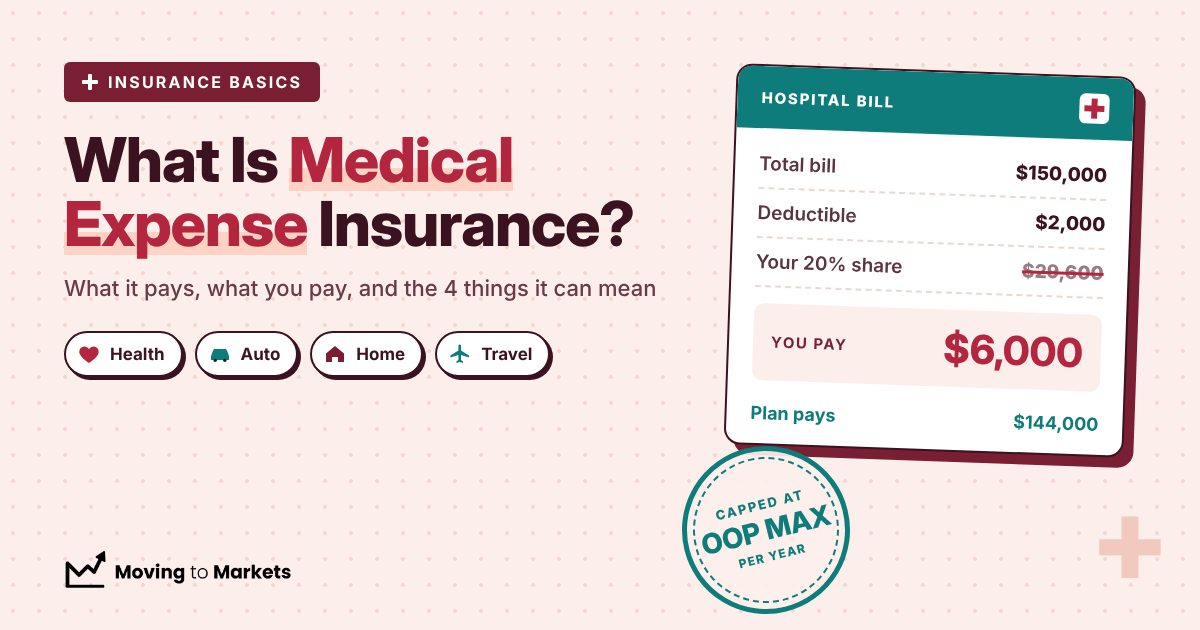
Say your plan has a $2,000 deductible, 80/20 coinsurance, a $6,000 out-of-pocket maximum and a $200 monthly premium.
| Small surgery | Long hospital stay | |
|---|---|---|
| Total bill | $10,000 | $150,000 |
| You pay the deductible | $2,000 | $2,000 |
| Your 20% of the rest | $1,600 | $29,600, but capped |
| You pay in total | $3,600 | $6,000 (the out-of-pocket max) |
| Plan pays | $6,400 | $144,000 |
| Your premiums for the year | $2,400 | $2,400 |
| Your total cost for the year | $6,000 | $8,400 |
Look at the second bill. Without the out-of-pocket max, 20% of $148,000 would cost you $29,600 on top of the deductible. The cap is the part that keeps a bad year from wrecking your savings, and most definition pages skip it.
What are the types of medical expense insurance?
Insurance license exams split medical expense insurance into three classes: basic medical expense (hospital, surgical and physician coverage with low limits and no deductible), major medical (a deductible, coinsurance and high limits), and comprehensive major medical (both combined into one plan with one deductible). Today almost every plan sold works like comprehensive major medical.
If you’re studying for the life and health exam, here’s how each class works.
Basic medical expense pays from the first dollar, so there’s usually no deductible. It comes in three parts: hospital expense (room and board plus extras like lab work and drugs during the stay), surgical expense (paid from a schedule of set amounts per surgery), and physician expense (non-surgical doctor visits). The limits are low, so a big claim runs out fast.
Major medical covers a wide range of care with high limits. You pay a deductible, then coinsurance, and a stop-loss cap limits how much coinsurance you pay in a year. That stop-loss is what the ACA now calls the out-of-pocket maximum.
Supplemental major medical sits on top of a basic plan. The basic plan pays first. Then you pay a corridor deductible before the major medical layer kicks in.
Comprehensive major medical rolls basic and major medical into one policy with one deductible from the start.
The exam also asks about deductible types:
- Per cause: a new deductible for each illness or injury.
- Calendar year: one deductible per year, no matter how many claims.
- Family: the whole family is done once a set total is met, often after two or three members meet theirs.
- Carryover: expenses from the last three months of the year count toward next year’s deductible.
Plan types you’ll see when you shop
| Plan type | Need a referral for specialists? | Out-of-network care covered? | Usual trade-off |
|---|---|---|---|
| HMO | Yes | No, except emergencies | Lower premiums, smaller network |
| PPO | No | Yes, at a higher cost | Higher premiums, more freedom |
| EPO | No | No, except emergencies | Middle ground on price |
| POS | Yes | Yes, at a higher cost | HMO rules with some PPO flexibility |
| HDHP | Depends on the network | Depends on the network | Low premium, high deductible, can pair with an HSA |
For 2026, a plan counts as an HDHP if its deductible is at least $1,700 for one person or $3,400 for a family. That lets you put up to $4,400 (or $8,750 for a family) into a health savings account, tax-free. Our guide on whether an HSA rolls over covers what happens to that money.
What type of contract is medical expense insurance?
A medical expense policy is a contract of adhesion, aleatory, unilateral and conditional. The insurer writes the terms and you accept them as-is, the amounts exchanged are unequal, only the insurer makes a legally enforceable promise to pay, and it pays only if you meet conditions like paying premiums and filing claims.
Here’s what each term means with a real example:
- Adhesion: you can’t rewrite the policy. If a clause is unclear, courts usually read it in your favor.
- Aleatory: you might pay $2,400 in premiums and use $200 of care, or pay $2,400 and get $144,000 back.
- Unilateral: you can stop paying and let the policy lapse. The insurer can’t sue you for that.
- Conditional: the insurer pays only if you keep paying premiums, file the claim and follow the rules, like getting prior approval when the plan requires it.
How did the ACA change medical expense insurance?
Before the ACA, many plans capped lifetime benefits, often at $1 million or more, turned down sick applicants and refused to pay for pre-existing conditions. ACA rules banned lifetime dollar limits in 2010 and, from 2014, banned annual dollar limits on essential health benefits, health-based pricing and pre-existing condition exclusions.
This matters because a lot of study guides and older articles still list “lifetime maximum” and “underwriting” as normal features of major medical. For an ACA-compliant plan, they’re not.
| Rule | Before the ACA | ACA plans today |
|---|---|---|
| Lifetime dollar limit | Common, often $1 million or more | Banned on essential health benefits |
| Annual dollar limit | Common | Banned on essential health benefits since 2014 |
| Pre-existing conditions | Could be excluded or denied | Must be covered, same price |
| Medical questions to buy a plan | Standard | Not allowed in individual and small-group plans |
| Out-of-pocket maximum | Varied, sometimes none | Capped at $10,600 / $21,200 in 2026 |
| Kids on parent’s plan | Varied | Up to age 26 |
The old rules still apply to some products. Short-term health plans can still deny you for health reasons, cap benefits and skip whole categories like maternity care. A 2024 federal rule limited them to three months, but on August 7, 2025, the Departments of Labor, HHS and Treasury said they wouldn’t prioritize enforcing it while they write new rules. Your state may set its own limits. Fixed indemnity plans pay a set cash amount, like $300 a day in the hospital, no matter what the bill is. Grandfathered plans that existed before March 23, 2010 also skip some ACA rules, though they still can’t set lifetime limits.
If you’re not sure what kind of plan you have, look for the words “This is not ACA-compliant coverage” or “This is not health insurance” in the plan documents.
What is medical expense coverage on a car insurance policy?
On a car policy, medical expense coverage (usually called medical payments or MedPay) pays medical bills for you and your passengers after a crash, no matter who caused it. It usually has no deductible, pays up to a limit you choose, and can cover your health plan’s deductible and copays too.
MedPay pays for things like:
- Ambulance rides and ER visits
- Hospital stays and surgery
- X-rays and doctor follow-ups
- Funeral costs, on many policies
It also covers you as a pedestrian or a passenger in someone else’s car on most policies.
A real case: you rear-end someone and your passenger hurts their neck. The ER bill is $3,200. With $5,000 in MedPay, your policy pays it, and your passenger doesn’t have to file with their own health plan or wait on a fault decision.
Common limits are $1,000, $2,500 and $5,000 per person, according to NerdWallet, and some insurers sell higher amounts. A higher limit costs more each month.
Is MedPay required? In most states it’s optional. Maine and Pennsylvania require it. In New Hampshire, car insurance itself isn’t mandatory, but if you buy a policy, MedPay comes with it.
MedPay vs PIP
| MedPay | Personal injury protection (PIP) | |
|---|---|---|
| Medical bills | Yes | Yes |
| Lost wages | No | Yes |
| Help paying for things you can’t do while hurt (childcare, cleaning) | No | Often |
| Deductible | Usually none | Often has one |
| Where it’s required | Maine, Pennsylvania, New Hampshire (if you buy a policy) | About a dozen no-fault states, including Florida, Michigan, New York and New Jersey |
If you already have good health insurance, MedPay mostly covers your deductible and your passengers. If you don’t have health insurance, it’s one of the cheapest ways to get some medical coverage after a crash. You can compare carriers in our cheap car insurance companies guide.
What is medical payments coverage on a homeowners policy?
Medical payments to others, on a homeowners or renters policy, pays medical bills for guests who get hurt on your property or because of you or your pet, without anyone filing a lawsuit or proving fault. Limits usually run $1,000 to $5,000 per person. It never pays for you or people who live with you.
Say your neighbor’s kid falls off your backyard swing and needs $1,800 in stitches and an X-ray. Medical payments coverage pays that bill. If the family sues for more, your liability coverage takes over.
Do you need travel medical insurance?
You may need travel medical insurance if you’re leaving the US. Many US health plans pay little or nothing for care abroad, and Original Medicare generally doesn’t cover care outside the US. A travel medical policy pays for illness or injury during your trip and often for emergency evacuation home.
Before you buy one, call your health plan and ask two questions: does it cover emergency care abroad, and does it pay the hospital directly or only reimburse you later? Many hospitals abroad want payment upfront.
Look at three numbers on any travel medical quote: the medical limit, the evacuation limit and the deductible. A medical evacuation flight home can cost tens of thousands of dollars, so that limit matters as much as the medical one.
How is medical expense insurance different from disability, accident and indemnity plans?
Medical expense insurance pays your actual medical bills. Disability insurance replaces lost income. Accident and critical illness plans pay a fixed cash amount when a covered event happens. Hospital indemnity pays a set amount per day in the hospital. Workers’ comp covers job injuries.
| Coverage | What it pays | Example |
|---|---|---|
| Medical expense (health) insurance | Your actual medical bills, after deductible and coinsurance | Pays $144,000 of a $150,000 hospital stay |
| Disability income insurance | Part of your paycheck while you can’t work | 60% of your salary after a 90-day wait |
| Accident insurance | A fixed cash amount per injury | $500 for a broken arm |
| Critical illness insurance | A lump sum on diagnosis | $10,000 for a cancer diagnosis |
| Hospital indemnity | A fixed amount per day admitted | $300 a day |
| Workers’ compensation | Medical bills and lost wages for job injuries | Covers surgery after a fall at work |
The cash plans (accident, critical illness, hospital indemnity) can help with your deductible, but none of them replace health insurance.
How do you get medical expense insurance in the US?
Most Americans get health insurance through an employer. You can also buy a plan on Healthcare.gov or your state’s marketplace, qualify for Medicaid based on income, get Medicare at 65, or keep your old job’s plan for up to 18 months through COBRA.
- Through work. Your employer usually pays most of the premium. Sign up when you’re hired or during open enrollment.
- On the marketplace. Open enrollment starts November 1 each year on Healthcare.gov. Losing other coverage, getting married, having a baby or moving gives you a special enrollment period, usually 60 days.
- Medicaid and CHIP. Free or very low-cost coverage if your income qualifies. You can apply any time of year.
- Medicare. Starts at 65, or earlier for some people with disabilities.
- COBRA. Keeps your job’s plan after you leave, but you can be charged up to 102% of the full premium, so it’s often pricey.
How much does medical expense insurance cost?
Employer health coverage averaged $9,325 a year for one person and $26,993 for a family in 2025, according to KFF. Workers paid $1,440 and $6,850 of that on average, and their employers paid the rest. Marketplace prices depend on your age, ZIP code, tobacco use and income.
On top of premiums, plan for the deductible and the out-of-pocket maximum. A family with employer coverage can easily spend $6,850 in premiums plus a few thousand in deductibles in a heavy year.
Is medical expense insurance tax deductible?
- Employer plans: your share of premiums usually comes out of your paycheck before taxes.
- Self-employed: you can usually deduct your health premiums on your return, even without itemizing.
- Out-of-pocket bills: deductible only if you itemize and only the part above 7.5% of your adjusted gross income. With a $60,000 AGI, the first $4,500 doesn’t count. If you spent $10,000, you could deduct $5,500.
- HSA: money you put in is tax-free, and you can spend it tax-free on medical bills.
FAQ
Is medical expense insurance the same as health insurance?
Usually, yes. Insuranceopedia and most license study guides use the two terms the same way. On a car or home policy, though, “medical expense” means medical payments coverage, which pays crash or guest injury bills up to a small limit.
What is first-dollar coverage?
First-dollar coverage pays from the first dollar of a bill with no deductible. Basic medical expense plans work this way. Most plans today make you meet a deductible first, though many pay for preventive care at $0.
What is a corridor deductible?
It’s the amount you pay between a basic medical plan’s benefits running out and a supplemental major medical plan starting. If the basic plan pays $5,000 and the corridor deductible is $1,000, you pay the next $1,000 before major medical pays.
Does MedPay cover passengers?
Yes. MedPay pays for injuries to you and anyone riding in your car, up to the per-person limit, no matter who caused the crash.
Does MedPay pay if I have health insurance?
Yes. MedPay can pay first, and it can cover your health plan’s deductible and copays from the crash. It won’t pay the same bill twice.
Does medical expense insurance cover pre-existing conditions?
ACA-compliant health plans must cover pre-existing conditions at the same price as everyone else. Short-term plans and some other non-ACA products can still exclude them.
Is there a limit on how much health insurance will pay?
ACA plans can’t put a yearly or lifetime dollar cap on essential health benefits. They can limit visit counts for some services, like 20 physical therapy visits a year.
Is medical expense insurance tax deductible?
Premiums through work are usually paid pre-tax. Self-employed people can usually deduct premiums. Out-of-pocket bills are deductible only above 7.5% of your AGI if you itemize.
The bottom line
Medical expense insurance pays your medical bills, and most of the time the phrase means health insurance. On a car or home policy, it means a smaller coverage that pays crash or guest injury bills without a deductible. Whatever plan you have, find three numbers before you need care: the deductible, the coinsurance and the out-of-pocket maximum. Those tell you what a bad year will really cost.