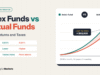
Your new job hands you a 401(k) form with 25 funds on it. Half of them have “Index” in the name, the other half have names like “Growth Fund of America” or “Blue Chip Growth”. Your coworker says just buy the index fund. Your uncle says mutual funds are safer. And you sit there wondering if these are even two different things.
Here is the short answer. An index fund is not the opposite of a mutual fund. “Mutual fund” is a way a fund is built and sold. “Index fund” is a way of picking what goes in it. Lots of index funds are mutual funds. So the real choice you are making is between an index fund (it copies a market index like the S&P 500) and an actively managed fund (a manager picks stocks trying to beat that index).
On that choice the numbers are not close for most people. In 2025 the average index stock mutual fund charged 0.05% a year, while actively managed US stock funds averaged 0.64%, according to the Investment Company Institute. And over the 10 years to June 2026, 83% of large-company active funds did worse than the S&P 500, per S&P Dow Jones Indices.
Below is how both work, what they cost you in real dollars, how they are taxed and when an active fund still makes sense.
What is a mutual fund?
A mutual fund pools money from thousands of investors and buys a basket of stocks, bonds or both. You buy shares straight from the fund company (or through your broker or 401(k)), and the price is set once a day after the market closes. That price is called the net asset value, or NAV.
Mutual funds have been around in the US since the 1920s and got their rules from the Investment Company Act of 1940. Today you’ll find them everywhere, most of all in 401(k) plans.
What matters for you is that a mutual fund can be run one of two ways:
- Actively managed: a manager and a team of analysts choose what to buy and sell. The goal is to beat a benchmark.
- Index (passive): the fund buys whatever is in an index and holds it. No stock picking.
What is an index fund?
An index fund copies a list of stocks or bonds that someone else maintains. The S&P 500 index fund owns the 500 companies in the S&P 500, in the same weights. When S&P adds or drops a company, the fund does the same. That’s pretty much the whole job.
Index funds come in two wrappers:
| Type | Example | How you buy it | Price updates |
|---|---|---|---|
| Actively managed mutual fund | American Funds Growth Fund of America (AGTHX) | From the fund company, broker or 401(k) | Once a day |
| Index mutual fund | Fidelity 500 Index Fund (FXAIX) | From the fund company, broker or 401(k) | Once a day |
| Index ETF | Vanguard S&P 500 ETF (VOO) | On the stock exchange, like a stock | All day |
So when someone says “index funds vs mutual funds”, they nearly always mean the first row against the second and third rows. That’s the comparison the rest of this article makes.
Index funds vs mutual funds at a glance
| Index fund | Actively managed mutual fund | |
|---|---|---|
| Who picks the stocks | Nobody, it follows an index | A fund manager and analysts |
| Goal | Match the market | Beat the market |
| Average cost (2025) | 0.05% for index stock mutual funds, 0.14% for index stock ETFs | 0.64% for active US stock funds |
| Sales loads | Almost never | Common on A shares, up to 5.75% |
| Minimum to start | Often $0 (some $1,000 to $3,000) | Often $250 to $3,000 |
| Trading inside the fund | Low, only when the index changes | Higher, the manager buys and sells through the year |
| Capital gains paid out to you | Usually small | Often bigger |
| 10-year record vs S&P 500 | Matches it, minus a tiny fee | 83% of large-cap funds trailed it |
| Best for | Most long-term investors, 401(k)s, beginners | Some bond and international investors, people who want a specific manager |
Cost figures come from ICI’s 2025 fee report, performance from SPIVA U.S. Mid-Year 2026.
Fees: what 0.05% vs 0.64% costs you over 30 years
An expense ratio is the yearly fee a fund takes out of your money. You never get a bill for it. The fund just quietly takes it from the balance, which is why most people ignore it.
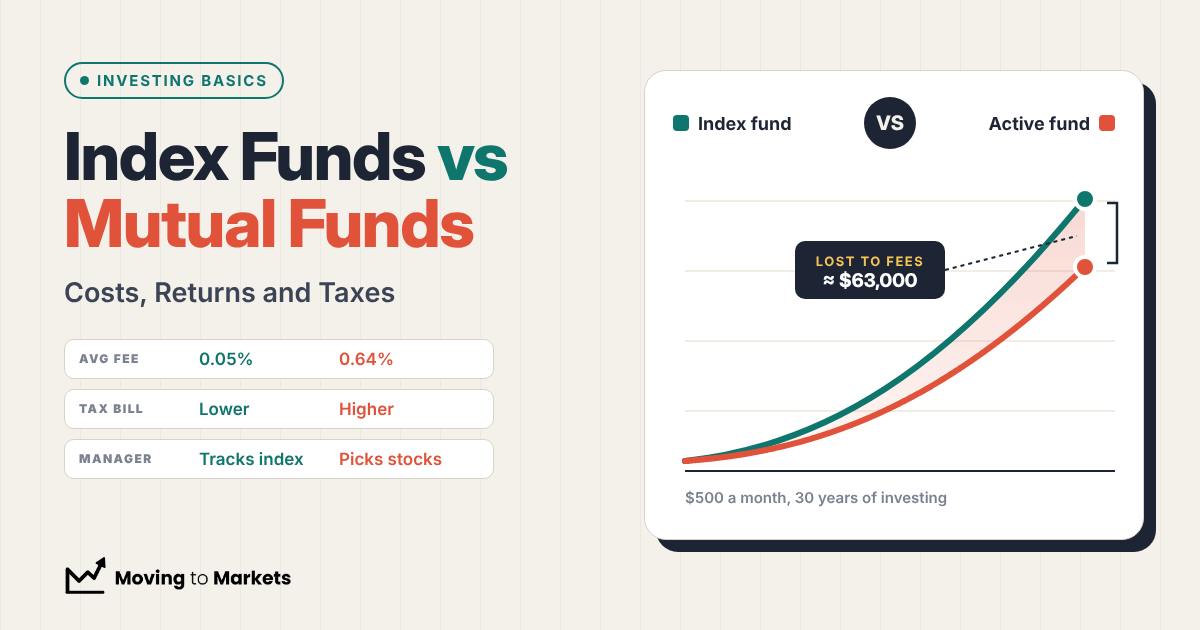
Small percentages don’t look like much. So let’s put dollars on them, using ICI’s 2025 averages and a 7% yearly return before fees:
| What you invest | Index fund at 0.05% | Active fund at 0.64% | What fees cost you |
|---|---|---|---|
| $10,000 once, left for 30 years | $75,063 | $63,584 | About $11,500 |
| $500 a month for 30 years | $600,729 | $537,663 | About $63,000 |
That $63,000 gap comes only from the fee. It assumes the active fund earns the exact same return as the index before fees, which most of them don’t (more on that below).
The fee gap is way smaller than it used to be. In 1996 the average stock mutual fund charged 1.04%. In 2025 it was 0.40%, partly because people moved their money into cheap index funds and fund companies cut prices to keep up. At the end of 2025, index mutual funds and index ETFs held 52% of all money in long-term US funds, up from 19% in 2010, according to ICI.
Sales loads and 12b-1 fees
Some active funds also charge a sales load, a one-time fee when you buy. Growth Fund of America’s A shares charge up to 5.75% up front. Put $10,000 in and up to $575 goes to the sales charge, so only $9,425 gets invested on day one. Bigger purchases get a lower rate, and many 401(k) plans waive the load.
Many active funds also charge a 12b-1 fee, a yearly marketing and distribution fee that is part of the expense ratio. On AGTHX it is 0.24% of the 0.58% total. The big index mutual funds from Fidelity, Schwab and Vanguard charge no load and no 12b-1 fee.
Performance: what SPIVA shows
S&P Dow Jones Indices publishes a report twice a year called SPIVA that checks how active funds did against their index. It counts funds that closed or merged as losers, which is fair, because you can’t stay in a fund that no longer exists.
Here is what the mid-year 2026 report found for periods ending June 30, 2026:
| Fund type | Time period | Share of active funds that trailed their index |
|---|---|---|
| Large-cap US stock funds | First half of 2026 | 67% |
| Large-cap US stock funds | Full year 2025 | 79% |
| Large-cap US stock funds | 5 years | 89% |
| Large-cap US stock funds | 10 years | 83% |
| Large-cap US stock funds | 20 years | 93% |
| Mid-cap US stock funds | First half of 2026 | 74% |
| Small-cap US stock funds | First half of 2026 | 69% |
| International stock funds | First half of 2026 | 49% |
| Emerging market funds | First half of 2026 | 38% |
| Investment-grade intermediate bond funds | First half of 2026 | 43% |
Two things stand out. First, the longer you hold, the worse active stock funds look. Over 20 years only about 1 in 14 large-cap funds beat the S&P 500. Second, active funds hold up better in some areas, like international stocks, emerging markets and bonds. Those are the places where an active fund has a fair shot.
The funds you don’t see
Only 37% of the large-cap funds that existed 20 years ago are still around today, per the same SPIVA report. The rest closed or got merged into other funds, usually because they did badly. So when a fund company shows you their “top performing funds”, you’re only seeing the survivors. The ones that flopped quietly disappeared.
Taxes and capital gains distributions
This part only matters if you hold the fund in a regular taxable brokerage account. Inside a 401(k), IRA or Roth IRA, you can skip this section.
Every time a fund manager sells a stock for a profit, the fund owes tax on that gain. Funds don’t pay it themselves. They pass the gains to you, usually once a year in December, as a capital gains distribution. You owe tax on it even if you never sold a single share of the fund and even if you reinvested it.
Here’s an example with round numbers. Say you hold $50,000 of an active stock fund in a taxable account, and in December it pays out 6% of its value as long-term gains. That’s $3,000 on your 1099-DIV. At the 15% rate you’d owe $450 in tax that year, on money you never touched.
An S&P 500 index fund trades a lot less because it only sells when a company leaves the index. So its yearly payouts tend to be much smaller. Index ETFs usually pay out even less, often nothing, because of the way ETF shares get swapped with big traders without selling stock.
For 2026, long-term gains and qualified dividends are taxed at these federal rates:
| Rate | Single filers (taxable income) | Married filing jointly |
|---|---|---|
| 0% | Up to $49,450 | Up to $98,900 |
| 15% | $49,451 to $545,500 | $98,901 to $613,700 |
| 20% | Over $545,500 | Over $613,700 |
Short-term gains are taxed as regular income, which can be a lot higher.
Index mutual fund or index ETF?
Say you’ve decided on index funds. Now you face a second choice: the mutual fund version or the ETF version. Both can be really cheap, and the difference mostly comes down to how you invest.
| Index mutual fund | Index ETF | |
|---|---|---|
| Example | FXAIX (0.015%), SWPPX (0.02%), VFIAX (0.04%) | VOO (0.03%) |
| Average cost, stock index funds (2025) | 0.05% | 0.14% |
| When you can trade | Once a day at the closing price | Anytime the market is open |
| Automatic monthly investing | Easy at most fund companies | Depends on the broker |
| Taxes in a taxable account | Low | Usually lower |
| Available in your 401(k) | Very common | Less common |
People often say ETFs are always cheaper. They aren’t. In 2025 the average index stock mutual fund (0.05%) was actually cheaper than the average index stock ETF (0.14%).
If you set up $300 a month on autopilot, an index mutual fund is a simple fit. If you invest in a taxable account and want the lowest tax bill, an index ETF usually wins.
Picking funds in your 401(k)
This is where most Americans make this choice, so here is how to read that menu:
- Look for “Index” in the name. “Fidelity 500 Index”, “Vanguard Total Stock Market Index” and “S&P 500 Index Fund” are all index funds.
- Check the expense ratio. It’s listed on the plan’s fee disclosure. An index fund under about 0.10% is good. An active fund at 0.60% to 1% is normal for active but costs you more.
- Check the target-date fund too. Many people end up in one by default. Some hold index funds (Vanguard Target Retirement funds charge around 0.08%), others hold active funds and cost a lot more. Same year on the label, very different fees.
- If your plan has no index fund, pick the cheapest broad fund available, get the full company match and then put extra savings in an IRA where you choose your own funds.
Popular index funds and what they cost
| Fund | Ticker | Type | Expense ratio | Minimum |
|---|---|---|---|---|
| Fidelity 500 Index Fund | FXAIX | Index mutual fund | 0.015% | $0 |
| Schwab S&P 500 Index Fund | SWPPX | Index mutual fund | 0.02% | $0 |
| Vanguard 500 Index Fund Admiral Shares | VFIAX | Index mutual fund | 0.04% | $3,000 |
| Fidelity ZERO Total Market Index Fund | FZROX | Index mutual fund | 0% | $0 (Fidelity accounts only) |
| Vanguard S&P 500 ETF | VOO | Index ETF | 0.03% | Price of one share, or $1 with fractional shares |
For comparison, the active Growth Fund of America (AGTHX) charges 0.58% a year, a sales charge of up to 5.75% and needs $250 to start. It’s one of the biggest active funds in the country, with about $336 billion in it as of October 2026.
Expense ratios for FXAIX, SWPPX and VFIAX come from Morningstar data as of September 2026. AGTHX figures come from Capital Group’s prospectus dated November 1, 2026.
When an active fund can make sense
Index funds win most of the time, not every time. An active fund can be a reasonable pick when:
- You’re buying bonds. Only 43% of intermediate bond funds trailed their index in the first half of 2026. Bond managers have more room to add value by choosing what to hold.
- You want international or emerging market stocks. These were the two stock categories where most active funds beat their index in early 2026.
- Your 401(k) has no index option. Then the cheapest active fund is your best choice.
- You want a specific approach an index can’t copy, like a fund that avoids certain industries for personal reasons.
Even then, check the fee. An active fund charging 1% has to beat its index by 1% a year just to tie it.
So which should you choose?
Go with an index fund if:
- You want low cost and don’t want to watch your funds.
- You’re investing for 10 years or more.
- You’re new to investing and want one simple holding to start.
- You hold the fund in a taxable account (an index ETF is even better here).
Think about an active fund if:
- You’re investing in bonds, international or emerging market stocks.
- Your 401(k) doesn’t offer index funds.
- You know exactly why you want that specific manager and you’re fine paying more.
For most people the answer is a broad, cheap index fund like an S&P 500 or total stock market fund, held for a long time. It’s boring, and that’s sort of the point.
FAQ
Are index funds mutual funds?
Many are. An index fund can be a mutual fund (like FXAIX) or an ETF (like VOO). “Mutual fund” describes how the fund is built and sold, “index fund” describes how it picks investments.
Is the S&P 500 an index fund?
No. The S&P 500 is an index, a list of about 500 large US companies kept by S&P Dow Jones Indices. You can’t buy it directly. You buy a fund that tracks it, like FXAIX, SWPPX, VFIAX or VOO.
Can you lose money in an index fund?
Yes. An index fund drops when the market drops. In 2022 the S&P 500 fell about 18% including dividends, and S&P 500 index funds fell with it. They don’t guarantee any return, they just give you the market’s return minus a small fee.
Are mutual funds riskier than index funds?
It depends on what the fund holds, not on the label. An active fund that owns 40 tech stocks is riskier than an S&P 500 index fund. An active bond fund is far less risky than a stock index fund. Compare what’s inside.
Which is better for beginners?
An index fund. You get hundreds of companies in one purchase, fees close to zero and nothing to research. A target-date index fund in your 401(k) is even simpler.
Do index funds pay dividends?
Yes. A stock index fund passes along the dividends the companies in it pay, usually every quarter. You can take them as cash or reinvest them.
Why do active funds still exist if most lose to the index?
Some do beat their index, mostly in bonds and international stocks. Many investors also buy through advisors or 401(k) plans that offer active funds. And loads and 12b-1 fees pay the people who sell them.