We all know that one friend who pulls out a different card for gas, another one for groceries and a third one for dinner, and somehow knows which one gives the most points. And then there’s the other friend who has had the same single card since college and never thought twice about it.
So who is doing it right? Honestly, both of them can be.
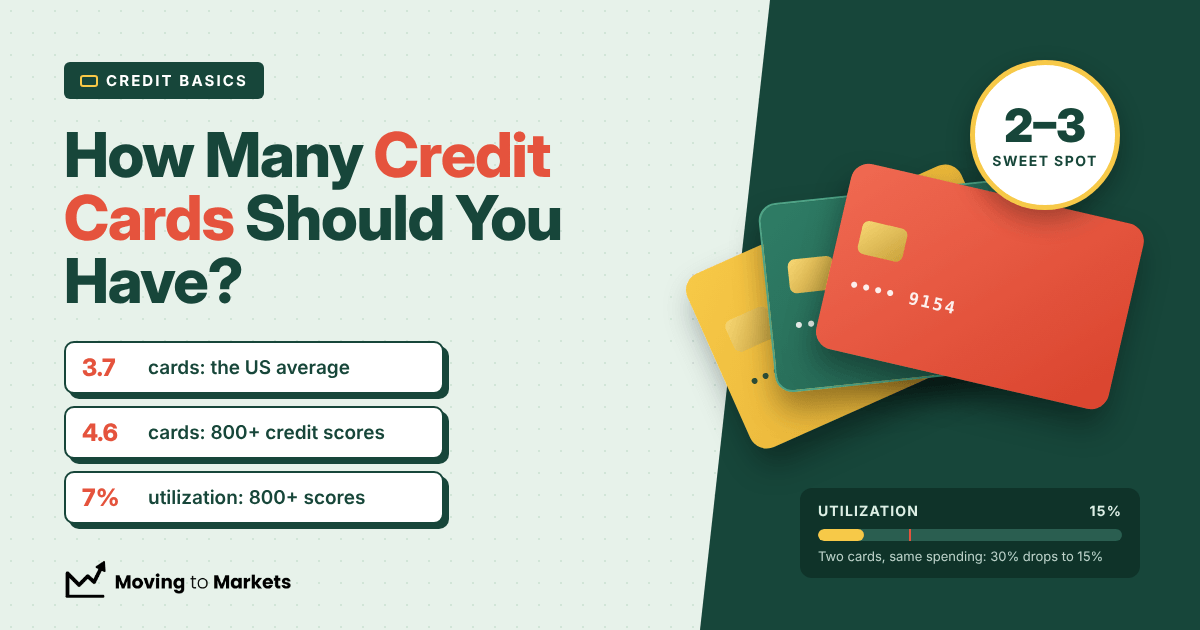
Here’s the short answer. Most people do best with two or three credit cards. If you’re just starting out, one card is plenty for the first 6 to 12 months. Five or more only makes sense if you pay every card in full each month and you actually track what each one earns. The average American has 3.7 active credit cards, according to Experian, and people with FICO scores of 800 and up average 4.6.
The number of cards matters less than what you do with them. But the number does change your credit score, your approval odds and how easy it is to miss a payment. Below is how all of that works, with real numbers.
How many credit cards does the average American have?
Experian looked at its credit files in June 2025 and found Americans carry 3.7 credit cards they actually use, down from 4.1 ten years earlier. “Active” here means you used it or carried a balance in the last six months, so drawer cards don’t count.
The number changes a lot with age:
| Generation | Average active credit cards (2025) |
|---|---|
| Gen Z (18 to 28) | 2.2 |
| Millennials (29 to 44) | 3.4 |
| Gen X (45 to 60) | 4.4 |
| Baby boomers (61 to 79) | 4.4 |
| Silent Generation (80+) | 3.1 |
Source: Experian, data as of June 2025.
Where you live barely moves it. Among the 20 biggest metro areas, Seattle sits lowest at 3.5 cards and Miami, Tampa and Riverside, California tie for highest at 4.1.
And Americans are using those cards. Credit card balances hit $1.285 trillion in the third quarter of 2026, up $52 billion from a year earlier, according to the New York Fed. The CFPB’s December 2025 report puts the average APR on general purpose cards at 25.2%. That number is why everything in this article assumes you pay in full. Carry a balance at 25% and no rewards card on earth comes out ahead.
One more number worth knowing: in a NerdWallet survey done with The Harris Poll and published in April 2026, 33% of Americans with credit cards said they have too many.
The right number of cards for your situation
There’s no law that caps how many cards you can have. But there is a number that fits your life. Find yourself in this table:
| Your situation | How many cards | Why |
|---|---|---|
| No credit history yet | 1 | A secured or student card builds your history. One due date, nothing to juggle. |
| Rebuilding after late payments or collections | 1, then 2 after a year of on-time payments | Every new application is a hard inquiry, and you need a clean year first. |
| Everyday spender who pays in full | 2 to 3 | Lowers your utilization, gives you a backup card, and covers your main spending categories. |
| Rewards and travel fan | 4 to 6+ | Only if you track every due date, fee and bonus. |
| Self-employed or side business | 2 to 3 personal + 1 business | Keeps business spending separate for taxes. |
Two cards is a good target for most people for a simple reason. If your only card gets frozen for fraud while you’re at the airport or a gas station, you’re stuck. A second card from a different bank, ideally on a different network (say one Visa and one Mastercard), fixes that. If one of your cards is an American Express or Discover, pair it with a Visa or Mastercard, because some small shops and a lot of places outside the US don’t take Amex or Discover.
How the number of credit cards affects your credit score
FICO doesn’t give you points for having more cards. What it scores is how you use them. Here’s how FICO weighs your score:
- Payment history: 35%
- Amounts owed (mostly utilization): 30%
- Length of credit history: 15%
- Credit mix: 10%
- New credit (applications and new accounts): 10%
Adding or closing a card touches three of those five. Here’s how.
More cards can lower your utilization
Utilization is the share of your credit limits you’re using. Say you put $1,500 a month on one card with a $5,000 limit. That’s 30% utilization when the statement posts.
Open a second card with another $5,000 limit and keep using the first one the same way. Now you’re at $1,500 out of $10,000, or 15%. You didn’t change your spending at all, and your score likely goes up.
You’ve probably heard “stay under 30%.” That’s a rule of thumb, not a cliff. Lower is better. Experian found people with FICO scores of 800 or higher use only 7% of their credit on average, while the average for everyone is 29% (Experian, June 2026 data).
Each new card costs you a few points for a while
When you apply, the bank pulls your credit. That’s a hard inquiry. According to myFICO, one inquiry takes less than five points off most people’s FICO scores. It stays on your report for two years but only counts in your score for one.
A new card also lowers the average age of your accounts. If your only card is 8 years old and you open a new one, your average drops to 4 years overnight. With a long history behind you, that dip barely shows. With a short one, it can sting more.
So space out your applications. Waiting six months between cards gives the inquiry time to fade and keeps you under most bank limits (more on those below). If you plan to buy a house or a car soon, don’t open any new card in the 6 to 12 months before you apply for the loan.
More cards means more due dates to miss
This is the part people underrate. One payment that’s 30 days late can stay on your credit report for seven years, and payment history is 35% of your score. If you get a fourth card for a sign-up bonus and then forget about it one month, that one late payment can do more damage than the bonus was worth.
Can a bank stop you from getting more cards?
Yes. The law doesn’t limit how many cards you can hold, but banks do. None of them publish these rules officially, but card sites and readers track them closely. Here’s what’s reported as of 2026:
| Bank | Reported rule |
|---|---|
| Chase | 5/24: you’ll likely be denied if you opened 5 or more personal cards from any bank in the last 24 months. Also about 2 Chase cards per 30 days. |
| American Express | About 5 credit cards max (charge cards with no preset limit don’t count). Roughly 1 new card per 5 days and 2 per 90 days. |
| Capital One | Reportedly 2 personal cards at a time, and about 1 application every 6 months. |
| Citi | 1 personal card per 8 days, 2 per 65 days. |
| Bank of America | 2/3/4: 2 cards in 2 months, 3 in 12 months, 4 in 24 months. |
| Barclays, U.S. Bank | No widely reported hard limit, but they look at recent applications. |
Sources: One Mile at a Time (October 2026) and Military Money Manual (July 2026).
Chase 5/24 is the one that trips up most people. It counts cards from every bank, and it counts cards where you’re only an authorized user. One Mile at a Time reported in October 2026 that it’s still enforced for most applicants. So if you want a Chase card someday, get it before you open a bunch of others.
What two or three cards look like in real life
You don’t need a complicated setup. Here’s a simple one that works for a lot of people:
- A flat-rate card with no annual fee for everything. The Citi Double Cash and Wells Fargo Active Cash both pay 2% cash back with a $0 annual fee (terms from the issuers’ sites, November 2026).
- A second card from a different bank for a category you spend a lot on, like groceries or gas. This one is also your backup.
- A third card only if it pays for itself.
Run the math before you add that third card. If you spend $2,000 a month and all of it goes on a 2% card, you earn $480 a year. Now say you want the Chase Sapphire Preferred for travel. It has a $95 annual fee. That card has to earn you at least $95 more per year than your 2% card would have earned on the same spending, or you’re losing money. Sign-up bonuses help in year one, but the fee comes back every year.
Signs you have too many credit cards
Feeling like you have too many is pretty common, a third of cardholders say so. Here are some honest tests:
- You missed a due date in the past 12 months.
- You can’t name the limit and annual fee on every card you own without checking.
- You pay more in annual fees than you get back in rewards.
- You carry a balance on more than one card.
- You opened a card for the bonus and haven’t used it since.
If two or more of those sound like you, stop opening cards. Then decide what to do with the ones you have.
Should you close a credit card you don’t use?
Usually no, but it depends on the card.
Here’s what happens when you close one. You lose that card’s limit right away, so your utilization jumps. Say you owe $4,000 across cards with $20,000 in total limits. That’s 20%. Close a card with an $8,000 limit and you’re suddenly at $4,000 out of $12,000, which is 33%. Same debt, worse score.
Your credit history doesn’t vanish at once, though. A card you close in good standing can stay on your report for up to 10 years and keeps adding to your history during that time.
Close the card if: – It has an annual fee you can’t justify, and the bank won’t move you to a no-fee version (ask first, a “product change” keeps the account age and limit). – You keep overspending on it. – It’s a store card you never use and your other limits are high.
Keep it open if it’s your oldest card or it has a big limit and no fee.
One thing nobody warns you about: banks can close a card you never use. There’s no set timeline, and each bank decides. The fix is easy. Put one small recurring bill on it, like a $10 streaming subscription, and set up autopay for the full balance. The card stays active and you never have to think about it.
Do authorized user and business cards count?
Authorized user cards: If a parent or partner adds you to their card, that account usually shows up on your credit report. That can help a lot if you’re young and the card is old with a perfect payment record. It can also hurt you if they miss payments, so you can ask to be removed. Keep in mind authorized user cards count toward Chase 5/24, even though you never applied for them.
Business cards: Most business cards don’t show on your personal credit report while you pay on time. Chase, Amex, Citi, Bank of America, Wells Fargo, U.S. Bank and Barclays generally keep them off, according to Doctor of Credit. Discover and TD Bank do report them. Capital One reports some of its business cards (Spark Cash, Spark Cash Select, Spark Classic, VentureOne Business) and not others (Spark Cash Plus, Venture X Business, Venture Business), per Capital One. If you fall behind, almost every bank will report it on your personal file. And Chase business cards still need you to be under 5/24 to get approved.
How to build up to the right number of cards
If you’re starting from zero, here’s a plan that takes about two years:
- Month 0: Get one card. If you have no history, a secured card or a student card is the easiest approval. Use it for one or two small bills and pay it off in full every month.
- Month 6 to 12: After 6 to 12 months of on-time payments, apply for a regular no-fee card from a different bank. Keep using both a little.
- Month 18 to 24: Look at your spending. If one category (groceries, gas, travel) is big enough that a third card earns more than its annual fee, add it. If not, stay at two.
- Every year: Check every card’s fee, rewards and limit. Ask for a limit increase on cards you’ve had a while, and product change any card whose fee isn’t paying off.
Set autopay on every single card for at least the minimum payment. That one step protects 35% of your score.
FAQ
Is 2 credit cards enough? Yes, for most people. Two cards give you a backup if one gets frozen, lower your utilization and cover your main spending. Plenty of people with great credit never go past two.
Is 5 credit cards too many? Not if you pay them all in full and keep track of each one. People with 800+ FICO scores average 4.6 cards. It’s too many if you’re missing payments, paying fees you don’t earn back or carrying balances.
Does having more credit cards raise your credit score? Not directly. More cards can lower your utilization, which helps. But each new card means a hard inquiry and a younger average account age, which hurt a little for about a year.
How long should I wait between credit card applications? About six months. A hard inquiry stops counting in your FICO score after 12 months, and spacing out applications keeps you clear of bank rules like Chase 5/24 and Capital One’s six-month limit.
Does closing a credit card hurt my credit? It can. You lose that card’s limit, so your utilization goes up. The account itself can stay on your report for up to 10 years if it was in good standing.
Do authorized user cards count toward my number of cards? They show on your credit report and count toward Chase 5/24. Other banks mostly look at cards you applied for yourself.
Do business credit cards show on my personal credit report? Most don’t, unless you fall behind. Discover, TD Bank and some Capital One business cards do report to your personal file.
How many credit cards does someone with an 800 credit score have? About 4.6 on average, according to Experian’s June 2026 data, and they use only 7% of their total credit limits.
The bottom line
For most people the answer is two or three credit cards. Start with one, add a second from a different bank after six months to a year of on-time payments, and only add a third if it earns more than it costs. Keep your balances low, set autopay on everything and space out your applications. Do that and the exact number matters a lot less than you’d think.