We all know that one friend who somehow pays $200 less than everyone else in the same building. Same floor plan, same view of the parking lot. When you ask how, they just shrug and say “I asked.”
That’s most of the secret, honestly. Yes, you can negotiate rent, and right now is one of the better times in years to do it. Rental vacancy in the US hit 7.3% in the second quarter of 2026, the highest since 2017, and about 4 in 10 listings in the biggest metros offered some kind of deal in August. Landlords with empty units lose money every day, and a lot of them would rather give you a discount than lose you.
You still need a plan. Ask for a specific number, back it up with real listings, offer something in return, and get the final deal signed. Below is how to do each step, what to say word for word, and how much you can realistically ask for in 2026.
Is 2026 a good time to negotiate rent?
In most of the country, yes. Here’s what the numbers look like right now:
| What | Number | Source |
|---|---|---|
| National median rent | $1,384 a month, up just 0.1% in a year | Apartment List, October 2026 |
| Asking rent in the 50 largest metros | $1,699, down 0.9% in a year, 37th straight month of yearly declines | Realtor.com, August 2026 |
| Rental vacancy rate | 7.3%, highest since 2017 | US Census, Q2 2026 |
| Listings offering a concession | 43.5% (30.6% offered free rent) | Realtor.com, August 2026 |
| Average days a unit sits empty | 36 | Apartment List, October 2026 |
A lot of new apartment buildings opened in the last two years, especially in the South and Southwest, and landlords are competing for the same renters. That gives you room to push.
Where renters have the most bargaining power
Your city matters more than your script. Zumper ranked 44 metros by how much pull renters have, and these came out on top in June 2026:
| City | Median 1-bedroom rent | Change in a year | Large buildings offering 1+ month free |
|---|---|---|---|
| Austin | $1,330 | down 12.5% | 42% |
| Denver | $1,570 | down 7.6% | 48% |
| Nashville | $1,500 | down 7.4% | 33% |
| Dallas | $1,350 | down 6.9% | 25% |
| Tampa | $1,520 | down 6.2% | 31% |
Source: Zumper, June 2026.
Realtor.com found the same cities at the top for concessions in August 2026: Denver (71.9% of listings), Austin (70.7%), Las Vegas (69.6%), Nashville (69.0%) and San Antonio (67.9%). Texas has the highest state vacancy rate at 13.3%.
The other side is real too. One-bedroom rent in San Francisco jumped 21.9% to $4,060 in the same Zumper report. If you rent there, or in Manhattan, you can still ask, but expect a smaller win, more likely a waived fee than a lower rent.
When to negotiate rent
For a renewal, start 60 to 90 days before your lease ends. Most landlords send renewal offers 45 to 60 days out. If you talk to them first, you’re setting the number instead of reacting to theirs. Check your lease too, because some require you to give notice 60 days ahead if you plan to leave.
For a new lease, aim for November through February. Fewer people move in winter, so units sit longer and landlords get nervous. Summer is the hardest time to ask for anything.
A few other good moments:
- The unit has been listed for more than 36 days (the national average right now). Zillow and Apartments.com show how long a listing has been up.
- It’s the last week of the month and the unit is still empty. The landlord is about to lose another full month of rent.
- The building just opened and is still filling up. New buildings almost always run move-in specials.
How much to ask for
Ask for a specific number and tie it to proof. “Can you lower it a bit?” gives the landlord nothing to work with. “Two units on this block list at $1,750 for the same size, can you match that?” does.
A good rule:
- Comps are cheaper than your rent: ask to match the lowest comparable listing.
- No clear comps, soft market (like Austin or Denver): ask for 5% to 8% off.
- Tight market (like San Francisco or New York): ask for 3% to 5%, or ask for a fee waiver instead.
On $1,600 rent, 5% is $80 a month, or $960 a year. That’s real money for a 10-minute email.
Understand net effective rent
Lots of buildings in 2026 advertise “one month free.” Here’s how to read it. If the rent is $1,500 and you get one month free on a 12-month lease, you pay $16,500 for the year instead of $18,000. That works out to $1,375 a month, which leasing offices call the “net effective rent.”
Now here’s the catch nobody tells you. When your lease renews, the landlord prices the increase off the full $1,500, not the $1,375. A free month helps this year only. A lower base rent helps every year after.
So when you have the choice, ask for the discount spread across the monthly rent. If the office says the free month is all they can do, take it, but know that you’ll face a bigger jump at renewal and plan for it.
How to negotiate a rent increase at renewal
This is where most people search for help, and there’s a good reason to push back right now. RealPage data published in July 2026 shows renewal rents rising about 3.5% this year while rents for new move-ins stayed flat. In plain words, your landlord may be asking you to pay more than the new tenant who moves in next door.
Here’s the step-by-step:
- Look up every listing for your floor plan in your building and within a mile or two. Screenshot the price and the date.
- Write down your record. Months of on-time rent, zero complaints, how long you’ve lived there.
- Do the landlord’s math. At $1,384 median rent and 36 days on the market, a vacancy costs the landlord around $1,400 to $1,700 in lost rent before they pay for cleaning, paint and listing. If they’re raising you $60 a month, that’s $720 a year. Losing you costs them more.
- Counter with a number and a trade. Offer a longer lease or flexibility on your move-out date.
- Get the new number signed in a lease addendum before the old deadline passes.
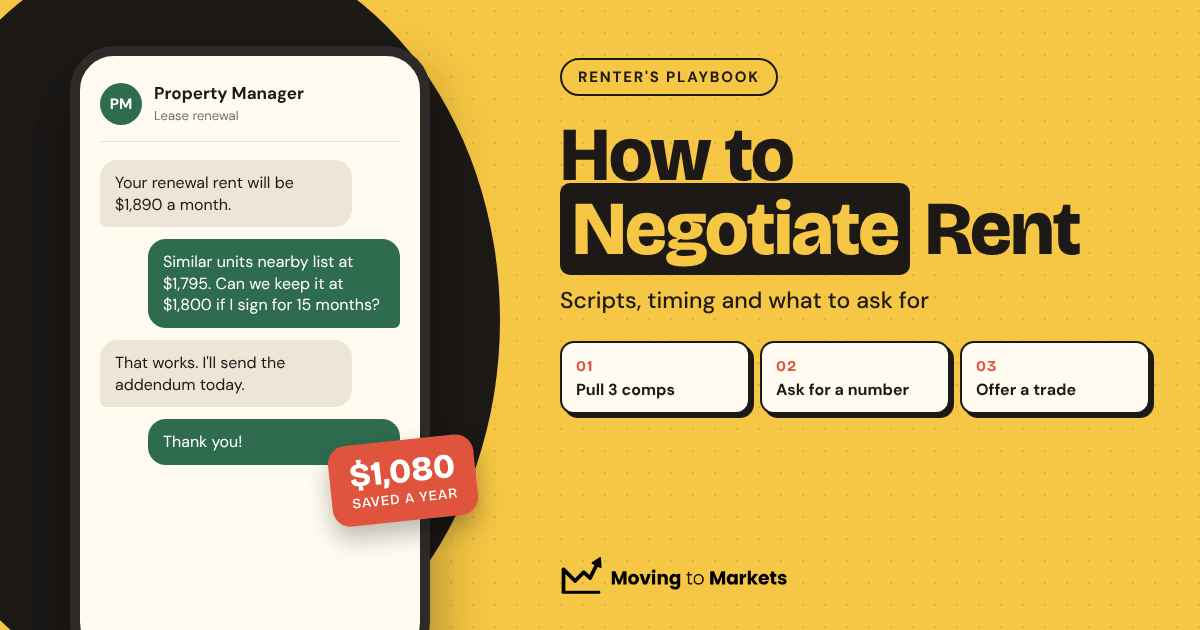
A real example: You pay $1,800. The renewal offer comes in at $1,890, a 5% increase. Three similar units in the area list between $1,775 and $1,825. You counter: stay at $1,800 for a 15-month lease. If they agree, you save $90 a month, or $1,080 over a year. If they come back at $1,840, you still saved $600.
Corporate landlords vs individual owners
Who owns your building changes your whole approach.
Individual owners (a duplex, a few houses, a small building) set rents themselves. They care about a tenant who pays on time and doesn’t call at 2 a.m. about a squeaky door. Personal stuff works with them: offering to mow the lawn, handle snow, or stay for two years.
Large management companies often use pricing software that suggests rents for each unit every day. That’s why a leasing agent might tell you “the system sets the price.” The best-known company, RealPage, settled an antitrust case with the US Department of Justice. Under the deal, which a federal judge in North Carolina approved in 2026, RealPage can no longer use competitors’ private, current rent data to recommend live prices, and landlords can’t set the software to auto-accept its numbers without a way to override them. New York banned rent-setting software that pools data from competing landlords in December 2025, California passed its own law in October 2025, and cities including San Francisco, Philadelphia, Minneapolis, San Diego and Seattle have local bans.
You can still negotiate with a big company. You just ask for different things:
- Ask for prices on every lease length. The software often prices 13, 15 and 18-month leases differently from 12. One may be $40 to $80 cheaper.
- Ask about every open unit in your floor plan. A unit on a lower floor or facing the parking lot can cost less for the same size.
- Ask what concessions are active this week. Specials change often and agents don’t always mention them.
- Ask the manager, not the leasing agent. Agents often can’t approve exceptions. Property managers can.
Skip the “I’ll do yard work” offer at a 300-unit complex. They have a maintenance crew.
What to offer in return
Landlords say yes faster when they get something back:
- A longer lease. 15 or 18 months means one less turnover for them, and it can push your renewal into winter, when you have more pull.
- Flexible move-in or move-out dates. If the unit is empty now, moving in this week instead of next month saves them rent.
- Prepaying. Only if you have the cash and the landlord is a small owner you trust. Never prepay a corporate building more than they ask for, and check your state’s rules on prepaid rent first.
- Proof you’re low-risk. A credit report, pay stubs or a reference from your last landlord. If you’ve paid rent on time for 12 or 24 months, show the bank statements.
- Giving something up. No parking spot, no storage unit, a unit without the renovated kitchen.
Things to ask for besides lower rent
If the base rent won’t move, these often will:
- Waived application, admin or “amenity” fees
- Free or cheaper parking
- No pet rent or a smaller pet deposit
- A lower security deposit
- Included internet or utilities
- A free month on a longer lease
- New carpet, paint, appliances or a washer and dryer before you sign
- Permission to sublet if you need to leave early
In New York City, the FARE Act, in effect since June 2025, means you don’t pay the broker fee when the landlord hired the broker. If a listing tries to charge you anyway, you can push back on it.
Word-for-word scripts
Email for a new lease
Hi [Name],
I’m interested in unit [number] and I’d like to apply this week. I’ve been comparing listings nearby, and [address] has a similar 1-bedroom listed at $[price], and [address] is at $[price].
Would you be open to $[your number] a month? I can sign a 15-month lease and move in by [date]. I have a credit score of [score] and can send pay stubs and a landlord reference today.
Thanks, [Your name]
Email to counter a renewal increase
Hi [Name],
Thanks for sending the renewal offer. I’d like to stay. I’ve paid on time every month for [number] years and haven’t had any issues with the unit.
The renewal is $[new rent], but similar units in the area are listed between $[low] and $[high] right now (screenshots attached). Could we keep the rent at $[current or your number]? I’m happy to sign for 15 months instead of 12.
Let me know what works. [Your name]
When they say “the system sets the price”
“I get that. Can you show me what the system has for a 13, 15 and 18-month lease on this unit? And are there any other units in this floor plan open now or in the next 30 days? I’d also like to know what specials you’re running this week.”
Follow-up after 7 days with no answer
“Hi [Name], just checking on my note from last week about the renewal. My lease decision is due [date], so I want to make sure we sort it out before then.”
A polite walk-away line
“I understand. I’m going to look at a few other places this week, and I’ll let you know by Friday whether I’m renewing.”
Only say this if you mean it, and if you’ve checked what moving would cost you.
Know your rights before you negotiate
Some rent increases aren’t up for negotiation because they’re not legal in the first place. Three states cap yearly increases for most rentals:
- California: 5% plus local inflation, up to 10%. For increases on or after August 1, 2026, the cap is 8.6% to 8.8% in most areas. Buildings under 15 years old and many single-family homes owned by individuals are exempt. Any increase over 10% needs 90 days’ written notice.
- Oregon: 7% plus inflation, up to 10%. The 2026 cap is 9.5%. Buildings under 15 years old are exempt.
- Washington: 7% plus inflation, up to 10%, under a law signed in May 2025. The 2026 cap is 9.683%. New buildings are exempt for their first 12 years.
Cities can be stricter. Rent-stabilized apartments in Los Angeles and San Francisco, and rent-stabilized units in New York City, follow their own yearly limits.
If your landlord asks for more than the legal cap, you don’t negotiate it down. You tell them the increase is over the limit and point to the law. Your city or state housing department website lists the current numbers. For a quick check, search “[your city] rent increase limit 2026.”
What to do if your landlord says no
A no on rent isn’t the end of it. Go down this list:
- Ask for one non-rent item: a waived fee, free parking, an upgrade.
- Ask for quotes on a shorter or longer lease.
- Ask for a smaller increase. “Can we split the difference at $[number]?”
- Do the moving math before you walk away.
That last step matters. Say your rent goes up $75 a month, so $900 a year. Now add up what moving costs you: movers or a truck, application fees, a new security deposit, a few days off work, maybe a week of paying two rents at once. In a lot of cases that’s more than $900, so staying at the higher rent wins. If the increase is $200 a month and the building down the street offers a free month, moving probably wins.
Put the deal in writing
Every page tells you to “get it in writing.” Here’s what that means. You want a signed lease or lease addendum that lists the new rent, the start and end dates, and whether any concession continues at renewal. A text from a leasing agent saying “sure, we can do $1,750” is not enough, because the agent may not have the authority to bind the owner.
FAQ
Is it rude to negotiate rent? No. Landlords and leasing offices get asked all the time. Be polite, be specific and don’t make threats you won’t follow through on.
How much can you negotiate off rent? In soft markets in 2026, 5% to 8% is realistic. In tight markets, 3% to 5% or a waived fee is more likely. Matching a lower comparable listing is the easiest win.
Can you negotiate rent at a big apartment complex? Yes, but ask about lease lengths, other units and current specials rather than a straight price cut. Talk to the property manager if the leasing agent can’t approve it.
Can you negotiate a rent increase on renewal? Yes, and in 2026 you have a good argument because renewal rents are rising faster than new-lease rents. Bring comps and offer a longer lease.
What is net effective rent? It’s the monthly rent after spreading a concession over the lease. $1,500 rent with one month free on a 12-month lease works out to $1,375 a month.
Can a landlord raise rent after you negotiate? Not during a fixed-term lease, unless the lease says so. At renewal they can, within any local or state caps and with proper notice.
Should I negotiate rent by email or in person? Start by email so you have a record and can attach your comps. Follow up by phone or in person if you don’t hear back in a week.
Can you negotiate rent with bad credit? It’s harder, but you can offer a larger deposit, a co-signer or proof of steady income and on-time rent history. Focus on what the landlord gets from you.
The bottom line
Negotiating rent comes down to four things: pick the right time, ask for a real number, back it up with listings, and offer something in return. In 2026, with vacancy at its highest level in almost a decade and concessions everywhere in cities like Austin, Denver and Nashville, landlords have more reason to say yes than they’ve had in years.