You open your mailbox and there’s an envelope that says you’ve been pre-selected for a Mastercard with a $700 credit limit. No deposit. Bad credit is fine. If your score has been beaten up by a medical bill, a repo or a couple of missed payments, an offer like that looks pretty good at first.
That envelope is very often the Destiny Mastercard. And most of the reviews online can’t even agree on what it costs. One site says the annual fee is $75, another says $175, a third says $250. They’re all sort of right, because Destiny comes in several versions and nobody tells you that.
So we pulled the actual cardholder agreements and put every fee in one place. Here’s what the Destiny credit card really costs, what it does for your credit, how to apply and when you should pick something else.
Destiny credit card at a glance
The Destiny Mastercard is an unsecured credit card for people with fair, poor or limited credit. The Bank of Missouri issues it and Concora Credit runs the accounts. Concora used to go by Genesis Financial Solutions and changed its name in 2023, so you may still see “Genesis” on some older pages.
The quick answer:
- APR: 35.9% on purchases and cash advances, in every version we found
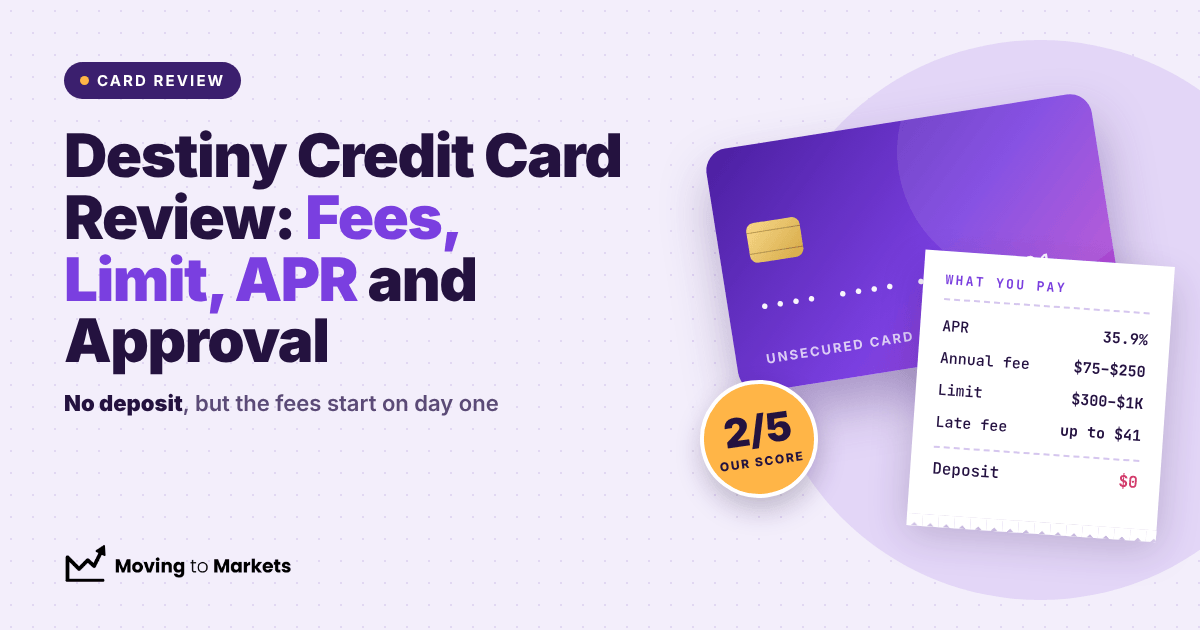
- First-year annual fee: $75, $125 or $250, depending on your offer
- Credit limit: $300, $700 or $1,000, depending on your offer
- Security deposit: none
- Reports to: all three major credit bureaus, every month
- Open to new applicants: yes. As of November 13, 2026, destinycard.com shows working “Apply Now” buttons and no notice that applications are closed
The three versions of the Destiny Mastercard
Destiny does not publish its rates and fees on its website. Its FAQ says your cardholder agreement comes in the mail with the card, after you’re approved. That’s why the reviews you’ve read don’t match.
We found three cardholder agreements from The Bank of Missouri. The version you get depends on the offer you’re shown when you apply or the one that came in the mail. Here’s how they compare:
| $1,000 limit (version 232) | $700 limit (version 242) | $300 limit (version 243) | |
|---|---|---|---|
| Annual fee | $250 first year, $99 after | $125 every year | $75 first year, $99 after |
| Monthly fee | $0 first year, then $19.25 a month ($231 a year) | None | None |
| Credit you can use on day one | About $750 | About $575 | About $225 |
| Purchase APR | 35.9% | 35.9% | 35.9% |
| Cash advance APR | 35.9% | 35.9% | 35.9% |
| Cash advance fee | $5 or 5%, whichever is more (max $100) | Same | Same |
| Foreign transaction fee | 1% | 1% | 1% |
| Late payment fee | $30, or $41 if you were late in the past 6 months | Same | Same |
| Returned payment fee | $30, or up to $41 | Same | Same |
| Overlimit fee (only if you opt in) | $30, or up to $41 | Same | Same |
| Minimum payment | 5% of your balance or $40, whichever is more | Same | Same |
| Minimum interest charge | $1.00 | Same | Same |
A few things in that table deserve a second look.
The annual fee comes out of your limit. Destiny charges the first annual fee when it opens your account. On the $1,000 card you start with a $250 balance, so you can spend about $750. On the $300 card you start with $75 already owed.
The $1,000 card gets expensive in year two. The monthly fee kicks in after your first year at $19.25 a month. Add the $99 annual fee and you pay $330 a year to keep a $1,000 card open.
You may have seen a $175 / $49 / $12.50 fee setup. WalletHub, Kudos and a few other sites still list a $175 first-year fee, $49 after and $12.50 a month. That doesn’t match any of the three agreements we found, so it’s most likely an older offer. Don’t count on getting it.
Before you accept any Destiny offer, scroll to the box called “Interest Rates and Interest Charges” and “Fees.” Federal law requires card issuers to print this box on applications and mail offers. That box is the only place that tells you which version you’re getting.
What the Destiny card really costs you
Fees on a card like this look small one at a time. Here’s what they add up to.
If you pay your balance in full every month (no interest at all), three years costs you:
- $1,000 version: $250 + $99 + $99 in annual fees, plus $231 + $231 in monthly fees = $910
- $700 version: $125 × 3 = $375
- $300 version: $75 + $99 + $99 = $273
That’s the best case. Now say you carry a balance, which most people with a card like this end up doing at some point.
At 35.9% APR, a $500 balance costs you about $15 a month in interest. Destiny’s minimum payment on $500 is $40 (5% would be $25, so the $40 floor applies). If you pay only the $40 minimum and stop using the card, it takes about 16 months to clear and you pay around $135 in interest.
Max out the $1,000 version ($750 of spending after the fee) and pay the minimum, and you’re looking at about 28 months and roughly $367 in interest, before the $19.25 monthly fee and the annual fee hit on top of it.
For comparison, a secured card with no annual fee and a $200 deposit costs you $0 if you pay on time, and you get the $200 back when you close it or upgrade.
How the Destiny card affects your credit score
Destiny reports your account to all three major credit bureaus every month. On-time payments get added to your credit file, and that’s the main reason to have this card. Payment history is the largest part of your FICO score.
There’s one catch that no other review mentions. The annual fee hurts your credit utilization on day one. Utilization is how much of your limit you’re using, and most lenders like to see it under 30%. On the $300 card, the $75 fee puts you at 25% before you buy anything. On the $1,000 card, the $250 fee does the same thing. Spend another $100 on the $300 card and you’re at 58%.
What to do about it:
- Pay off the annual fee within the first month so your reported balance drops.
- Keep your balance under $90 on the $300 card, $210 on the $700 card and $300 on the $1,000 card.
- Pay before the statement closing date, not only before the due date. The balance on your statement is the one that gets reported.
Destiny’s agreement says it can raise or lower your limit at any time without telling you first. It does not promise automatic increases or say how often it reviews accounts, so don’t apply counting on one.
How to apply for the Destiny Mastercard
You apply online at destinycard.com. There’s no phone application. If you got a mail offer, use the “Received a Mail Offer?” link and enter your reservation code.
According to Destiny’s FAQ, you need:
- To be at least 18
- A valid Social Security number
- A physical US address (and to apply from a US internet connection)
- No past Destiny account that was charged off
Destiny also checks your income, debts and identity. Approval is not guaranteed, even with a mail offer.
Applying won’t hurt your score if you’re turned down. Destiny’s site says that if your application is not approved, a hard inquiry won’t show up on your credit report. If you are approved, expect a hard inquiry. Credit Karma’s listing says you usually get a decision in about 60 seconds. The card shows up in the mail within 14 business days in most cases.
You can only have one Destiny account at a time, and Destiny doesn’t offer balance transfers.
What you get with the card
The benefit list is short:
- Monthly reporting to all three credit bureaus
- No security deposit
- Mastercard Zero Liability, so you don’t pay for charges you didn’t make
- Mastercard ID Theft Protection at no extra cost
- Cash advances at banks and ATMs, but at 35.9% with no grace period and a $5 or 5% fee, so skip them unless it’s an emergency
- Online account access at mydestinycard.com, where you can check your balance and pay your bill
The $300 version’s agreement includes a rewards section that pays 1.5% cash back on purchases as a statement credit. You don’t earn it on fees or cash advances. We didn’t find a rewards section in the other two versions, and Destiny’s website doesn’t mention rewards at all, so check your own agreement.
You don’t get a free credit score, an intro APR, a balance transfer option or travel perks.
Our Destiny Mastercard review
We scored the Destiny card on the five things that matter most if you’re rebuilding credit. Each score is out of 5.
| Category | Score | Why |
|---|---|---|
| Fees | 1 / 5 | $273 to $910 over three years with no interest, and up to $41 per late or returned payment |
| Interest rate | 1.5 / 5 | 35.9% is about as high as credit cards go |
| Approval odds | 4 / 5 | Built for bad and limited credit, no deposit, and no hard pull if you’re declined |
| Credit building | 3 / 5 | Reports to all three bureaus monthly, but the fee eats into your utilization from day one |
| Features and service | 2 / 5 | Zero Liability and ID theft protection only. No app mentioned on the official site, phone support on weekdays only |
| Overall | 2 / 5 |
Pros
- No security deposit, so you can get a card without tying up $200 or more
- Reports to Equifax, Experian and TransUnion every month
- A declined application doesn’t add a hard inquiry
- Decisions come back in about a minute
- The $700 version has no monthly fee and the same $125 every year, so you know what you’ll pay
Cons
- Annual fees of $75 to $250 in year one, charged before you buy anything
- The $1,000 version adds a $19.25 monthly fee after year one
- 35.9% APR on everything, cash advances included
- Your available credit starts $75 to $250 lower than your limit
- Destiny doesn’t publish its terms online, so you can’t compare versions before you apply
- Customer service by phone only on weekdays, 6 am to 6 pm Pacific
The verdict
The Destiny Mastercard works for one kind of person: someone who has been turned down for secured cards and can’t put down any deposit at all. If that’s you, pick the $700 version if you get the choice. Its $125 fee stays flat, and it has no monthly fee. Pay the fee off in month one, keep your balance low and pay in full every month.
For almost everyone else, a secured card costs less. If you can save up $200 in the next month or two, you’ll save hundreds of dollars over the next three years and build the same payment history.
Destiny vs. secured cards: what you’d pay instead
Each card below has no annual fee or a much lower one than Destiny. Numbers come from each issuer’s website, checked November 13, 2026.
| Card | Annual fee | Deposit | Purchase APR | Rewards |
|---|---|---|---|---|
| Destiny Mastercard ($700 version) | $125 | None | 35.9% | None |
| Discover it Secured | $0 | $200 minimum (deposit sets your limit, up to $2,500) | 22.99% variable | 2% at gas stations and restaurants (up to $1,000 a quarter), 1% on everything else |
| Capital One Platinum Secured | $0 | $49, $99 or $200 for a $200 starting limit | 29.24% variable | None |
| OpenSky Secured Visa | $35 | $200 minimum | 24.14% variable | Up to 10% cash back at select merchants |
Capital One is worth a closer look if a deposit is the problem. Depending on your credit, you may get a $200 limit for a $49 deposit. That’s less than the Destiny fee, you get it back, and there’s no annual fee.
Already have a Destiny card? Here’s who to call
A lot of people searching “Destiny credit card” already have one and just need to log in or pay. These details come from Destiny’s official FAQ:
- Account login: mydestinycard.com
- Customer service: 1-800-583-5698, Monday to Friday, 6 am to 6 pm Pacific
- Lost or stolen card: 1-800-304-3096
- Card didn’t arrive within 14 business days: 1-800-314-6340
- Mail your payment to: Concora Credit, PO Box 96541, Charlotte, NC 28296-0541
- Letters and disputes: Concora Credit, PO Box 4477, Beaverton, OR 97076-4477
- Fax: 1-503-268-4711
Watch out for look-alike sites. destinycard.org, for example, ranks high on Google and has login and payment pages, but it says in its own footer that it isn’t connected to Destiny. Only enter your login on mydestinycard.com or through destinycard.com.
Traveling? Destiny’s FAQ says purchases outside the US may get declined if you don’t call ahead first. You’ll also pay a 1% foreign transaction fee on every purchase.
Frequently asked questions
Is the Destiny credit card legit?
Yes. The Bank of Missouri, an FDIC member bank, issues the card, and Concora Credit services it. It’s a real Mastercard you can use anywhere Mastercard is accepted. It is expensive, but it isn’t a scam.
What credit score do you need for the Destiny card?
Destiny doesn’t publish a minimum score. The card is made for fair, poor or limited credit, and Destiny looks at your income, debts and identity along with your credit report. A low score alone won’t rule you out, but approval isn’t guaranteed.
What is the Destiny credit card limit?
The three versions we found start at $300, $700 or $1,000. The first annual fee is charged against that limit, so you can actually spend about $225, $575 or $750 at the start.
Does Destiny raise your credit limit?
Its cardholder agreement says it may raise or lower your limit at any time. It doesn’t promise reviews on a schedule, and Destiny doesn’t publish a way to ask for an increase.
Does applying for the Destiny card hurt your credit?
Not if you’re declined. Destiny says no hard inquiry shows up if your application isn’t approved. If you’re approved, a hard inquiry will appear.
Can you get a cash advance with the Destiny card?
Yes, at banks and ATMs that take Mastercard. You pay $5 or 5% of the amount, whichever is more, and 35.9% interest starts right away with no grace period. A $200 cash advance costs you $10 up front plus about $6 in interest for one month.
Can I lower the late fee?
No. The CFPB tried to cap most card late fees at $8 in 2024, but a federal court in Texas threw that rule out in April 2025. Destiny charges $30 for your first late payment and up to $41 if you’re late again within six months. Set up autopay for at least the minimum.
Can I have more than one Destiny card?
No. Destiny allows one account per person.
Should you get the Destiny Mastercard?
Get it only if you’ve been turned down for secured cards, you can’t spare even a $49 deposit, and you’ll pay in full every month. Go for the $700 version if you get the choice, pay the fee off right away and keep your balance below 30%. After 12 months of on-time payments, check if you qualify for a card with no annual fee and close Destiny before the next fee hits, keeping in mind closing your oldest card can dip your score a little.
If you can wait a month or two and save up a deposit, take Discover it Secured or Capital One Platinum Secured. You’ll build the same credit history and keep a few hundred dollars in your pocket.