You split a pizza with your roommate, she sends you $14 on Venmo, and neither of you pays a cent. You do this every week. So at some point you probably asked yourself how a free app with over 60 million monthly users pays its bills.
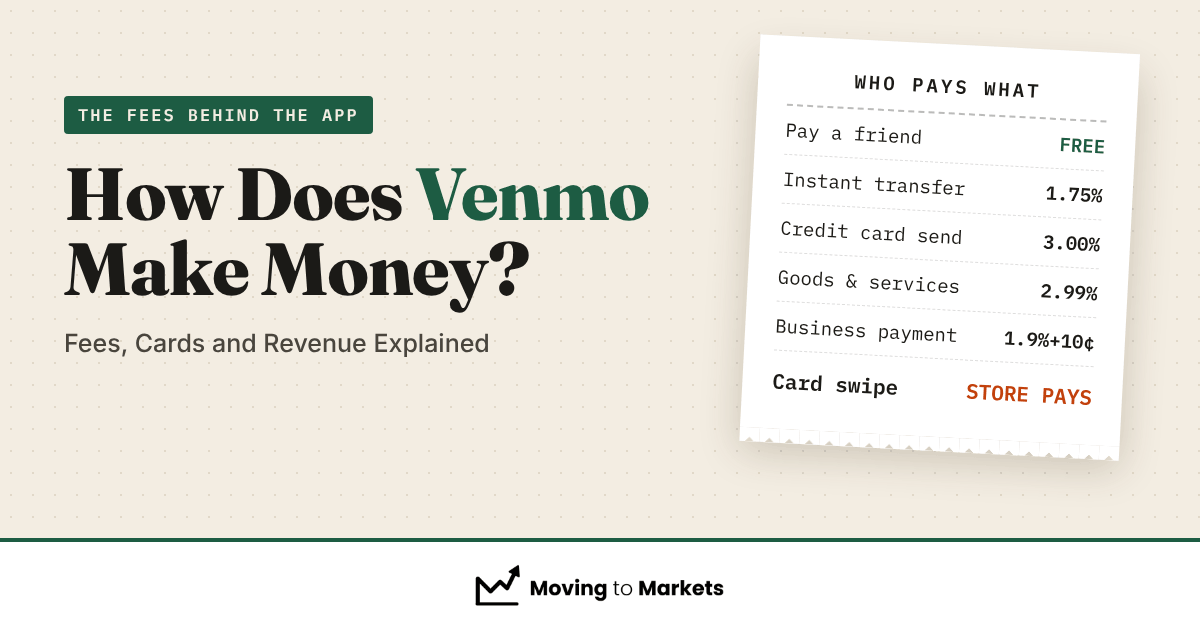
The answer is that Venmo charges for almost everything except the part you use most. Sending money to a friend from your bank or balance is free. Getting that money out fast, paying with a credit card, selling stuff, using the Venmo cards and shopping with Venmo at a store all cost someone a fee. Most of the time that someone is a business, not you.
And it adds up. Venmo moved $96.8 billion in the third quarter of 2026, up 14% from a year earlier, according to PayPal’s results. That’s about one dollar in every five that runs through PayPal. Venmo brought in roughly $1.7 billion in revenue in 2025, up about 20%.
Below is every way Venmo makes money, with the actual fees and what they cost you on real amounts.
Venmo fees at a glance
Here’s what Venmo charges as of November 2026, straight from Venmo’s fee page:
| What you do | What it costs |
|---|---|
| Send money from your balance, bank or debit card | Free |
| Send money with a credit card | 3% |
| Standard transfer to your bank (1 to 3 business days) | Free |
| Instant Transfer to your bank or debit card | 1.75% (min $0.25, max $25) |
| Receive a goods and services payment (personal account) | 2.99%, paid by the seller |
| Receive a payment on a business profile | 1.9% + $0.10 |
| Receive a payment through Tap to Pay (business profile) | 2.29% + $0.09 |
| Receive a payment on a charity profile | 1.9% + $0.10 |
| Cash a payroll or government check in the app | 2% ($6 minimum) |
| Cash any other check in the app | 5% ($6 minimum) |
| Add cash to your Venmo Debit Card at a store | $3.74 |
| ATM withdrawal at a MoneyPass ATM | Free |
| ATM withdrawal out of network, US or abroad | $2.50 |
| Over-the-counter cash withdrawal at a bank | $3.00 |
| Use the Venmo Debit Card outside the US | 2.5% (new since November 4, 2026) |
| Send money to a PayPal user outside the US | 5% (min $0.99, max $4.99), plus 3% if paid by credit card |
| Buy or sell crypto | 1.5% to 2.2% depending on amount |
If you only ever send money to friends from your bank and wait a day or two for transfers, Venmo makes nothing directly from you. Everything else on that list is where the money comes from.
1. Instant Transfer fees
This is the fee most Venmo users actually pay. When money lands in your Venmo balance you have two choices: move it to your bank for free and wait 1 to 3 business days, or pay 1.75% and get it in about 30 minutes.
Here’s what that looks like on real numbers:
- $10 transfer: you pay the $0.25 minimum
- $100 transfer: $1.75
- $500 transfer: $8.75
- $1,000 transfer: $17.50
- $2,000 transfer: $25, because the fee stops growing at about $1,429
People pay it because they need rent money today, not Wednesday. Venmo knows that. The fee used to be 1% and then 1.5%, and Venmo raised it to 1.75% with a $25 cap in 2022. A lot of articles online still list the old rates, so don’t trust a fee chart that doesn’t say when it was checked.
2. Credit card fees on payments
Venmo lets you send money with a credit card, but it charges you 3% to do it. Card networks charge Venmo a fee every time a credit card gets used, and Venmo passes that cost to you with a little on top.
So if you pay your friend back $60 for concert tickets with your credit card, you pay $61.80. If you use your debit card or bank account, you pay $60. Unless you’re chasing card points or you’re out of cash until payday, there’s no good reason to pay that 3%.
3. Goods and services and business payments
This is where Venmo makes money off sellers instead of you.
Goods and services on a personal account. When someone pays you for something, like a used bike on Facebook Marketplace or a pair of concert tickets, they’re supposed to mark it as goods and services. You, the seller, pay 2.99%. Sell a $100 bike and you get $97.01. The buyer gets purchase protection in return, which friends and family payments don’t have.
Business profiles. Small sellers like dog walkers, hairstylists and food trucks can set up a free Venmo business profile. Each payment they get costs them 1.9% plus 10 cents. A $40 haircut costs the stylist $0.86. Business profile payments through Tap to Pay, where the customer taps a card or phone on the seller’s phone, cost 2.29% plus 9 cents, so about $1.01 on that same $40.
Charity profiles pay the same 1.9% plus 10 cents.
These payments matter for taxes too. Venmo sends a Form 1099-K to sellers who get more than $20,000 across more than 200 goods and services payments in a year. That’s the federal threshold after the One Big Beautiful Bill Act of 2025 set it back to the old level, as CPA Practice Advisor reported. Some states use lower thresholds. Friends and family payments don’t count toward the limit, but you’re not supposed to mark sales as friends and family to dodge the fee. Venmo can flag or limit your account if you do.
4. Pay with Venmo at online stores
You’ve probably seen the Venmo button at checkout on sites like Amazon, DoorDash and Uber. When you pay that way, you pay nothing extra. The store pays Venmo a processing fee instead, much like it would pay Visa or Mastercard.
This is one of Venmo’s fastest growing businesses. Pay with Venmo volume jumped 43% in the third quarter of 2026 compared to a year before, PayPal said on its earnings call. Venmo has also added the button to travel sites, college tuition payments and prediction market apps this year.
For Venmo, this is the better kind of payment. A $14 pizza split earns Venmo zero. A $14 DoorDash order paid with Venmo earns it a merchant fee.
5. The Venmo Debit Card
The Venmo Debit Card is a Mastercard tied to your Venmo balance. It’s free to get and free to use at stores. Venmo makes money on it in two ways.
Interchange. Every time you swipe the card, the store’s payment processor pays a small fee to the bank behind the card, and Venmo gets a share. You never see this fee. The store does.
Card fees. The $2.50 out-of-network ATM fee, $3 over-the-counter withdrawal fee, $3.74 cash reload fee and, since November 4, 2026, a 2.5% fee on purchases and withdrawals outside the US. Spend $400 on a trip to Cancun and that’s $10 in fees.
The debit card is the part of Venmo PayPal is pushing hardest right now. Venmo Debit Card monthly active accounts hit 6.7 million in the third quarter of 2026, up more than 55% from a year earlier, and 1.6 million people used it for the first time in that quarter alone. Spending on the card grew more than 60%.
Here’s why PayPal cares so much. A Venmo user with the debit card brings in five to six times more revenue than someone who only sends money to friends, according to PayPal’s third quarter commentary.
6. The Venmo Credit Card
The Venmo Credit Card is a Visa issued by Synchrony Bank. It has no annual fee and no foreign transaction fee. It makes money the way every credit card does:
- Interest. Purchase APRs run from prime plus 11.99% to prime plus 23.99%, depending on your account. Carry a balance and Synchrony collects the interest, then shares card revenue with Venmo under their partnership.
- Fees. Late payments and returned payments cost up to $41 each. Cash advances cost $10 or 5%, whichever is more.
- Interchange from stores, same as the debit card.
PayPal relaunched the card this year with rewards for splitting purchases with friends, which pushes you to put group dinners on the Venmo card instead of your regular one.
7. Interest on the money you leave in Venmo
This one doesn’t show up on any fee chart. When you leave $300 sitting in your Venmo balance, that money doesn’t earn you anything. But PayPal holds customer balances in bank accounts and investments that do earn interest, and PayPal keeps it.
PayPal earned $274 million in interest on customer balances in the first quarter of 2026 alone, according to its SEC filing. That figure covers both PayPal and Venmo, and PayPal doesn’t split out Venmo’s share. Still, with millions of people leaving a few hundred dollars in their Venmo account between payments, it’s real money for the company.
8. Crypto, check cashing and other smaller fees
Crypto. You can buy and sell Bitcoin, Ethereum and a few other coins in Venmo. The fee depends on the amount: 2.2% on $1 to $74.99, 2% on $75 to $200, 1.8% on $200.01 to $1,000, and 1.5% on larger trades. Buy $50 of Bitcoin and you pay $1.10. Venmo also earns a spread between the buy and sell price.
Check cashing. You can snap a photo of a check and get the money in minutes. Payroll and government checks with a pre-printed signature cost 2%, so a $1,000 paycheck costs you $20. Personal checks and other types cost 5%. Both have a $6 minimum, so cashing a $50 check from your grandma costs $6, not $2.50. Or you can wait for the free option, which takes longer.
International sends. Since March 2026, Venmo users can send money to PayPal users in other countries. It costs 5% with a $0.99 minimum and a $4.99 cap, plus 3% if you pay by credit card. Venmo waived this fee at launch and the waiver ended in August.
How much money Venmo actually makes
PayPal owns Venmo and doesn’t publish a full profit and loss statement for it. Here’s what it does report:
| Figure | Number |
|---|---|
| Venmo payment volume, Q3 2026 | $96.8 billion (up 14%) |
| Venmo’s share of PayPal’s total payment volume | About 20% |
| Venmo revenue, 2025 | About $1.7 billion (up about 20%) |
| Venmo monthly active users, 2025 | About 67 million |
| Venmo Debit Card monthly active accounts, Q3 2026 | 6.7 million (up 55%+) |
| Pay with Venmo volume growth, Q3 2026 | 43% |
| Share of Venmo users using a financial product | 23% |
Do some quick math and $1.7 billion spread over 67 million monthly users comes to about $25 a year per active user. That’s low compared to how much money moves through the app. It’s also why PayPal keeps saying Venmo’s revenue per account is the number it wants to grow.
That last row tells the story. Only 23% of Venmo users use anything beyond basic payments, PayPal CEO Enrique Lores said on the third quarter 2026 earnings call. The other 77% mostly send free payments to friends. Venmo’s whole plan for the next few years is to move more of those people onto the debit card, Pay with Venmo and the credit card, where the money is.
Is Venmo profitable?
Nobody outside PayPal knows for sure, because PayPal doesn’t report Venmo’s profit on its own. Back in 2019, reports said Venmo was not profitable yet. Since then revenue has grown from under $400 million a year to about $1.7 billion, and PayPal says Venmo’s revenue per user grew at a double-digit rate in 2026. That growth puts Venmo in much better shape than in 2019, but PayPal has never published a Venmo profit number. Treat any article that says “Venmo made X in profit” with suspicion unless it links to a PayPal filing.
How to use Venmo without paying any fees
You can use Venmo for years and never pay a fee if you stick to these rules:
- Pay from your bank account, debit card or Venmo balance. Never a credit card.
- Use standard transfer. Plan a few days ahead for rent and bills.
- Use MoneyPass ATMs with the Venmo Debit Card. There are tens of thousands of them across the US.
- Mark payments correctly. Friends and family for splitting dinner. Goods and services when you’re buying from a stranger and want protection. The 2.99% fee falls on the seller, not you.
- Skip the check cashing feature unless you really need the cash today.
- Use another card abroad. The new 2.5% foreign transaction fee makes the Venmo Debit Card a bad travel card. The Venmo Credit Card has no foreign fee.
Venmo vs Cash App vs Zelle on fees
| Fee | Venmo | Cash App | Zelle |
|---|---|---|---|
| Send to a friend from bank or balance | Free | Free | Free |
| Send with a credit card | 3% | 3% | Not allowed |
| Instant transfer to bank | 1.75% (min $0.25, max $25) | 0.5% to 1.75% (min $0.25) | Free, money moves in minutes |
| Seller or business fee | 1.9% + $0.10 (business), 2.99% (goods and services) | 2.75% (business account) | No fee, no purchase protection |
Zelle is free across the board because banks run it and get their money elsewhere. That’s also why Zelle gives you no purchase protection. Venmo and Cash App both charge for speed and for selling.
A short history of who owns Venmo
Andrew Kortina and Iqram Magdon-Ismail founded Venmo in 2009. They were roommates at the University of Pennsylvania and started it so friends could pay each other back without cash. Braintree, a payments company, bought Venmo in 2012 for $26.2 million. A year later, PayPal (then owned by eBay) bought Braintree for $800 million in cash, and Venmo came with it. PayPal split from eBay in 2015 and has owned Venmo ever since.
A lot of articles say “PayPal bought Venmo in 2013.” That’s close but not quite right. PayPal bought the company that owned Venmo.
FAQ
Is Venmo free? Yes, for sending money to friends from your bank, debit card or balance, and for standard transfers to your bank. You pay when you use a credit card (3%), Instant Transfer (1.75%), check cashing, out-of-network ATMs or the debit card abroad.
Why does Venmo charge 1.75% for Instant Transfer? Because it can. The free option takes 1 to 3 business days, and enough people want the money now that the fee is one of Venmo’s main income sources. The fee is capped at $25.
Does Venmo make money off my balance? Yes, indirectly. Your Venmo balance doesn’t pay you interest, but PayPal earns interest on the customer money it holds. PayPal made $274 million that way in the first quarter of 2026 across PayPal and Venmo.
Who pays the goods and services fee? The seller. If you pay someone $100 for a used guitar and mark it as goods and services, you pay $100 and the seller gets $97.01.
Does Venmo charge to receive money? Not for personal payments from friends. Sellers pay 2.99% on goods and services payments, and business profiles pay 1.9% plus 10 cents.
Who owns Venmo? PayPal Holdings owns Venmo. PayPal got it in 2013 when it bought Braintree.
The bottom line
Venmo gives away the thing you use it for most, sending money to friends, and charges for speed, credit cards, selling and spending. Every time you hit Instant Transfer, tap the Venmo card at a store or pay with the Venmo button at checkout, someone pays a small fee. With nearly $100 billion moving through the app every quarter, those small fees came to about $1.7 billion last year.