We all know that one friend from college who wore a suit to a 9 a.m. class, had a stack of Excel shortcuts taped to their laptop and kept saying “I’ve got a superday on Friday.” That friend wanted to be an investment banker, and they started planning it before most people picked a major.
If you are reading this, maybe you’re that friend, or you want to be. The path is pretty set, but it starts earlier than you think and the odds are tight. Goldman Sachs took under 1% of its intern applicants in 2026, the third year in a row below 1%.
The short answer: to become an investment banker in the US, earn a bachelor’s degree in finance, economics or accounting, land an investment banking internship the summer before senior year, convert it into a full-time analyst offer, then pass FINRA’s SIE and Series 79 exams once the bank sponsors you. Most analysts start at 22, and making managing director takes about 10 to 12 more years.
The path at a glance
| Step | When you do it | What it costs you |
|---|---|---|
| Pick a finance-friendly major and keep your GPA up | Freshman year | Tuition |
| Join a finance club and start networking | Freshman and sophomore year | $0 |
| Apply for junior-year summer internships | Fall of sophomore year (summer 2028 apps opened November 2026) | $0 |
| Take the SIE exam (optional, but it helps) | Any time after you turn 18 | $100 |
| Do the 9 to 10 week summer internship | Summer after junior year | Paid |
| Get a full-time return offer | End of the internship | $0 |
| Pass the Series 79 (and Series 63 if your bank asks) | First months on the job | Usually paid by the bank ($395 + $147) |
| Work as an analyst | Years 1 to 3 | Paid |
What does an investment banker actually do?
An investment banker helps companies raise money and buy or sell businesses. Junior bankers build financial models in Excel, write pitch books in PowerPoint and run due diligence. Senior bankers win clients and negotiate deals. FINRA’s Series 79 covers this work: stock and bond offerings, mergers and acquisitions, tender offers and restructurings.
Say a software company wants to buy a smaller rival for $2 billion. The bankers value the target, figure out how to pay for it (cash, new debt, new stock or a mix), talk to the other side’s bankers and keep the deal on schedule until it closes.
Most banks split the work into two kinds of teams:
- Coverage groups focus on an industry, like healthcare, tech or energy. They know the companies and pitch them ideas.
- Product groups focus on a type of deal: M&A, equity capital markets (IPOs and stock sales), debt capital markets (bonds and loans) or restructuring.
JPMorganChase places its summer analysts in one of three areas: Coverage (Industry), Advisory or Capital Markets.
What degree do you need to become an investment banker?
You need a bachelor’s degree. Finance, economics and accounting are the most common majors, but banks also hire engineering, math and liberal arts students who can show they understand accounting and valuation. The BLS says a bachelor’s is the typical entry requirement and an MBA may help you move up later.
Your major matters less than three things banks look at on your resume:
- GPA. Many large banks screen at a 3.5 or higher. A lower GPA isn’t the end, but you will need a strong internship to make up for it.
- School. “Target schools” are the ones banks recruit at directly, like Penn (Wharton), NYU (Stern), Columbia, Harvard and Michigan (Ross). If you’re not at one, you can still get in. You just need to network harder (more on that below).
- Relevant experience. A wealth management internship, a corporate finance role or a student investment fund all count.
You don’t need the CFA to get in. Some ranking pages make it sound like an entry requirement. It isn’t. The CFA takes years of exams and work experience, and bankers who earn it usually do so later, if at all.
When should you apply for investment banking internships?
Apply in the fall or winter of your sophomore year for the internship the summer after junior year. For summer 2028, JPMorgan opened applications on November 4, 2026, Bank of America on November 5 and Barclays on November 3. Goldman Sachs and Morgan Stanley are expected to open in early January 2027.
This is the part that catches people. You’re applying almost 18 months before you start, and most offers come from that junior-year internship. The full-time job is usually just the return offer.
| Bank | Summer 2028 applications | Source |
|---|---|---|
| Evercore (New York advisory) | Opened September 9, 2026 | Leland, Nov 6, 2026 |
| Barclays | Opened November 3, 2026 | Trackr, Nov 11, 2026 |
| JPMorgan | Opened November 4, 2026 | Trackr, Nov 11, 2026 |
| Bank of America | Opened November 5, 2026 | Trackr, Nov 11, 2026 |
| Deutsche Bank | Expected early December 2026 | Trackr estimate |
| Citi | Expected mid-December 2026 | Trackr estimate |
| Goldman Sachs | Expected early January 2027 | Trackr estimate |
| Morgan Stanley | Expected early January 2027 | Trackr estimate |
| Moelis | Usually December of sophomore year | Leland |
Many banks review applications as they come in, so applying in week one beats applying in week six.
The odds are rough. Goldman Sachs got 315,126 internship applications in 2024 and accepted 0.9%. In 2025 it got more than 360,000 and accepted 0.7%. In 2026 it hired about 2,500 interns and said the rate was under 1% again (Fortune, June 8, 2026). Apply to 30 or 40 banks, not five.
How do you network your way into a bank?
Networking means talking to bankers before you apply so someone inside knows your name. Start with alumni from your school on LinkedIn, ask for 15-minute calls, prepare two or three real questions, and follow up after. Plan on 6 to 12 months of networking before interviews, according to Mergers & Inquisitions.
Here is a simple plan that works for most students:
- Build a list. Find 50 to 100 alumni at banks on LinkedIn or your school’s alumni database. Analysts and associates answer more often than managing directors.
- Send a short email. Three sentences: who you are, why you’re writing to them in particular, and a request for 15 minutes.
- Prepare. Read about their group and one recent deal. Ask what they work on day to day and how they got there.
- Follow up. Send a thank-you the same day. Check in again in a month or two with something specific, like “I read about the deal you mentioned.”
- Ask for a referral. After a good call or two, ask if they’d be comfortable passing your resume to their recruiter.
If you’re at a non-target school, this step is everything. You won’t get a campus visit from Goldman, so the warm intro has to come from you.
What do investment banking interviews ask?
Expect two kinds of questions: behavioral (“Why banking? Walk me through your resume”) and technical (accounting, valuation and deal math). The final round, called a superday, is usually four to six back-to-back interviews in one day. Bankers want to see you can do the work and won’t fall apart at 1 a.m.
The technical topics show up again and again:
- How the three financial statements connect (if depreciation goes up by $10, walk me through it)
- How to value a company: comparable companies, precedent transactions and discounted cash flow (DCF)
- Enterprise value versus equity value
- Basic merger math: is a deal accretive or dilutive?
- A simple leveraged buyout (LBO) for some interviews
For behavioral questions, have three stories ready: a time you worked under pressure, a time you messed up, and a time you led a team. Then have a clear 60-second answer for “Why investment banking?” that mentions something real, like a deal you followed.
Goldman Sachs’ head of human capital management, Jacqueline Arthur, told Fortune in June 2026 that technical skills are common among applicants and the difference is “how you apply those tools.”
Which licenses do investment bankers need?
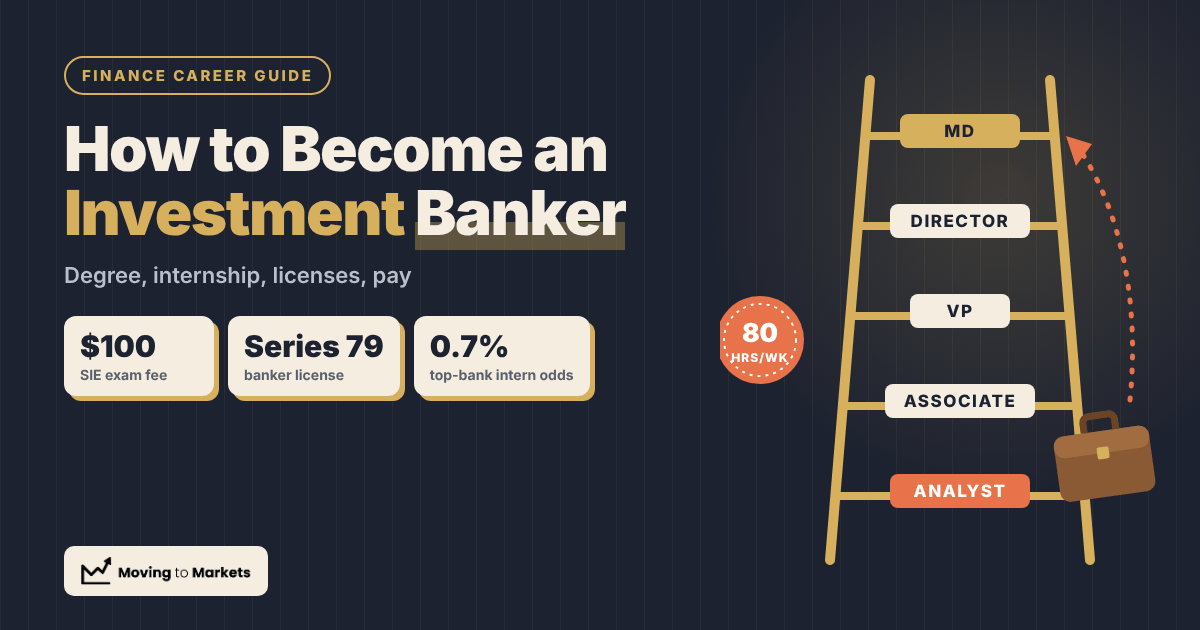
Investment bankers in the US register as Investment Banking Representatives by passing two FINRA exams: the SIE and the Series 79. You can take the SIE on your own at 18 for $100. The Series 79 costs $395 and needs a sponsoring firm, so your bank sets it up after you’re hired.
| Exam | Cost | Questions | Time | Passing score | Need a firm to sponsor you? |
|---|---|---|---|---|---|
| SIE (Securities Industry Essentials) | $100 | 75 | 1 hr 45 min | 70 | No, open to anyone 18+ |
| Series 79 (Investment Banking Representative) | $395 | 75 | 2 hr 30 min | 73 | Yes |
| Series 63 (state law, run for NASAA) | $147 | 60 scored + 5 unscored | 75 min | 43 of 60 | Yes |
| Series 7 (General Securities Representative) | $395 | 125 | 3 hr 45 min | 72 | Yes |
Source: FINRA exam pages, checked November 15, 2026.
A few things most guides get wrong:
- The Series 7 is not the investment banking exam. It’s for people who sell securities, like stockbrokers. FINRA says you’d need the Series 7 (or Series 82) on top of the 79 only if you also market deals directly to investors, like on a road show.
- You can’t just sign up for the Series 79. FINRA requires you to be associated with and sponsored by a member firm. The SIE is the only one you can take as a student.
- Your SIE pass lasts four years. If you pass it at 19, it’s still good when you start full time at 22.
- Some banks also have analysts take the Series 63. It’s a state law exam, and whether you need it depends on your bank and role.
Retake rules are getting easier. Starting January 19, 2027, if you fail a FINRA exam you wait 15 days instead of 30 before trying again after a first or second fail, and 60 days instead of 180 after a third (FINRA Regulatory Notice 26-18). If you leave the industry, your exam credit stays valid for two years (four for the SIE), or up to five years if you join FINRA’s Maintaining Qualifications Program.
How much do investment bankers make?
First-year analysts at large US banks earn a base salary of about $100,000 to $125,000, plus a year-end bonus that brings total pay to roughly $160,000 to $190,000. The BLS median for the broader securities sales agent group is $78,660, which mixes in stockbrokers and bank branch reps, so it undersells banking pay.
Here’s where those numbers come from, since banks don’t post them:
| Measure | Amount | Source |
|---|---|---|
| BLS median, securities, commodities and financial services sales agents | $78,660 (May 2025) | BLS Occupational Outlook Handbook |
| Same group, working in the securities industry | $103,030 | BLS |
| Top 10% of that group | More than $212,880 | BLS |
| First-year analyst base at large banks | $100,000 to $125,000 | Wall Street Careers (Feb 2026), citing Mergers & Inquisitions |
| First-year analyst total pay (median) | About $160,000 | Prospect Rock Partners 2025 report, via College Transitions |
| Group heads (median total pay) | About $1.75 million | Prospect Rock Partners |
| Average 2025 Wall Street bonus, NYC | $246,900 | New York State Comptroller, via InvestmentNews (Mar 27, 2026) |
The BLS doesn’t track investment bankers as their own job. It lumps them into “securities, commodities and financial services sales agents,” which is why ranking pages that quote “$78,000” are off by a lot for anyone at a bank’s IB division.
The bonus is the swing factor. In a good year for deals it’s big, and in a slow year it shrinks. New York’s securities industry paid out a record $49.2 billion in bonuses for 2025, up 9%, across about 198,200 workers.
Money tip if you get there: your first paychecks come with New York rent and taxes, so it goes faster than it looks on paper. Our guide on 401(k) vs Roth 401(k) helps you pick the right account at a high income. How many hours do investment bankers work?
Analysts often work 70 to 80 hours a week, and more during live deals. JPMorgan caps junior bankers at 80 hours a week “in most cases” since September 2024, with live deals exempt. It also protects 6 p.m. Friday to noon Saturday and one full weekend every three months.
The hours got public attention after Leo Lukenas III, a 35-year-old Bank of America investment banker and former Green Beret, died in May 2024. Reports said he had worked several 100-plus hour weeks on a $2 billion deal. After that, Bank of America began requiring US employees to log hours every day, and Goldman Sachs and Morgan Stanley said they would keep tracking hours closely (Fortune and Axios, September 12, 2024).
So yes, it has gotten a bit better. But a “cap” with deal exceptions still means a lot of late nights. If you need predictable evenings, banking will be hard on you for the first two or three years.
How long does it take to become an investment banker?
It takes about four years to get your first analyst job, since most people start right after a bachelor’s degree. Reaching managing director usually takes another 10 to 12 years, moving through analyst, associate, vice president and director. People who join after an MBA skip the analyst years and start as associates.
The ladder at most large US banks looks roughly like this:
| Title | Typical years in the role | What you do |
|---|---|---|
| Analyst | 2 to 3 | Models, pitch books, data, late nights |
| Associate | 3 to 4 | Checks analysts’ work, manages the model and the deal process |
| Vice president | 3 to 4 | Runs the deal day to day, main client contact |
| Director (or SVP) | 2 to 3 | Wins business, manages several deals |
| Managing director | Ongoing | Brings in clients and fees |
These are typical ranges. Fast promotions happen, and plenty of people leave after two years as an analyst for private equity, hedge funds or corporate development.
Can you become an investment banker without a target school or after college?
Yes. Non-target students usually start at boutiques or middle-market banks and move to bigger banks later. Career changers often come in through an MBA, joining as summer associates, or move laterally from Big 4 transaction services, corporate development or commercial banking. Mergers & Inquisitions says the window gets small after 3 to 4 years out of school.
Here are the main side doors:
- Boutique or middle-market banks. Smaller firms that do smaller deals. They hire more non-target students and the work is similar. Two years there can get you a lateral move to a bigger bank.
- MBA route. Work 3 to 5 years, go to a top business school, then recruit for summer associate roles in your first year. This is the most common path for career changers.
- Lateral move. Transaction services at an accounting firm, valuation work or credit analysis at a commercial bank can lead to analyst or associate roles if you network into them.
- A master’s in finance. Some students from non-target schools use a one-year MSF to get a second shot at recruiting.
Is investment banking worth it for you?
It’s worth it if you want fast learning, high pay early and strong exit options to private equity or corporate finance, and you can handle 70 to 80 hour weeks for a few years. It’s a poor fit if you want steady hours, or if the deal work itself doesn’t interest you, because the pay alone won’t carry you.
Ask yourself honestly:
- Do you like the idea of building a model at 11 p.m. if it means you get to see how a $2 billion deal comes together?
- Can you take blunt feedback on a pitch book from someone who’s slept four hours?
- Do you have a plan for year three, like staying for associate or moving to private equity?
If you said yes to most of those, start now. Get your resume in shape, take the SIE for $100, send your first five alumni emails this week and put the November application dates in your calendar.
FAQ
Do you need a license to be an investment banker?
Yes. In the US you register as an Investment Banking Representative by passing FINRA’s SIE and Series 79. Your bank sponsors you for the Series 79 after you’re hired.
Can you take the Series 79 without a job?
No. FINRA requires a sponsoring member firm for the Series 79. The SIE is the only FINRA exam you can take without a firm, at age 18 or older.
Do investment bankers need the Series 7?
Usually not. The Series 79 is the investment banking exam. FINRA says you’d need the Series 7 or 82 only if you also market offerings directly to investors.
How much does a first-year investment banking analyst make?
About $100,000 to $125,000 in base salary at large US banks, with total pay of roughly $160,000 to $190,000 after the bonus. Banks don’t publish exact figures, so these come from industry surveys.
What GPA do you need for investment banking?
Many large banks look for a 3.5 or higher. Boutiques and middle-market banks can be more flexible, especially if you have relevant internships.
When do investment banking internship applications open?
For large US banks, applications for the summer after junior year open in the fall or winter of sophomore year. JPMorgan opened its summer 2028 program on November 4, 2026.
How hard is it to get into investment banking?
Very. Goldman Sachs accepted 0.7% of more than 360,000 internship applicants in 2025 and under 1% in 2026. Apply widely and network early.
Can you become an investment banker at 30?
Yes, usually through an MBA. You’d join as a summer associate during business school and start full time as an associate, skipping the analyst years.