We all know that one drawer in the kitchen. Takeout menus, dead batteries, a birthday card from your aunt and, somewhere under all that, a check for $150 she sent back in March. You find it in November and the first thing you think is: can I still cash this thing?
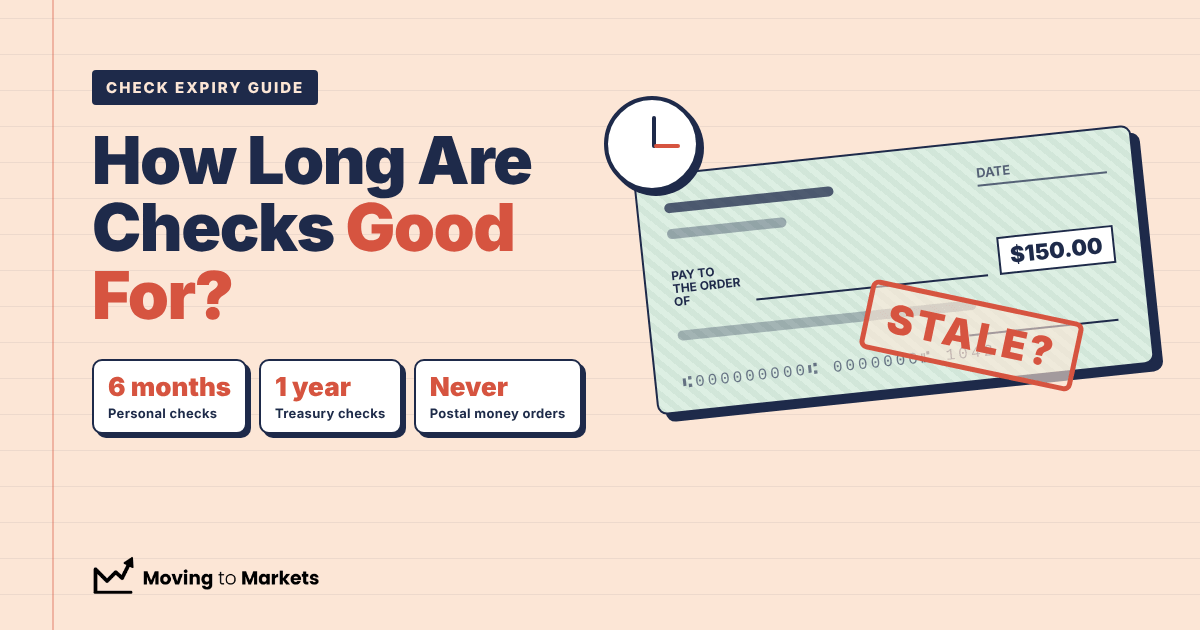
Here’s the short answer. A personal or business check is good for six months. After that, the bank doesn’t have to pay it, but it still can. A US Treasury check is good for one year. Cashier’s checks, certified checks and USPS money orders don’t expire, though the money moves to your state’s unclaimed property office if nobody cashes them for a few years.
Below you will find the rule behind each type of check, what actually happens after the date passes, and what to do if you’re holding an old check or you wrote one that never got cashed.
How long is each type of check good for?
| Check type | How long it’s good for | Where the rule comes from | What happens after |
|---|---|---|---|
| Personal check | 6 months | UCC 4-404 (state law) | Bank can refuse or pay it; ask the writer for a new one |
| Business check | 6 months, or less if printed “void after 90 days” | UCC 4-404 plus the company’s own printed limit | Ask the company to reissue it |
| Payroll check | 6 months at the bank; the wages are still owed | UCC 4-404 and state wage law | Employer reissues it, or it goes to the state after about 1 year |
| Cashier’s check | No legal expiry; some print “void after 90 days” | UCC 3-104, issuing bank’s policy | Issuing bank reissues it; goes to the state after 3 to 7 years |
| Certified check | No expiry; exempt from the six-month rule | UCC 4-404 names it as an exception | Bank pays it; goes to the state after a few years |
| US Treasury check (IRS, SSA, VA) | 1 year from the issue date | 31 USC 3328 | Treasury cancels it, but the agency still owes you |
| State or local government check | Set by the agency, often 6 months to 1 year | State law and the date printed on the check | Contact the agency that sent it |
| USPS money order | Never expires | USPS | Cash it any time at a Post Office |
| Other money orders (Western Union, MoneyGram) | Never expires | Issuer terms | A service charge may come off after 1 to 3 years |
How long is a personal check good for?
A personal check is good for six months, or about 180 days, from the date written on it. After six months, the check becomes “stale dated,” and your bank no longer has to pay it. The rule comes from UCC 4-404, which every state has adopted. It is state law, not federal law.
The exact wording matters here. UCC 4-404 says a bank “is under no obligation” to pay a check, other than a certified check, that someone presents more than six months after its date. Then it adds that the bank “may charge its customer’s account for a payment made thereafter in good faith.”
So two things are true at once:
- Your bank can turn the old check away. If you deposit a seven-month-old check, the writer’s bank may send it back unpaid.
- Your bank can also just pay it. Plenty of old checks go through, because machines read the amount and account number, not the date.
Six months means six calendar months. A check dated May 10 goes stale on November 10.
Does a check really expire after six months?
Not exactly. The money the person owes you doesn’t vanish, only the bank’s duty to honor that piece of paper. If a bank refuses your stale check, the writer still owes you the debt. Ask them for a new check or a transfer through Zelle, Venmo or their bank.
The risk sits with you, the person depositing it. Say you deposit that $150 check from March in November. Your bank may make the money available the next day, and you spend it. A week later the writer’s bank returns it as stale. Your bank takes the $150 back out of your account. If you’ve already spent it, you’re now overdrawn, and at Chase that costs $34 per item and at Wells Fargo $35. Before you deposit anything older than six months, text or call the person who wrote it. Ask if the account is still open and if they’re fine with you cashing it. That one message saves you a returned item and a possible fee.
How long are business and payroll checks good for?
Business checks follow the same six-month rule as personal checks, but many companies print “void after 90 days” or “void after 180 days” on the front. Payroll checks also go stale after six months at the bank, but your employer still owes you the wages and has to reissue the check.
A printed void date is the company’s own limit. It tells the bank “don’t pay this after 90 days,” and most banks respect it. Companies do this so they can clean up their books instead of carrying old uncashed checks for months.
Payroll checks are different, because they’re wages. Under state wage laws, an employer can’t keep your pay just because you forgot to cash a check. If your paycheck is old:
- Ask your HR or payroll team to void it and issue a new one, or pay it by direct deposit.
- If the company won’t reissue it, file a wage claim with your state’s labor department.
- If a year or more has passed, search your state’s unclaimed property site. In most states, including California, Texas, Florida and Ohio, employers must hand over uncashed wages after one year.
How long is a cashier’s check or certified check good for?
A cashier’s check has no legal expiry date, because the bank itself is the one paying it. A certified check is exempt from the six-month rule by name in UCC 4-404. Some banks still print “void after 90 days” on cashier’s checks. If yours does, take it to the issuing bank and ask them to reissue it.
A cashier’s check is a check where the bank is both the writer and the payer (UCC 3-104). The bank took the money from the buyer’s account when it printed the check, so the funds sit with the bank until someone cashes it. That’s why the money doesn’t disappear when a printed date passes.
What happens in real life:
- Within the printed date: cash or deposit it anywhere. See our guide on how to cash a cashier’s check for where to go and how long the hold lasts.
- After a “void after 90 days” date: your own bank may refuse it. The issuing bank can still pay it or reissue it.
- Lost or stolen: UCC 3-312 lets the payee file a declaration of loss with the issuing bank. The claim becomes enforceable 90 days after the date on the check (for a certified check, 90 days after the bank certified it). Until then, the bank can still pay anyone who shows up with the real check.
- After several years: the bank must send the money to the state. That’s 3 years for official bank checks in California and New York, 5 in Florida and Delaware, and 7 in Idaho, North Carolina, Oklahoma and Vermont.
How long are government and Treasury checks good for?
A US Treasury check, the kind the IRS, Social Security and the VA send, is good for one year from the issue date. After 12 months, Treasury cancels it and sends the money back to the agency. The agency still owes you, so contact them for a replacement. State and local government checks set their own limits, usually printed on the front.
The one-year rule is in 31 USC 3328. Treasury “shall not be required to pay” a check unless it’s taken to a bank within 12 months. 31 USC 3334 then cancels those checks and returns the money to the agency that issued them. Both sections say the cancellation doesn’t touch the government’s “underlying obligation.” In plain words: the paper check stops working, but you are still owed the money.
How to get your money back from an old federal check:
- IRS tax refund. The IRS refunds page says that if your uncashed check is more than a year old, it will mail you a new one with a CP32 notice. Start a refund trace with the “Where’s My Refund?” tool, the IRS2Go app, or by calling 800-829-1954. Married couples who filed jointly call 800-829-1040 or mail Form 3911.
- Social Security. Call SSA at 800-772-1213 or visit your local office. SSA’s own rules (POMS GN 02401.903) say it will replace an uncashed check if the payment is still due to you.
- Other agencies (VA, federal pension, vendor payment). Contact the agency that sent the check, not your bank.
One more thing to know. Executive Order 14247, signed March 25, 2025, told Treasury to stop issuing paper checks for federal payments, including tax refunds and benefits, starting September 30, 2025. Exceptions cover people without bank access, some emergency payments, and a few law enforcement cases. When you ask for a replacement, give the agency your bank account details and the new payment will come by direct deposit.
State tax refunds, unemployment checks and city payments follow each agency’s own rules. Read the front of the check. If it says “void after 180 days,” that’s the limit, and the agency’s phone number is usually printed right there.
Do money orders expire?
No. USPS money orders never expire, and you can cash one free at any Post Office. Western Union money orders don’t expire either, but depending on the state where it was bought, a non-refundable service charge can come off the amount if nobody cashes it within one to three years.
Here’s what each issuer says:
| Issuer | Expires? | Fee for an old money order | Max amount |
|---|---|---|---|
| USPS | Never | None | $1,000 per domestic money order |
| Western Union | Never | Service charge after 1 to 3 years, varies by state | Set by the store selling it |
| MoneyGram | Check the back of your money order | Check the terms printed on it | Set by the store selling it |
USPS money orders cost $2.65 for up to $500 and $3.75 for $500.01 to $1,000. If you lose one, USPS charges $23 to replace it. Hang on to the receipt stub, because you need the serial number to file the claim.
Even a money order that “never expires” can end up with your state. Unredeemed money orders usually move to the unclaimed property office after 3 to 7 years, depending on the state.
What does “void after 90 days” mean on a check?
It means the person or company that wrote the check has told its bank not to pay it after 90 days. Most banks follow that instruction. The debt behind the check is still owed, so if you missed the date, ask the writer to reissue it. Don’t try to deposit it and hope.
You’ll see “void after 90 days” most often on business checks, insurance claim checks, rebate checks and some cashier’s checks. A rebate check is the one case where you might really lose out. Many rebate programs say in their terms that an uncashed check is forfeited, so read the fine print before you call.
When does an old check become unclaimed property?
When nobody cashes a check for a set number of years, the bank or company must send the money to the state where the payee lives. This is called escheatment. Payroll checks usually move after one year. Cashier’s checks, money orders and vendor checks usually move after three to five years. The money stays yours, and you can claim it free.
Dormancy periods by state, in years (from NAUPA’s state tables):
| State | Payroll checks | Cashier’s checks and money orders | Vendor checks |
|---|---|---|---|
| California | 1 | 3 (cashier’s checks; money orders differ) | 3 |
| New York | 3 (1 for wages held by the Department of Labor) | 3 | 3 |
| Texas | 1 | Set by state law, check the Comptroller’s site | 3 |
| Florida | 1 | 5 | 5 |
| Delaware | 5 | 5 | 5 |
A few other examples: payroll checks go to the state after 2 years in Pennsylvania and 3 years in Maryland, Massachusetts and Missouri. North Dakota splits bank checks in two, 2 years for cashier’s checks and 7 for money orders.
Read Also: Is Weekly or Biweekly Pay Better? The Real Math for Your Paycheck
NAUPA, the group of state unclaimed property offices, says about 1 in 7 people have unclaimed money waiting. Most states share one free search site, MissingMoney.com. California’s State Controller says there is no deadline to claim money once the state has it, and New York says the same: no fee and no time limit.
Never pay a company to find your unclaimed money. The state search is free.
What should you do with an old check you received?
Look at the date and the type of check first. If a personal or business check is under six months old, deposit it. If it’s older, contact the writer before you deposit it. For a Treasury check over a year old, call the agency that sent it. For a cashier’s check, call the issuing bank.
Step by step:
- Check the date. Count six months for personal and business checks, one year for Treasury checks.
- Look for printed limits. “Void after 90 days” or “void after 180 days” overrides the general rule.
- Contact the writer. Ask if they want to reissue it or send the money another way. For a company, call the number on the check.
- If they say go ahead, deposit it with a teller, not at an ATM or through a mobile app. A teller can tell you right away if the bank will take it.
- Keep the money untouched for a week or two. A stale check can come back days after the funds show up.
- If the writer won’t pay, remember they still owe you the debt. Small claims court is an option for larger amounts.
- If years have passed, search MissingMoney.com and your state’s unclaimed property site.
What if you wrote a check that was never cashed?
The money stays in your account until someone cashes the check, and a bank can still pay it after six months. If you don’t want an old check cashed, place a stop payment order. A stop payment lasts six months, and you have to renew it in writing to keep it going.
Most guides skip this side, and it’s the one that costs people money. You write a $600 check to a contractor in January, forget about it, and your balance looks like you have $600 extra. In September the contractor finally deposits it, the bank pays it in good faith, and your account goes negative.
What to do:
- Track every check you write until it clears. Your bank’s app shows which check numbers have been paid.
- Contact the payee after 30 to 60 days. They may have lost it.
- Place a stop payment before you send a replacement, or you could pay twice. Under UCC 4-403, a stop payment order lasts six months. An oral order lapses after 14 days unless you confirm it in writing. You can renew it for another six months, in writing, before it runs out. Banks usually charge a fee for this; check your fee schedule.
- Check your statements every month. UCC 4-406 gives you one year from the statement date to report a forged signature or altered check. After that, you can’t make the bank cover it.
- If the payee never cashes it, your bank or your state may treat the money as yours after the dormancy period. For a business, uncashed vendor and payroll checks have to be reported to the state.
Can you deposit a postdated check early?
Yes, in most cases the bank can pay a postdated check before the date written on it. UCC 4-401 lets the bank pay early unless the writer gave the bank notice of the postdating. If you write a postdated check, tell your bank in writing, or the money could leave your account early.
A postdated check is the opposite of a stale one. The date on it is in the future. Banks process checks by machine, so the date often goes unchecked. The writer’s notice to the bank works like a stop payment and lasts six months under the same 4-403 rules.
Frequently asked questions
How long is a check good for?
Six months for personal and business checks, one year for US Treasury checks. Cashier’s checks, certified checks and USPS money orders don’t expire, but the money goes to the state after a few years if nobody cashes them.
Can I cash a check that is 7 months old?
Maybe. The bank can refuse it after six months, but it may also pay it. Call the person who wrote it first, so you don’t get hit with a returned deposit later.
Is the six-month check rule federal law?
No. It comes from UCC 4-404, which each state adopts. There is no federal law that sets an expiry for personal checks.
How long is a cashier’s check good for?
There’s no legal expiry, because the bank is the one paying it. Some print “void after 90 days.” After that date, take it to the issuing bank to cash or reissue it.
How long is a payroll check good for?
Six months at the bank, but your employer still owes the wages. Ask payroll to reissue it. After about one year, most states require the employer to send the money to the state.
Do IRS refund checks expire?
They stop working after one year. The IRS says that if your uncashed refund check is more than a year old, it will mail a new one with a CP32 notice. Call 800-829-1954 or use the refund tracker to start.
Do USPS money orders expire?
No. USPS money orders never expire and you can cash them free at a Post Office.
What happens if I deposit an expired check?
The writer’s bank may return it unpaid. Your bank then takes the money back out of your account, and you could owe an overdraft fee if you’ve already spent it.
Can I still get money from a really old check?
Usually yes. Ask the writer or agency to reissue it, or search MissingMoney.com and your state’s unclaimed property site. Claiming from the state is free.
How long does a stop payment last?
Six months under UCC 4-403. An oral request lapses after 14 days unless you confirm it in writing. You can renew it in writing for another six months.