We all know someone who got turned down for a credit card and then got told, in the same breath, to “go build some credit.” With what? Every card wants a score, and you can’t get a score without a card. A lot of people end up opening Chime for the free checking and then notice the credit card sitting right there in the app, with no credit check and no annual fee.
That card used to be called the Chime Credit Builder Secured Visa. Chime now calls it the Chime Card, and a few things changed along the way, mainly the cash back. The reviews online haven’t caught up. Some say it pays nothing, some say 1.5%, some say 5%.
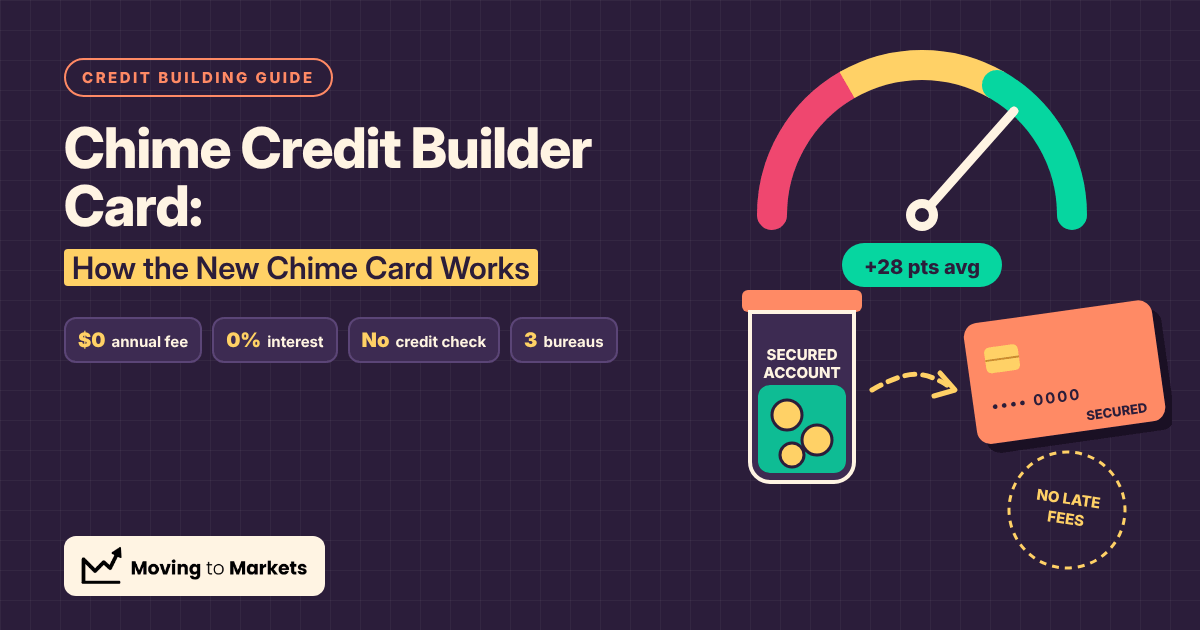
The short answer: the Chime Credit Builder card is now the Chime Card, a secured Visa credit card with no annual fee, no interest and no credit check. You need a Chime Checking account, and your spending limit is whatever money you move into it. It reports to Experian, Equifax and TransUnion, and it pays 2% or 5% cash back only if you get qualifying direct deposits into Chime.
Chime Card at a glance
| Chime Card (formerly Chime Credit Builder) | |
|---|---|
| Card type | Secured Visa credit card |
| Issued by | The Bancorp Bank, N.A. or Stride Bank, N.A. (check the back of your card) |
| Annual fee | $0 |
| Interest (APR) | None |
| Credit check to apply | None |
| Minimum deposit | None |
| Credit limit | No set limit; you can spend what’s in your Secured Deposit Account |
| Credit bureaus | Experian, Equifax and TransUnion |
| Cash back | 5% with Chime Prime, 2% with Chime Plus, on one category you pick each month, up to $1,500 in purchases. None without either status |
| Late fee | None |
| Foreign transaction fee | None, per Chime’s FAQ |
| What you need | A Chime Checking account |
What happened to the Chime Credit Builder card?
Chime replaced the Credit Builder card with the Chime Card. New members can only open the Chime Card now, and Chime’s help center calls Credit Builder a legacy product. If you already have Credit Builder, you can upgrade in the app, but once you switch you can’t go back to the old card.
The way it works is the same as before. You still move money into a secured account, spend against it and pay it off. The big change is cash back. In 2025 Chime added 1.5% cash back on rotating categories. In April 2026 it launched a new top tier called Chime Prime and changed the rewards to what you see today: 2% or 5% on a category you choose.
You’ll also see the card called the “Secured Chime Visa Credit Card” in Chime’s legal terms. Same card.
If you’re upgrading from Credit Builder, the switch doesn’t need a new credit check. Chime asks you to confirm your name, address and Social Security number and says this won’t affect your score. Activate the new card fast: Chime’s rewards terms say upgraders need to activate within 30 days of it being mailed to keep the 5% rate.
How does the Chime Card work?
You put money into a Secured Deposit Account linked to your Chime Checking. That balance is your spending limit. You swipe the card like any credit card, Chime sends a monthly statement and reports your payments to all three credit bureaus, and you pay the bill with the money already set aside.
Here’s the cycle step by step:
- Open Chime Checking and the Chime Card. There’s no credit check and no minimum deposit.
- Move money in. Money you add to Chime Checking moves into your Secured Deposit Account automatically, and you can also move it manually. Chime lets you add money by direct deposit, debit card transfer, Apple Pay, PayPal or Venmo, or cash at retail locations.
- Spend. Your “Available” amount in the app is your limit. If you have $300 in the secured account, you can spend $300.
- Get your statement. Chime says statements are ready by the 28th of each month.
- Pay by the 23rd of the next month. You can turn on Safer Credit Building, which pays your statement automatically from the secured account on the due date, or pay it yourself in the app.
- Chime reports to the bureaus. Your payment, payment date and highest balance go to Experian, Equifax and TransUnion each month.
There is no interest at all, so you never get charged for carrying a balance. The money is already sitting there. That’s the whole trick of the card: it works almost like a debit card for you, but it shows up as a credit card on your credit report.
If you’re still fuzzy on how a credit card and a debit card differ in the first place, our guide to debit vs credit card covers it.
What do you need to get a Chime Card?
You need a Chime Checking account, a Social Security number and a US address. Chime does not check your credit and doesn’t ask for a minimum deposit or a minimum score. Direct deposit is not required to open the card, but you need it to earn any cash back.
Chime’s card disclosure says: to apply for a Chime Card, you must also open a Chime Checking Account. That’s the only hard rule on the card itself.
Some review sites, Bankrate among them, still say you need a $200 direct deposit to apply. That was the rule for the old Credit Builder card. On the current Chime Card, the direct deposit rules decide your membership tier, and the tier decides your cash back and perks.
How much cash back can you earn with the Chime Card?
Chime Prime members earn 5% and Chime Plus members earn 2% on one spending category they pick each month, on up to $1,500 in purchases. That caps cash back at $75 a month for Prime and $30 a month for Plus. Members with neither status earn nothing on the card.
Here’s what each tier takes, from Chime’s Membership Tiers terms:
| Tier | What you need in the last 34 days | Cash back on your chosen category | Most you can earn a month |
|---|---|---|---|
| Chime (no tier) | No qualifying direct deposit | 0% | $0 |
| Chime Plus | One qualifying direct deposit of $200 or more, or $400 or more in total | 2% | $30 |
| Chime Prime | $3,000 or more in qualifying direct deposits in total | 5% | $75 |
You pick one category in the app each month. NerdWallet lists the six options as grocery stores, gas, restaurants, taxi and rideshare, travel, and monthly bills. Your pick resets on the 1st of each month, according to Chime’s rewards terms, so set a reminder to choose again. Cash back lands in your Secured Deposit Account, usually within nine days after the purchase settles.
Now the real numbers. Say you spend $400 a month on groceries with the card:
- Chime Plus (2%): $8 a month, or $96 a year
- Chime Prime (5%): $20 a month, or $240 a year
- No tier: $0
What counts as a “qualifying direct deposit” matters a lot here. Chime counts paychecks from an employer or payroll company, gig app payouts, and government benefits. It doesn’t count PayPal, Cash App or Venmo transfers, bank transfers, mobile check deposits, cash deposits, or one-time deposits like a tax refund.
So if you get paid $1,100 every two weeks, you’ll be at Chime Plus most months and you’ll hit Prime only when three paychecks land within 34 days. If you’re paid in cash or through Venmo, you won’t earn anything on this card.
Purchases on your Chime debit card don’t earn this cash back. Neither do cash advances, gift cards, fees or disputed charges.
Does the Chime Credit Builder card really build credit?
Yes, if you pay on time. Chime reports to all three bureaus, so your on-time payments build a payment history that FICO counts. In the Experian study Chime cites, the average member gained 28 FICO 8 points, and the top 10% gained 71 points after about eight months.
Chime advertises “up to 70 points” on its product page. Read the footnote. The study, done by Experian in September 2025, looked at members whose first purchase with Credit Builder happened between April and August 2024. The top 10% of those members saw a 71-point increase in their FICO Score 8 after about eight months. The average across everyone was 28 points. Chime also says score improvement isn’t guaranteed.
You may still see “an average 30-point increase” on older pages like GOBankingRates. That number came from Chime’s 2020 beta of the card.
Here’s what Chime reports and what it doesn’t:
| Reported to the bureaus | Not reported |
|---|---|
| Payment amount and payment date | Credit utilization |
| Payment status and any amount past due | A credit limit |
| Highest balance and current statement balance | |
| How long you’ve had the card |
The utilization part is a big deal for how fast your score moves. On a regular card, using 80% of a $500 limit hurts your score even if you pay in full. On the Chime Card that can’t happen, because there’s no limit to compare your balance against. The flip side: this card can’t help lower your overall utilization either. If you also carry a balance on another card, the Chime Card won’t water it down the way a high-limit card would.
Payment history makes up 35% of a FICO score, and that’s where this card helps you. If you have no credit file at all, it takes about six months of reported history to get your first FICO score.
Chime also offers rent reporting through a partner called Boom, which can add your rent payments to your credit file at two of the three bureaus. That’s separate from the card and optional.
When is the Chime Card payment due, and what if you miss it?
Chime statements are ready by the 28th of each month and the payment is due on the 23rd of the next month. Chime charges no late fee and no interest. If the statement is still unpaid 24 days after the due date, Chime pauses your card until you pay.
No late fee sounds great, but a missed payment can still hurt you. Chime reports the amount past due and your payment status to the bureaus. A payment that ends up 30 or more days late can show on your credit report for seven years, and that one mark can undo months of good history.
The simple fix: turn on Safer Credit Building. It pays the statement from your secured account on the due date, so as long as the money is there, you can’t miss a payment.
On a regular credit card, timing your payment around the statement date changes the balance the bureaus see. On the Chime Card it matters less, because Chime doesn’t report utilization and doesn’t charge interest.
What fees does the Chime Card charge?
The Chime Card has no annual fee, no interest, no late fee, no minimum deposit fee and no foreign transaction fee. You can pay $2.50 for an out-of-network ATM withdrawal and $50 plus tax if you want the optional titanium metal card.
| Fee | Cost |
|---|---|
| Annual fee | $0 |
| Interest | None |
| Late fee | $0 |
| Foreign transaction fee | $0 (Chime’s FAQ says no international fees) |
| In-network ATM (47,000+ ATMs) | $0 |
| Out-of-network ATM | $2.50, and the ATM owner may add its own fee |
| Over-the-counter cash advance at a bank | Fees may apply, per Chime’s disclosures |
| Titanium card (optional) | $50 plus tax. Black and Evergreen are free |
Compare that with a fee-heavy card for bad credit. The Destiny Mastercard charges $75 to $250 in the first year and 35.9% APR, as we found in our Destiny credit card review. On the Chime Card, you can spend a full year without paying a dollar.
Chime Card pros and cons
Pros
- No credit check, no annual fee, no interest and no late fees
- No minimum deposit; start with $20 if that’s what you have
- Reports to all three credit bureaus
- High-balance months don’t hurt your score, since utilization isn’t reported
- Up to 5% cash back if you have the direct deposits for it
- Autopay from the secured account makes a missed payment unlikely
Cons
- You must bank with Chime; you can’t open it alone
- No cash back at all without qualifying direct deposits
- Cash back caps out at $1,500 in purchases a month
- No path to an unsecured card. Chime says there’s no current upgrade option
- It can’t lower your overall utilization if you carry balances on other cards
- Closing the card can affect your score, and Chime says a closed Chime Card can’t be reopened
Chime Card vs other secured cards
The Chime Card is cheaper and easier to get than most secured cards, but traditional secured cards from Discover and Capital One report a credit limit and can move you to an unsecured card. Pick Chime if you want zero credit check and zero fees, and pick a bank secured card if you want a path to a regular card.
| Chime Card | Discover it Secured | Capital One Platinum Secured | |
|---|---|---|---|
| Credit check | None | Yes | Yes |
| Deposit | None required; your balance is your limit | $200 minimum, up to $2,500 | $49, $99 or $200 for a $200 limit |
| Annual fee | $0 | $0 | $0 |
| APR | None | 22.99% variable | 29.24% variable |
| Rewards | 2% or 5% on one category, needs direct deposit | 2% at gas stations and restaurants (up to $1,000 a quarter), 1% everything else | None |
| Reports a credit limit | No | Yes | Yes |
| Moves to unsecured card | No | Automatic reviews starting at 8 months | Line increases based on payment history |
Discover and Capital One figures come from their own pages, checked November 14, 2026. APRs are variable and change with the prime rate.
A lot of people use both. They open the Chime Card first because it’s instant and free, and then add a secured or starter card from a bank six to twelve months later, once they have a score. The second card gives you a reported credit limit and a way to graduate.
Who should get the Chime Card?
Get the Chime Card if you already bank with Chime or are happy to, you have no credit or bad credit, and you want to build a payment history without any chance of paying interest. Skip it if you don’t want to move your paycheck, or you want a card that turns unsecured later.
Good fit:
- You have no credit history and want a first card with no credit check
- Your score took a hit and you’ve been declined for secured cards
- You’ve paid credit card interest before and never want to again
- Your paycheck already goes to Chime, so the cash back is free money
Not a good fit:
- You want to keep your main bank and don’t want another checking account
- You’re paid in cash or by Venmo, so you’d get no rewards
- You want to graduate to a regular credit card on the same account
- You need a big credit line for a large purchase or for travel holds
How to apply for the Chime Card
Open a Chime Checking account in the Chime app or on chime.com, then pick the Chime Card, confirm your details and accept the terms. Chime gives you a virtual card right away, and the plastic card arrives in 7 to 10 business days.
- Download the Chime app or go to chime.com and open a Chime Checking account.
- In the app, find the Chime Card under “Discover more.”
- Choose a card color. Black and Evergreen are free, the titanium card costs $50 plus tax.
- Confirm your name and address and enter your Social Security number. Chime doesn’t run a credit check.
- Read and accept the terms.
- Set up direct deposit from your employer if you want cash back.
- Move money into your Secured Deposit Account and turn on Safer Credit Building.
- Activate the physical card in the app, by scanning the QR code on the envelope, or by calling 1-844-244-6363.
Then put one small regular bill on it, like your phone plan or a streaming subscription, and let autopay handle it. That’s enough to build a payment history.
Frequently asked questions
Is the Chime Credit Builder card still available?
No, not under that name. Chime replaced it with the Chime Card, and new members can only open the Chime Card. If you already have Credit Builder, it still works, and you can upgrade to the Chime Card in the app.
Does the Chime Card do a credit check?
No. Chime doesn’t run a hard or soft credit check to open the Chime Card. It asks for your Social Security number to confirm your identity, and Chime says that doesn’t affect your credit score.
Do you need direct deposit for the Chime Card?
Not to open it. You only need a Chime Checking account. You do need qualifying direct deposits to earn cash back: one $200 deposit or $400 in total within 34 days for 2%, and $3,000 in total within 34 days for 5%.
Which credit bureaus does Chime report to?
Chime reports to all three major bureaus: Experian, Equifax and TransUnion. It reports your payment amount, payment date, highest balance, statement balance and account age every month. It does not report utilization.
How fast does the Chime Card build credit?
In the Experian study Chime cites, the average member gained 28 FICO 8 points and the top 10% gained 71 points after about eight months. If you have no credit file, expect your first FICO score after about six months of reported payments.
What is the Chime Card credit limit?
There isn’t a set limit. You can spend whatever you’ve moved into your Secured Deposit Account. If you have $250 in the account, your limit is $250.
Does Chime charge a late fee?
No. Chime charges no late fee and no interest. If your statement is still unpaid 24 days after the due date, Chime pauses the card until you pay, and a late payment can still be reported to the bureaus.
Is Chime a legit company?
Yes. Chime is a financial technology company, and its cards are issued by The Bancorp Bank, N.A. or Stride Bank, N.A., both FDIC member banks. In May 2024 the CFPB ordered Chime to pay a $3.25 million penalty and $1.3 million in refunds for delaying refunds to people who closed their accounts.
The Chime Credit Builder card, now the Chime Card, is one of the cheapest ways to start a credit history in the US. No fee, no interest, no credit check. It builds payment history at all three bureaus, and if your paycheck already goes to Chime, the 2% or 5% cash back is a nice extra.
It has limits. It won’t turn into an unsecured card, it doesn’t report a credit limit, and the rewards disappear without direct deposit.