We all know someone who got the ambulance bill before they even got the stitches out. You call 911, or someone calls for you, and nobody in the back of that rig is asking which insurance you have. Three weeks later the envelope shows up. $1,800. $2,400. Sometimes way more if it was a helicopter.
Yes, almost every health plan covers ambulance rides that are medically necessary, and so do Medicare and Medicaid. You still pay your deductible and coinsurance. The bigger risk is a ground ambulance that’s out of network: federal law protects you from surprise bills for air ambulances, not ground ones, so in about half the states the company can bill you for the rest.
Does health insurance pay for an ambulance ride?
Yes. Every ACA-compliant health plan has to cover emergency services, and plans cover ambulance transport when your condition makes any other ride unsafe. You pay your normal cost sharing: deductible, then copay or coinsurance. Non-emergency rides usually need a doctor’s order and sometimes prior approval. Rides for convenience aren’t covered.
“Medically necessary” is the phrase that decides your claim. Insurers ask one question: could you have gone by car or taxi without putting your health at risk? Chest pain, a bad car crash, a stroke, a seizure, heavy bleeding: covered. A sprained ankle when your friend could’ve driven you: the plan may deny it, and you’ll owe the whole bill.
What you’ll see in most plan documents:
| Situation | Usually covered? | What you need |
|---|---|---|
| 911 emergency to the ER | Yes | Nothing in advance |
| Transfer between hospitals | Yes, if the first hospital can’t treat you | Doctor’s order |
| Scheduled ride (dialysis, rehab) | Sometimes | Doctor’s order, often prior authorization |
| Air ambulance | Yes, if ground transport is too slow or can’t reach you | Medical necessity |
| Ride home from the hospital | Rarely | Proof you can’t travel any other way |
| You called 911 but refused the ride | Depends on the plan | Some services bill for treatment on scene |
If you have an HSA-eligible plan, ambulance bills count toward your deductible and you can pay them with HSA money. Unused HSA money carries over, which we explain in does HSA roll over.
How much does an ambulance ride cost?
A ground ambulance ride usually costs $1,000 to $2,500 before insurance, depending on your state and how much care you need on the way. GoodRx lists 2026 average base rates of $1,179 for basic life support and $1,451 for advanced life support. Air ambulance charges are far higher: GAO found a 2017 median of $36,400 for a helicopter.
Ambulance bills have two parts. You pay a base rate for the level of care, then a charge for every mile with you on board (“loaded miles”). Oxygen, supplies and drugs can show up as extra lines.
| Type of ride | Typical charge | Source |
|---|---|---|
| Basic life support (BLS) ground | $1,179 average list price, $430 to $2,822 by state | GoodRx, July 2026 |
| Advanced life support (ALS) ground | $1,451 average list price, $607 to $3,406 by state | GoodRx, July 2026 |
| Average commercial ground ambulance bill | $1,093 | Commonwealth Fund, 2021 data |
| Helicopter air ambulance | $36,400 median charge | GAO, 2017 data |
| Fixed-wing air ambulance | $40,600 median charge | GAO, 2017 data |
Prices keep climbing. Elevance Health’s Public Policy Institute looked at commercial claims from 2012 through September 2025 and found ground ambulance charges rose 30% faster than medical inflation over that stretch, and 9% since 2022 alone. What insurers actually paid barely moved (3% to 6% above inflation). That gap is the part that can land on you.
California sits at the top of every list. GoodRx puts its ALS base rate at $3,406, and Elevance found about 89% of California rides were out of network.
What will I owe after insurance?
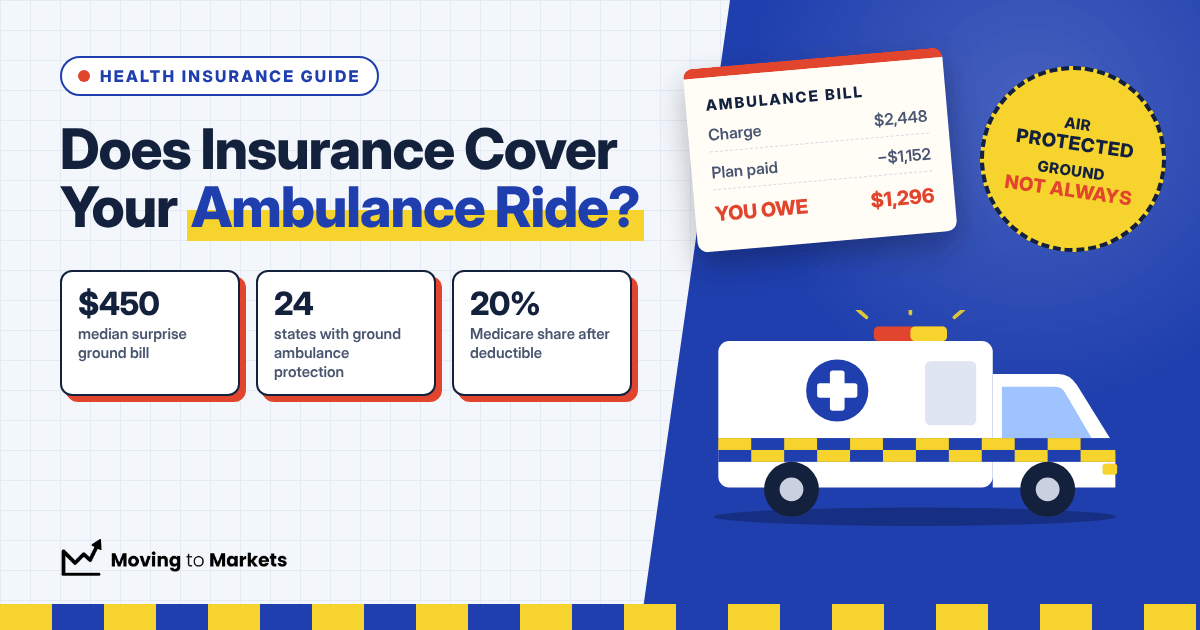
In network, you owe your deductible and coinsurance, often a few hundred dollars. Out of network, in a state without protections, the company can bill you the difference between its charge and what your plan paid. On a typical ride that difference can run over $1,000. PIRG found a median surprise ambulance bill of $450.
Here’s how the same ride can cost you $288 or $1,296. Say Medicare’s rate for your ride is $900. Elevance found insurers allow about 160% of the Medicare rate in network, and out-of-network ambulances charge about 272% of it. Your plan has 20% coinsurance and you’ve already met your deductible.
| In network | Out of network, state protects you | Out of network, no protection | |
|---|---|---|---|
| Ambulance charge | $1,440 (contract rate) | $2,448 | $2,448 |
| Plan’s allowed amount | $1,440 | $1,440 | $1,440 |
| Plan pays (80%) | $1,152 | $1,152 | $1,152 |
| Your coinsurance (20%) | $288 | $288 | $288 |
| Balance bill | $0 | $0 | $1,008 |
| You owe | $288 | $288 | $1,296 |
If you haven’t met your deductible yet, add whatever’s left of it. On a plan with a $2,000 deductible and nothing spent this year, you’d pay the full $1,440 allowed amount yourself, plus any balance bill.
The PIRG Education Fund’s 2022 report put the median surprise ground ambulance bill at $450, with state averages ranging from $121 in Maryland to $1,209 in California. Those figures come from claims older than 2019, so today’s numbers are likely higher.
Does the No Surprises Act cover ambulance bills?
Only air ambulances. The No Surprises Act, in effect since January 1, 2022, bans surprise out-of-network bills for emergency room care, some care at in-network hospitals, and air ambulance flights. Ground ambulances were left out. If an out-of-network ground ambulance takes you, federal law doesn’t stop the balance bill.
CMS’s own consumer page lists the three protected areas, and ground ambulance isn’t one of them. For an air ambulance, you only owe what you’d pay in network. If an air ambulance company bills you more, call the No Surprises Help Desk at 1-800-985-3059.
Congress knew about the ground ambulance gap. It set up the Advisory Committee on Ground Ambulance and Patient Billing, which sent its recommendations to federal agencies on August 28, 2024. Nothing has passed since. The Commonwealth Fund wrote in February 2026 that “federal action has stalled,” and CMS lists the committee as inactive.
One more catch. The law covers most private plans, but Medicare and Medicaid already have their own billing rules, so it doesn’t apply to them.
Which states protect you from surprise ground ambulance bills?
As of June 2026, 24 states have some protection from surprise ground ambulance bills, according to Elevance Health’s Public Policy Institute. These laws only cover fully insured plans, the kind your employer buys from an insurance company. Self-funded employer plans, which cover most US workers, fall under federal law and states can’t touch them.
Older laws covered by PIRG’s 2022 report include Colorado, Delaware, Florida, Illinois, Maine, Maryland, New York, Ohio, Vermont and West Virginia. Texas has one too, now extended to September 1, 2027.
The 2025 changes nobody else is talking about:
| State | What changed in 2025 |
|---|---|
| North Dakota | Caps charges at 250% of the Medicare rate |
| Utah | Insurers must pay the full state fee schedule rate, so there’s no balance left to bill you |
| Oregon | Local governments set rates and have to justify them publicly; covers transfers between facilities |
| New Hampshire | Added protections, including behavioral health rides; studying one rate for all payers |
| Illinois | Your cost share is capped at your normal copay or 10% of the charge, whichever is less |
Tennessee came close. House Bill 1061 passed the state House 94 to 0 in 2026, then stalled in a Senate committee. WSMV reported on a Clarksville man who got a $4,800 bill for an out-of-network transport after his insurer paid about $1,000. The hospital system zeroed out his balance only after reporters asked about it.
How to tell if your plan is self-funded: look at your insurance card or plan documents for “self-funded,” “self-insured” or “administered by.” If the insurer only administers the plan, state ambulance laws probably don’t protect you. Oregon and Washington let self-funded plans opt in, so ask HR.
Does Medicare cover ambulance rides?
Yes. Medicare Part B covers ground ambulance rides when any other vehicle could endanger your health, but only to the nearest facility that can treat you. You pay 20% of the Medicare-approved amount after the Part B deductible, which is $283 in 2026 and $292 in 2027. Air ambulance is covered when ground transport can’t get you there fast enough.
Medicare’s rules are stricter than most private plans in three ways:
- Nearest appropriate facility. If you ask to go to a hospital 30 miles away when one 5 miles away can treat you, Medicare may only pay for the shorter trip. You’d owe the extra miles.
- Non-emergency rides need a written order. A doctor has to say the ride is medically necessary. Dialysis rides for people with kidney failure are the common example.
- Prior authorization for repeat rides. If you get scheduled, non-emergency rides three or more times, the company should ask Medicare for approval before the fourth round trip in 30 days. This rule went nationwide by August 2022.
If the ambulance company thinks Medicare won’t pay for a non-emergency ride, it has to give you an Advance Beneficiary Notice (ABN) first. If you sign it and Medicare denies the claim, you owe the bill. If they never gave you one, you usually don’t.
The good news: ambulance companies must accept Medicare’s approved amount as payment in full. So on Original Medicare, you won’t get a balance bill, only your 20%. Using the $900 example above, that’s $180 after your deductible. A Medigap plan can cover that 20%.
Medicare Advantage plans have to cover ambulances too, but they set their own copays (often a flat amount per trip) and networks. Check your plan’s Summary of Benefits under “ambulance services.”
Does Medicaid cover ambulance rides?
Yes. Medicaid covers emergency ambulance rides in every state, and it has to provide rides to medical appointments for people who have no other way to get there. Ambulance companies that bill Medicaid can’t charge you more than Medicaid allows, so balance bills shouldn’t happen. Some states charge a small copay.
Most non-emergency Medicaid rides are not ambulances. They’re vans, rideshares or bus passes arranged through a broker your state picks. Call the number on your Medicaid card at least two or three days before a scheduled appointment.
If you have both Medicare and Medicaid, Medicare pays first and Medicaid picks up the 20%. We explain how payment order works with three plans in tertiary insurance.
Does car insurance cover an ambulance after a crash?
Often, yes. Personal injury protection (PIP) and medical payments coverage (MedPay) on your own policy pay ambulance bills after a crash, usually with no deductible. If another driver caused the crash, their bodily injury liability coverage should pay. In no-fault states, your PIP pays first, then your health insurance.
| Coverage | Who it’s for | Pays ambulance? | Deductible |
|---|---|---|---|
| PIP (required in no-fault states like Michigan, New York, New Jersey) | You and your passengers | Yes | Usually none |
| MedPay (optional in most states) | You and your passengers | Yes, up to your limit (often $1,000 to $10,000) | None |
| Other driver’s bodily injury liability | You, when they’re at fault | Yes, through a claim or settlement | None, but it’s slow |
| Uninsured/underinsured motorist | You, when the at-fault driver has no or low coverage | Yes | Varies |
| Health insurance | You | Yes, after car coverage runs out | Your normal deductible |
MedPay is cheap and pays fast, so it’s worth a look if you’re shopping.
Keep the ambulance bill and your EOB. If someone else caused the crash and your health plan paid, your insurer may ask to be paid back from any settlement.
When will insurance refuse to pay?
Insurers deny ambulance claims most often because the ride wasn’t medically necessary, the paperwork was missing, the trip went past the nearest appropriate hospital, or a scheduled ride had no prior authorization. A denial isn’t final. You can appeal, and a doctor’s letter explaining why you needed the ambulance wins a lot of them.
Common denial reasons:
- “Not medically necessary.” The ambulance crew’s notes didn’t show why a car wasn’t safe.
- Wrong destination. You went to a farther hospital by choice.
- Missing doctor’s order on a non-emergency ride.
- No prior authorization on a scheduled ride.
- Coding error. The company billed ALS when it should’ve been BLS, or the reverse.
- Coordination of benefits. Your health plan thinks car insurance should pay first.
How do I fight a big ambulance bill?
Don’t pay right away. Get an itemized bill, compare it to your insurer’s explanation of benefits, and ask whether the company was in network. Appeal any denial with a doctor’s letter. If you got balance billed, check your state’s law and file a complaint with your state insurance department. Then negotiate, and ask about financial aid.
- Wait for your EOB. The explanation of benefits shows what your plan allowed and what you owe. Don’t pay the ambulance company until you’ve seen it.
- Ask for an itemized bill. Look for duplicate charges, wrong mileage, or ALS billed when you only got BLS care.
- Check network status. Call your insurer and ask if the ambulance company is in network. If it’s not, ask the insurer to treat it as in network since you had no choice. Some will.
- Appeal a denial. You usually have 180 days to file an internal appeal. Include a letter from the ER doctor saying why you needed an ambulance. If the insurer still says no, ask for an external review.
- Use your state’s law. If you live in a state with ground ambulance protections and your plan is fully insured, tell the company in writing that you only owe your in-network cost share. Copy your state insurance department.
- Air ambulance balance bill? Call the No Surprises Help Desk at 1-800-985-3059.
- Negotiate. Many ambulance services are run by cities or fire departments. Ask for a prompt-pay discount, a hardship reduction or an interest-free payment plan. If a hospital owns the ambulance, apply for its charity care program.
Are ambulance memberships worth it?
They can be, if you live in an area where one is offered and your plan has a high deductible. For about $44 to $133 a year, many city and county ambulance services waive what you’d owe after insurance. They only cover that one provider inside its service area, so they won’t help on a road trip or with an air ambulance.
| Program | Cost | What it covers |
|---|---|---|
| Wake County, NC | $60 a year per household | Nothing out of pocket after insurance for 911 rides by Wake County EMS. Medicaid patients can’t enroll. |
| Pinellas County, FL (Sunstar FirstCare) | $89 single, $133 family (2026 prices) | Deductibles and copays after insurance. Uninsured members get 20% off. |
| Oklahoma City (EMSAcare) | $3.65 a month on your utility bill | Copays, coinsurance and deductibles for emergency rides. Covers uninsured residents too. Enroll in September only. |
| Pasadena, CA | $89 a year | Out-of-pocket costs for paramedic care and transport inside city limits. |
The math is simple. If your deductible is $2,000 and one ALS ride costs $1,451, a $60 membership pays for itself the first time you need it. If you’re on Medicaid or have a low-deductible plan, it’s probably not worth it.
Search your city or county name plus “ambulance membership” or “EMS subscription” to see if yours offers one.
FAQ
Does insurance cover an ambulance if I didn’t call it?
Yes, if the ride was medically necessary. Insurers look at your condition, not who dialed 911. If a bystander called and you were hurt, the claim goes through the normal way.
What happens if I refuse the ambulance ride?
Some services charge for treatment on scene even if you don’t go to the hospital. Insurance may or may not cover that charge. Ask your plan, or check your EMS provider’s billing page.
Does insurance cover an ambulance ride home from the hospital?
Usually not. Plans cover rides home only when you can’t safely travel by car, such as being bedbound or needing oxygen and monitoring. Ask the hospital’s case manager to get a doctor’s order before you leave.
Is an air ambulance covered by insurance?
Yes, when ground transport would take too long or can’t reach you. The No Surprises Act limits what you pay to your in-network cost share, even if the air ambulance is out of network.
Can an ambulance company send my bill to collections?
Yes. But under the major credit bureaus’ rules, paid medical debt comes off your report, and unpaid medical debt doesn’t show up until it’s a year old. Use that time to appeal and negotiate.
Does Medicare pay for ambulance to dialysis?
It can, if a doctor writes an order saying you need an ambulance. Repeat scheduled rides need prior authorization by the fourth round trip in 30 days.
Can I use my HSA or FSA for an ambulance bill?
Yes. Ambulance services are a qualified medical expense for HSA and FSA money. Our guide to medical expense insurance explains how plans cap what you pay in a year.
Will my out-of-pocket max cap an ambulance bill?
In-network cost sharing counts toward your out-of-pocket max. A balance bill from an out-of-network ground ambulance usually doesn’t, so it can go past your max.