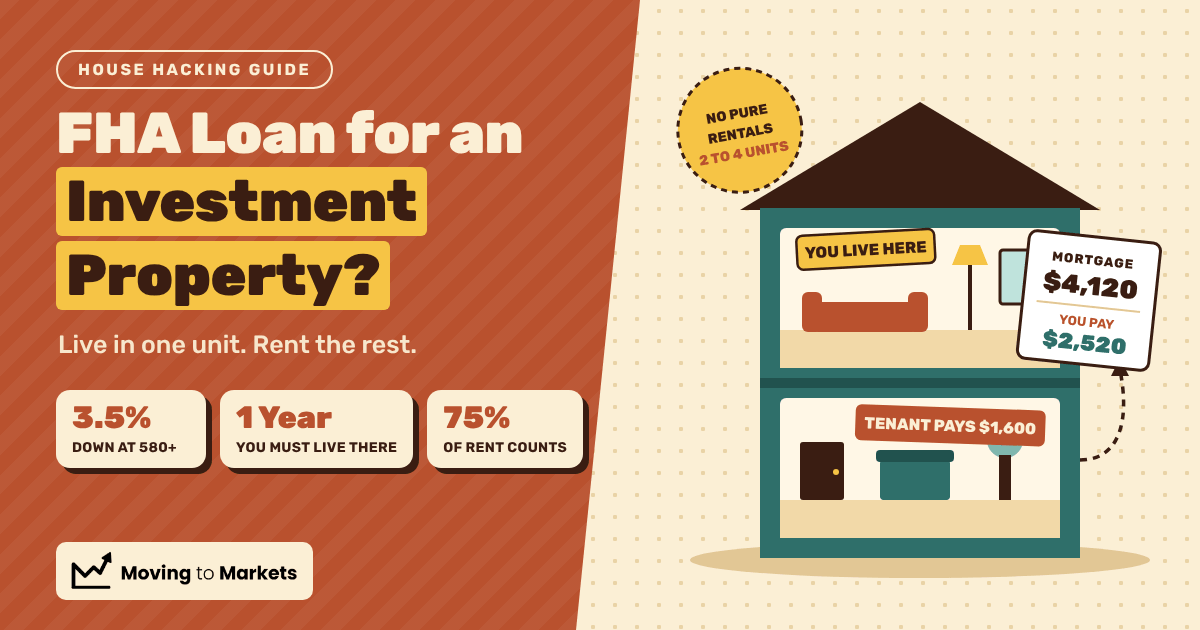
You can’t use an FHA loan to buy a pure investment property. FHA only insures homes you live in. But you can buy a 2 to 4 unit building with 3.5% down, live in one unit for at least a year and rent out the rest. After that year you can move out and keep the whole place as a rental with the same FHA loan.
We all know that one friend who bought a duplex, lives upstairs and the tenant downstairs pays half their mortgage. You hear that and you think, ok, can I just get an FHA loan and buy a rental? The 3.5% down sounds a lot better than the 25% an investor loan asks for.
The honest answer is no and yes. No, FHA won’t lend on a house you never plan to live in. Yes, there is a legal way around it, and lenders have a name for it: house hacking. This guide walks through the rules HUD actually enforces, the 2026 loan limits, and real monthly payments on a duplex and a fourplex at today’s rates, so you know if the numbers work before you call a lender.
New to property investing in general? Our guide on how to get into real estate investing compares house hacking with REITs and regular rentals.
Can you use an FHA loan for an investment property?
No, not for a property you won’t live in. FHA loans are for primary residences only: you must move in within 60 days of closing and live there at least one year. The exception is a 2 to 4 unit home. You live in one unit and rent the others, and that rent can help you qualify for the loan.
HUD’s Handbook 4000.1 says the borrower must occupy the home “as their principal residence within 60 Days of signing the security instrument” and intend to stay at least one year. A house you buy only to rent is an investment property in HUD’s terms, and FHA doesn’t insure those for purchase.
So these are fine with FHA: – A duplex, triplex or fourplex where you live in one unit – A single-family home where you rent out spare bedrooms – A house with a basement apartment or backyard unit you rent – Moving out after a year and renting the whole home, keeping the FHA loan
These are not: – A house you buy to rent from day one – A vacation home or second home – A property with 5 or more units (that’s commercial financing; see our multifamily investment guide)
How does house hacking with an FHA loan work?
House hacking means buying a 2 to 4 unit home with an owner-occupied FHA loan, living in one unit and renting the rest. You get FHA’s 3.5% down payment and lower credit score rules, and your tenants’ rent pays part of the mortgage. After one year you can move and rent every unit.
Here’s how it usually goes, step by step:
- Check your credit and cash. You need a 580 score for 3.5% down. Between 500 and 579 you need 10% down.
- Get preapproved for a multi-unit FHA loan. Tell the lender upfront it’s a 2 to 4 unit purchase, since the rent and reserve rules change.
- Look up your county’s FHA limit for the number of units. A fourplex limit is almost twice the single-unit limit.
- Run the self-sufficiency test if you’re looking at a triplex or fourplex. Do it before you make an offer.
- Close and move in within 60 days. Sign leases with tenants for the other units.
- Live there at least 12 months. Keep proof: driver’s license, voter registration, mail at that address.
- After a year, decide. Stay, refinance, or move out and rent your unit too.
What are the FHA requirements for a 2 to 4 unit home?
For a 2 to 4 unit FHA loan in 2026 you need a 580 credit score for 3.5% down (500 with 10% down), US citizenship or a green card, a 1.75% upfront mortgage insurance premium, an annual premium of 0.55% on most loans, and you must live in one unit. Triplexes and fourplexes must also pass a self-sufficiency test.
| Requirement | 2026 rule |
|---|---|
| Credit score | 580+ for 3.5% down. 500 to 579 for 10% down |
| Down payment | 3.5% or 10%, gifts allowed |
| Occupancy | Move in within 60 days, stay at least 1 year |
| Units | 1 to 4. You live in one |
| Upfront MIP | 1.75% of the loan, usually rolled into it |
| Annual MIP (30-year, under 5% down) | 0.55% if the base loan is $726,200 or less, 0.75% above that |
| How long MIP lasts | Life of the loan at 3.5% down. 11 years if you put 10% or more down |
| Who can borrow | US citizens and lawful permanent residents only, since May 25, 2025 |
| Self-sufficiency test | Triplexes and fourplexes only |
| Reserves | 3 to 4 units: usually 3 months of payments after closing (confirm with your lender) |
The residency rule is newer than most guides. HUD’s Mortgagee Letter 2025-09 cut non-permanent residents out of FHA for case numbers assigned on or after May 25, 2025. People on work visas who already have an FHA loan can’t get another one, even a Streamline refinance. In October 2026 HUD said the share of FHA loans going to non-permanent residents had dropped from 6% to zero.
The mortgage insurance part matters for fourplex buyers in pricey cities. Once the base loan goes over $726,200, the annual premium jumps from 0.55% to 0.75%. On an $868,500 loan that’s about $145 a month extra.
What are the 2026 FHA loan limits for 2 to 4 units?
In 2026 the FHA loan limit for a duplex runs from $693,050 in lower-cost counties to $1,599,375 in high-cost areas. A triplex runs $837,700 to $1,933,200, and a fourplex $1,041,125 to $2,402,625. Your exact limit depends on your county.
These come from HUD’s December 11, 2025 announcement:
| Units | Low-cost county floor | High-cost county ceiling |
|---|---|---|
| 1 unit | $541,287 | $1,249,125 |
| 2 units | $693,050 | $1,599,375 |
| 3 units | $837,700 | $1,933,200 |
| 4 units | $1,041,125 | $2,402,625 |
Alaska, Hawaii, Guam and the US Virgin Islands have higher ceilings, up to $3,603,925 for four units.
The 2027 limits aren’t out yet. The conforming loan limit update from FHFA usually lands in late November and HUD follows a couple of weeks later. If you’re closing in January 2027 or later, check HUD’s FHA limit lookup for your county before you shop.
How much does an FHA duplex cost each month?
On a $500,000 duplex with 3.5% down at a 6.77% FHA rate, the full payment is about $4,120 a month including mortgage insurance, property tax and insurance. If the other unit rents for $1,600, you pay about $2,520 out of pocket and put about $17,500 down plus closing costs.
Here’s the math. The rate is the 30-year FHA average from Mortgage Research Center (Fortune, November 18, 2026). Tax uses 1.1% of the price and insurance is $3,000 a year.
| Item | Amount |
|---|---|
| Price | $500,000 |
| Down payment (3.5%) | $17,500 |
| Base loan | $482,500 |
| Upfront MIP (1.75%, added to the loan) | $8,444 |
| Total loan | $490,944 |
| Principal and interest at 6.77%, 30 years | $3,191 a month |
| Annual MIP (0.55%) | $221 a month |
| Property tax (1.1%) | $458 a month |
| Homeowners insurance | $250 a month |
| Total monthly payment | $4,120 |
| Rent from the other unit | -$1,600 |
| Your share | $2,520 |
Closing costs at around 3% add about $15,000, so plan on roughly $32,500 cash to close. Sellers can pay some of that, and many states have down payment help.
Now be honest with yourself. The median asking rent in the US was $1,541 in Q3 2026 (Census Bureau). So in this example you pay about $980 more a month than a typical renter. What you get for it: about $5,212 of principal paid off in year one, and a building that can rent both units once you move out. If you’d rather not be a landlord to your neighbor, it’s an expensive way to live.
What is the FHA self-sufficiency test?
The self-sufficiency test applies to FHA loans on 3 and 4 unit homes. Add up the market rent for every unit, including yours, and subtract the greater of the appraiser’s vacancy estimate or 25%. What’s left must be equal to or higher than the full monthly payment with mortgage insurance, tax and insurance. Duplexes don’t have to pass it.
The formula in plain words:
Total market rent of all units x 75% ≥ full monthly payment (PITI + MIP)
The appraiser sets the rent, not the seller’s listing. Here are two fourplexes at 3.5% down and 6.77%:
| Fourplex A | Fourplex B | |
|---|---|---|
| Price | $650,000 | $900,000 |
| Base loan | $627,250 | $868,500 |
| Annual MIP rate | 0.55% | 0.75% |
| Principal and interest | $4,148 | $5,743 |
| MIP | $287 | $543 |
| Tax (1.1%) | $596 | $825 |
| Insurance ($4,800 a year) | $400 | $400 |
| Total payment | $5,431 | $7,511 |
| Market rent per unit | $2,100 | $1,800 |
| Total rent x 75% | $6,300 | $5,400 |
| Result | Passes | Fails by $2,111 |
Fourplex B would need about $2,504 a month in rent per unit to pass. That’s why so many fourplex deals die at this step when rates are near 7%.
If a property fails, you have a few options. Put more down to shrink the payment, negotiate the price, look at a duplex (no test), or use a conventional loan, which has no self-sufficiency test.
How much rental income can you count to qualify?
FHA lenders usually count 75% of the appraiser’s market rent for the units you won’t live in. The 25% cut covers vacancy and repairs. On a duplex with a $1,600 rental unit, $1,200 a month gets added to your income when the lender checks your debt-to-income ratio.
This is how house hacking lets you buy a bigger place than your paycheck alone would cover. Say you earn $10,000 a month, have a $400 car payment and the duplex payment is $4,120. Without rent, your total debt is 45.2% of income. Add $1,200 of counted rent and your income becomes $11,200 for the math, which brings it down to about 40.4%. Lenders usually like total FHA debt ratios at 43% or lower, with room up to about 50% when your credit and savings are strong.
Lenders handle this a bit differently. Some subtract the 75% figure from the payment instead of adding it to income.
FHA vs conventional vs investor loan: which costs less?
On a $500,000 owner-occupied duplex, FHA needs $17,500 down, a Fannie Mae conventional loan needs $25,000 (5%), and a pure investor loan needs $125,000 (25%). FHA wins on cash and credit score. Conventional often wins on monthly cost if your score is 700+, because PMI can be cancelled and FHA’s MIP usually can’t.
| FHA (live there) | Fannie Mae conventional (live there) | Investor loan (don’t live there) | |
|---|---|---|---|
| Down payment on $500,000 duplex | 3.5% = $17,500 | 5% = $25,000 | 25% = $125,000 |
| Minimum credit score | 580 (500 with 10% down) | 620 | 620, usually higher for good pricing |
| Mortgage insurance | 1.75% upfront + 0.55% a year, for life of loan | PMI until 20% equity, then removable | None |
| Self-sufficiency test on 3 to 4 units | Yes | No | No |
| Occupancy rule | Live there 1 year | Live there 1 year | None |
| Loan size limit | County FHA limit | Conforming limit | Conforming limit |
Fannie Mae dropped its owner-occupied 2 to 4 unit minimum to 5% down in November 2023. Before that it was 15% to 25%, which is why older articles still say FHA is the only low down payment option for multi-unit homes. It isn’t anymore.
The FHA mortgage insurance is the trade-off. At 3.5% down you pay the 0.55% premium until you sell or refinance. Conventional PMI goes away once you reach 20% equity. If you plan to keep the building 10+ years, run both quotes. Our guide to getting rid of PMI covers how that works.
What happens after you live there for one year?
After 12 months you can move out and rent your unit too, and you keep the FHA loan. There’s no rule forcing you to refinance. What you usually can’t do is take out a second FHA loan for your next home unless you meet one of HUD’s exceptions.
Your options once the year is up:
- Stay and keep renting the other units. Nothing changes.
- Move out and rent all units. The FHA loan stays in place at the same rate.
- Refinance to a conventional loan to drop MIP once you have about 20% equity. An investment property refinance will have stricter terms than your original loan.
- Sell. You’ve had a year of rent and some principal paydown.
The catch is your next home. FHA generally lets you have one FHA loan at a time. HUD allows a second one only in a few cases:
- Job relocation. You move for work to a new home more than 100 miles from your current one.
- Bigger family. You have more dependents and the current home is too small. Lenders typically want at least 25% equity in the current home, which is hard to have after one year with 3.5% down.
- Leaving a jointly owned home. For example, after a divorce where your ex keeps the house and the loan.
- You were a non-occupying co-borrower on a relative’s FHA loan, and now you’re buying your own home.
So the usual “buy a new fourplex every year with FHA” plan only works if you refinance or sell the previous one first. Many investors use FHA for the first building and a 5% down conventional loan for the next one.
What happens if you lie about living there?
Saying you’ll live in a home you plan to rent is mortgage fraud. A false statement on an FHA loan application is a federal crime under 18 U.S.C. 1010, punishable by fines and up to two years in prison. The lender can also call the loan due.
Lenders check. They look at where your mail goes, your driver’s license address, utility bills and sometimes send someone to the property. If a tenant is in “your” unit from day one, that’s a red flag.
Real life changes plans, and HUD knows that. If you take a job in another state six months after closing, you aren’t committing fraud because you meant to live there when you signed. Keep the job offer letter and moving records. Fraud is about what you intended at closing.
One more practical point: plan on regular leases for the rental units. Rocket Mortgage says FHA rules don’t allow Airbnb-style short-term rentals, so ask your lender before you count on nightly rental income.
Is an FHA house hack worth it?
It’s worth it if you’re fine living next to your tenants, can cover the full payment even with a unit empty, and plan to keep the building past year one. It’s a bad fit if you need the rent to cover the whole mortgage, since at 7% rates it rarely does.
Good signs: – You’d pay similar rent anyway and want to build equity instead. – You have savings to cover 3 months of the full payment. – The rental unit’s rent is at least 35% to 40% of the full payment. – You’d keep the building as a rental after you move.
Warning signs: – You need both tenants paying every month to make your own bills. – The property only passes the self-sufficiency test with optimistic rent. – You can’t deal with a 10 PM text about a clogged sink.
Frequently asked questions
Can I use an FHA loan to buy a rental property?
Not a property you only rent out. FHA requires you to live in the home. You can buy a 2 to 4 unit home, live in one unit and rent the others.
How long do I have to live in an FHA home before renting it out?
At least one year. You must move in within 60 days of closing and plan to stay 12 months. After that you can rent the whole home.
Can I buy a fourplex with an FHA loan?
Yes, with 3.5% down if your score is 580 or higher. You must live in one unit, stay under your county’s 4-unit limit ($1,041,125 to $2,402,625 in 2026) and pass the self-sufficiency test.
Does the FHA self-sufficiency test apply to duplexes?
No. It only applies to 3 and 4 unit properties. Duplexes and single-family homes skip it.
Can I have two FHA loans at the same time?
Usually not. HUD allows a second FHA loan for a job move of more than 100 miles, a bigger family with 25% equity in the current home, leaving a jointly owned home, or if you were a non-occupying co-borrower.
How much rental income does FHA count?
Usually 75% of the appraiser’s market rent for the units you rent out. A $1,600 unit adds $1,200 to your qualifying income.
Can non-US citizens get an FHA loan for a duplex?
Only green card holders. Since May 25, 2025, non-permanent residents can’t get new FHA loans, including Streamline refinances.
Is FHA or conventional better for a duplex?
FHA needs less cash (3.5% vs 5%) and a lower score (580 vs 620). Conventional usually costs less monthly for scores above 700 because PMI can be removed.