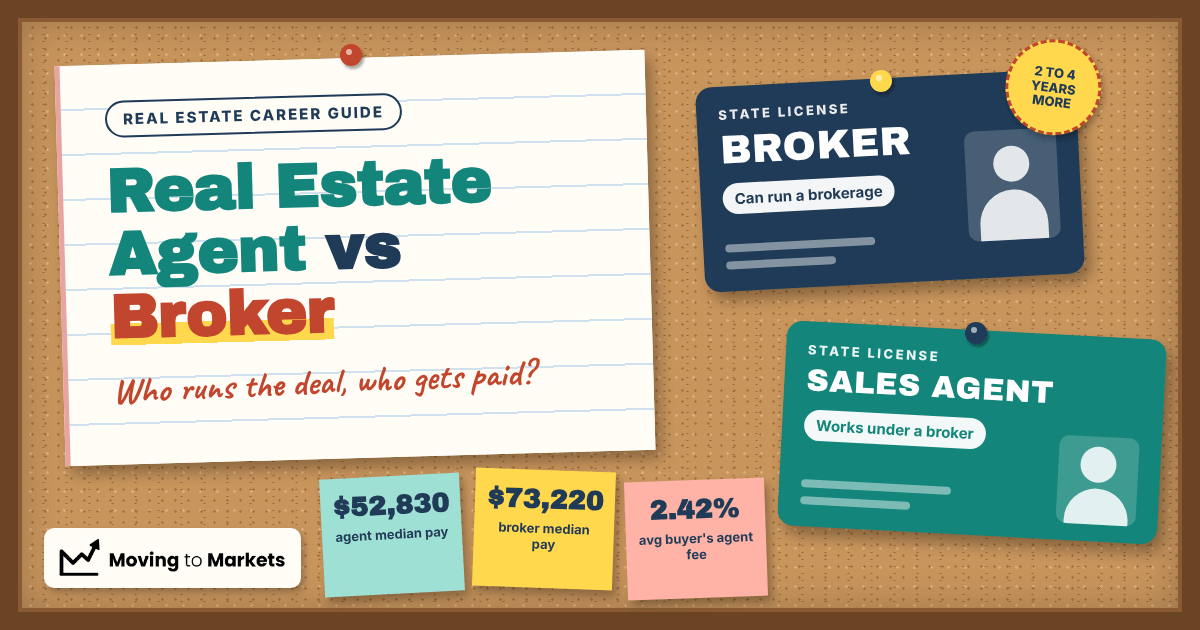
A real estate broker has a higher license than an agent. A broker can open a brokerage, hold client money in a trust account and supervise other agents. A real estate agent (called a sales agent or salesperson in most states) must work under a licensed broker. Getting a broker license usually takes 2 to 4 more years of experience and extra classes. Brokers earned a median of $73,220 in 2025 vs $52,830 for sales agents (BLS).
We all know that one person who calls themselves a “broker” on their business card, and their friend who calls themselves an “agent,” and they seem to do the exact same thing. They both show houses, both write offers, both post that photo with the keys. So what’s the difference, and does it matter when you’re the one buying or selling?
It matters a little for you as a client, and it matters a lot if you’re the one holding the license. A broker is the person the state holds responsible when something goes wrong in a deal. The agent works under that broker, and every commission check goes to the brokerage first, not to the agent. This guide breaks down the licenses, the rules in the biggest states, how the money moves after the 2024 NAR settlement, and who you should actually hire.
What is the difference between a real estate agent and a broker?
A real estate agent holds an entry-level license and must work under a supervising broker. A real estate broker holds an advanced license that takes more experience and education. Brokers can run their own firm, manage escrow money and hire agents. Agents can’t do any of those on their own, and they get paid through their broker.
| Real estate agent (sales agent) | Real estate broker | |
|---|---|---|
| License level | Entry level | Advanced |
| Can work on their own? | No, must work under a broker | Yes, can open a brokerage |
| Experience needed | None | Usually 2 to 4 years as an agent |
| Typical extra education | 63 to 180 hours (varies by state) | 72 to 900 more hours, or 8 college courses (California) |
| Gets paid by | Their brokerage | Clients, through the brokerage |
| Can hold earnest money in a trust account? | No | Yes |
| Can supervise agents? | No | Yes |
| Median pay (BLS, May 2025) | $52,830 | $73,220 |
| Number of jobs (BLS, 2025) | 427,000 | 103,500 |
For the day-to-day stuff you see as a client, like showings, writing offers, negotiating repairs and getting you to closing, an agent and a broker do the same work. The difference is legal: who signs off, who is liable, and who can open the doors of a company.
What does a real estate broker do that an agent can’t?
A broker can do five things an agent can’t: own or manage a brokerage, hire and supervise agents, hold client deposits in a trust account, sign off on contracts and advertising for the firm, and receive commission directly. An agent does the same client work but needs a broker’s license above them to do it legally.
Here’s what that looks like in practice:
- Runs the brokerage. The broker’s name is on the firm’s license. If a brokerage has 40 agents, one designated broker answers to the state for all 40.
- Holds the money. When you put down a $10,000 earnest money deposit, it often goes into the broker’s trust or escrow account (or to a title company). Agents can’t keep that money themselves.
- Supervises and trains agents. Brokers review contracts, approve ads and handle complaints. In Colorado, an employing broker has to take a 24-hour brokerage administration course before they can supervise anyone.
- Collects the commission. Every commission is paid to the brokerage, which then pays the agent their split. This is state law in most places, not a company policy.
- Takes on the legal risk. If an agent mishandles a deposit or leaves out a required disclosure, the state can discipline the supervising broker too.
What are the different types of real estate brokers?
There are three common types of brokers. A principal or designated broker runs the firm and is legally responsible for it. A managing broker runs an office or team day to day. An associate broker holds a broker license but chooses to work under another broker, the same way an agent does.
| Broker type | Also called | What they do |
|---|---|---|
| Principal broker | Designated broker, employing broker, qualifying broker | Holds the firm’s license, supervises everyone, owns the legal risk |
| Managing broker | Office manager, branch manager | Runs one office or team, hires and trains agents, handles daily problems |
| Associate broker | Broker associate, broker salesperson | Has a broker license but works under a principal broker, usually doing sales |
The associate broker confuses a lot of people. Why get the harder license and still work for someone else? Usually it’s because they want the option to open a firm later, they want to manage a team, or their brokerage pays a better split to licensed brokers. Some just like the title on the business card.
How do you become a real estate broker? State rules compared
Most states require 2 to 4 years of active experience as a licensed agent, extra pre-license classes and a broker exam. California needs 2 years of full-time work in the last 5 plus 8 college courses. Texas needs 900 classroom hours and, since January 1, 2026, 720 experience points. Florida needs 24 months and a 72-hour course.
The BLS puts it simply: “Every state requires real estate brokers and agents to be licensed,” and most require at least 2 years of experience for a broker license. The details change a lot by state, so here are the biggest markets, checked against each regulator in November 2026:
| State | Entry license | Entry education | Broker experience | Broker education |
|---|---|---|---|---|
| California | Salesperson | 3 college courses | 2 years full time in the last 5 (or a 4-year real estate degree) | 8 college courses |
| Texas | Sales agent | 180 hours | 4 years active in the last 5, 720 experience points (from Jan 1, 2026) | 900 hours total (270 qualifying + 630 related); a bachelor’s degree counts for only 300 hours from 2026 |
| Florida | Sales associate | 63 hours | 24 months active in the last 5, plus the sales associate post-license course | 72 hours |
| New York | Salesperson | 77 hours | 2 years as a salesperson, or 3 years in general real estate, plus a points minimum | 152 hours total |
| Colorado | Associate broker | 168 hours | 2 years active to become independent or employing broker | 24-hour brokerage administration course |
| Illinois | Broker (no salesperson license) | 75 hours | Managing broker is the next level | Set by IDFPR |
| Oregon | Broker | Set by the agency | 3 years active to become principal broker | Brokerage administration course |
| Washington | Broker | Set by DOL | 3 years full time in the last 5 to become managing broker | 90 hours (brokerage management, business management, advanced law) |
A few things that trip people up:
- California counts full-time only. The DRE treats full-time as 40 hours a week. If you work 20 hours a week, two calendar years only count as one year.
- Texas raised the bar in 2026. Applications filed on or after January 1, 2026 need 720 experience points, double the old 360. Every broker and broker applicant now also has to take TREC’s Broker Responsibility Course.
- Florida’s post-license comes first. You have to finish the sales associate post-license education before you can get a broker license.
- New York fees are low. The broker application is $185 and the written exam is $15.
Which states license everyone as a broker?
In Illinois, Colorado, Oregon and Washington, the entry-level license is already called a broker. Illinois has no salesperson or agent license at all. In these states, “agent vs broker” really means “broker vs managing broker” or “broker vs principal broker,” and the experience rules apply at that higher level.
So if you’re in Chicago and your agent says they’re a broker, that’s normal. It doesn’t mean they have 3 more years of experience than an agent in Texas. In Illinois, the step up is a managing broker license. In Oregon it’s principal broker (3 years of active experience). In Washington it’s managing broker (3 years full time in the last 5, plus 90 hours of classes). In Colorado, a new licensee starts as an associate broker and can become an independent or employing broker after 2 years of active experience.
How do agents and brokers get paid after the NAR settlement?
Commissions are paid to the brokerage, which then pays the agent a split. Since August 17, 2024, sellers can no longer post buyer agent pay on the MLS, and buyers must sign a written agreement before touring homes with an agent. The average buyer’s agent fee was 2.42% in Q3 2025 (Redfin), slightly up from 2.36% a year earlier.
The National Association of Realtors agreed to pay $418 million over about four years to settle the commission lawsuits. The court gave final approval on November 26, 2024, and a federal appeals court upheld the deal in August 2026. Two practice changes came out of it:
- No compensation offers on the MLS. A seller can still agree to pay the buyer’s agent, but that offer isn’t posted on Realtor MLS listings anymore.
- Written buyer agreements. Before an agent tours a home with you, you sign an agreement that says what they’ll be paid and how.
Here’s how one deal moves through the system. Say you buy a $416,700 home (NAR’s national median for October 2026), and your agent’s fee is 2.52% (Redfin’s Q3 2025 average for homes under $500,000):
- Commission: $416,700 x 2.52% = $10,501, paid to your agent’s brokerage at closing.
- Split: On a 70/30 split, your agent gets $7,351 and the broker keeps $3,150.
- A 100% plan: Some brokerages let the agent keep everything and charge flat fees instead. With a $400 transaction fee, the agent gets $10,101, but they also pay a monthly desk fee whether they close a deal or not.
- Taxes and costs: Most agents are independent contractors, so the agent still owes self-employment tax and pays their own MLS dues, marketing and license fees out of that check.
Commission is negotiable. No law sets it. On the selling side, a Clever survey of 533 agents (February 2026) put the average total around 5.70%, but that’s an agent survey, not closed-sale data, so treat it as a rough number.
Do brokers make more money than agents?
Yes, on average. The BLS reports a median of $73,220 for real estate brokers vs $52,830 for real estate sales agents (May 2025). Brokers earn more because they get a cut of every agent’s deal, they tend to have more years in the business, and they can take on management roles. About 55% of brokers and 54% of agents are self-employed.
A broker who runs an office with 20 agents can earn from deals they never touched. On the example above, the broker kept $3,150 from one sale. If those 20 agents close 8 deals each in a year, that’s 160 deals of overrides before the broker’s own sales. Of course, the broker also pays the rent, the software, the E&O insurance and the legal bills.
The BLS expects only 2% job growth for brokers and agents combined between 2025 and 2035, with about 40,400 openings a year, mostly from people leaving the field. For the full breakdown of pay by experience, state and what agents actually keep after costs.
Where does a Realtor fit in?
A Realtor is any licensed agent or broker who joins the National Association of Realtors and agrees to its Code of Ethics. It is a trademarked membership title, not a license. Joining is voluntary. An agent can be a Realtor, a broker can be a Realtor, and someone can be either one without ever becoming a Realtor.
NAR had about 1.44 million members in its 2026 Member Profile. That’s why you see “Realtor” so much. One ranking page says Realtors are “required to join” NAR, which gets it backwards: you’re only a Realtor because you chose to join.
| Title | Is it a license? | Who grants it |
|---|---|---|
| Real estate agent / salesperson | Yes | Your state real estate commission |
| Real estate broker | Yes | Your state real estate commission |
| Realtor | No, it’s a membership | National Association of Realtors |
Should you hire a real estate agent or a broker?
For most buyers and sellers, it doesn’t matter much. An agent and a broker charge from the same commission range, and an agent’s work is supervised by a broker anyway. Pick the person by local sales record, how fast they reply and what they’ll charge. A broker makes sense for unusual deals, such as commercial property, estates or disputes.
What to check before you sign anything:
- Look up their license. Every state has a free license lookup on its real estate commission site. Check the status and any discipline.
- Ask how many homes they sold near you in the last 12 months. A newer agent with 3 sales in your neighborhood can beat a broker with 30 sales across the county.
- Read the buyer agreement. It should say the fee (a percent or a flat dollar amount), how long it lasts, and what happens if the seller pays part of it.
- Negotiate. A 2.52% fee on $416,700 is $10,501. Getting it to 2% saves you $2,167.
- Ask who the supervising broker is. If a problem comes up with your agent, that’s the person you call next.
Is getting a broker license worth it for an agent?
It’s worth it if you want to open your own firm, manage a team or earn overrides on other agents’ deals. It’s usually not worth it if you only want to sell homes. In Texas the license takes 900 classroom hours and 4 years, and in California 8 college courses. Associate brokers often do the same work for a slightly better split.
Some honest math. If a broker license gets you from a 70/30 split to 80/20 on $10,501 commissions, you earn $1,050 more per deal. At 12 deals a year, that’s $12,601. Not bad. But if you open your own brokerage, you now pay for E&O insurance, a trust account, an office, MLS and board fees, and you’re on the hook when your agents make mistakes.
Get the broker license if: – You want to run a brokerage or a team with your name on it. – Your brokerage pays brokers a better split than agents. – You work in property management, commercial deals or a state where that work needs a broker license.
Skip it (for now) if: – You’re in your first 2 years and still building a client list. – You don’t want to supervise anyone or handle trust money. – You live in Illinois, Colorado, Oregon or Washington, where you already have the “broker” title.
Frequently asked questions
Is a real estate broker higher than an agent?
Yes. A broker holds a higher license level and can supervise agents and run a brokerage. An agent must work under a broker.
Can a real estate agent work without a broker?
No. In every state, a sales agent’s license has to be held by a supervising broker. The agent can’t collect commission directly.
How long does it take to become a real estate broker?
Usually 2 to 4 years of active agent experience plus extra classes. California needs 2 years full time in the last 5, Florida 24 months, and Texas 4 years plus 720 experience points.
Do brokers charge more commission than agents?
Not usually. Commission is negotiable and set by the brokerage and client, not by license level. The average buyer’s agent fee was 2.42% in Q3 2025 (Redfin).
What is an associate broker?
An associate broker has a broker license but works under another principal broker, usually doing sales like an agent does.
Is a Realtor an agent or a broker?
Either one. A Realtor is a licensed agent or broker who joined the National Association of Realtors. It’s a membership, not a license.
Which states don’t have a real estate salesperson license?
Illinois has no salesperson or agent license. Colorado, Oregon and Washington also call their entry-level licensees brokers.
What changed for buyers after the NAR settlement?
Since August 17, 2024, you sign a written agreement with your agent before touring homes, and sellers no longer post buyer agent pay on Realtor MLS listings.
Here’s the simple version. Hire the person, not the title. If they’re licensed, active in your area and clear about their fee in writing, an agent and a broker will do the same job for you. If you’re the one holding the license, the broker step pays off when you want to manage or own the business, not when you just want to sell more houses.