Multifamily investment means buying apartment buildings, or a share of one, to earn rent and growth in value. Buildings with 5 or more units are valued by their net operating income, not by nearby home sales, and financed with commercial or agency loans. In late 2026, national occupancy sits at 95% and new supply is falling, but with loan rates above most cap rates, the lender’s 1.25x debt coverage rule usually forces you to put 35% or more down.
We all know that one person in your family group chat who keeps saying “one day I’m gonna buy an apartment building and never work again.” Maybe they watched a few YouTube videos where some guy in a rented Lamborghini says he owns 400 doors. And honestly, the idea makes sense on paper. One roof, one boiler, twelve rent checks.
But here’s the thing nobody in those videos shows you: the spreadsheet. What the building really costs to run, how much the bank will actually lend, and what lands in your pocket after the mortgage gets paid. Most guides on multifamily investing were written in 2022, when rents were jumping 10% a year and loans cost 4%. That world is gone.
So this guide does the math with 2026 numbers. You’ll see how an apartment building gets valued, run a real 12-unit deal from rent to cash flow, and learn the loan rules that decide how much cash you need.
What counts as a multifamily investment?
A multifamily investment is any residential building with two or more units that you own to rent out. Lenders split it in two: 2 to 4 units count as residential and get home-style mortgages, while 5 or more units count as commercial and are valued and financed based on the rent the building produces.
That line at five units changes almost everything about the deal:
| 2 to 4 units (duplex, triplex, fourplex) | 5+ units (apartment building) | |
|---|---|---|
| Loan type | Residential mortgage (FHA, conventional, VA) | Commercial, agency (Fannie Mae, Freddie Mac) or HUD multifamily |
| Down payment | 3.5% to 5% if you live there; 15% to 25% if you don’t | Usually 20% to 40%, set by the building’s income |
| How it’s valued | Comparable home sales nearby | Net operating income ÷ cap rate |
| What the lender checks most | Your income and credit | The building’s income (DSCR), then you |
| Loan term | 30-year fixed is normal | 5 to 15 year terms on 30-year amortization; fixed for 30 years is rare |
| Personal liability | You’re personally on the hook | Agency and HUD loans are usually non-recourse |
If you want to start small by living in a duplex or fourplex, our guide on how to get into real estate investing walks through the FHA and 5% down house hacking math. The rest of this article is about buildings with five units or more, plus the passive ways to own a piece of one.
How is the multifamily market doing right now?
Occupancy is steady and rents are rising again, slowly. RealPage put national apartment occupancy at 95.0% in October 2026, with effective rents up 1.7% from a year earlier, the biggest annual gain since May 2023. New supply is dropping fast after a record 2024, which tends to help landlords.
Here’s where things stand as of November 2026:
- Occupancy: 95.0% in October 2026, down 0.2 points from September and up 0.1 points from a year earlier (RealPage). In Q3 it averaged 95.4%.
- Rents: Up 1.7% year over year in October, but down 0.7% during the month itself, the first monthly cut of 2026. Fall and winter are always the slow leasing season.
- Demand vs supply: In the 12 months through Q3 2026, renters absorbed about 304,800 new apartments while about 318,000 were completed (RealPage). That’s close to balanced.
- Supply is shrinking: Yardi Matrix counts 696,281 apartments completed in 2024, the peak, then 656,936 in 2025. It forecasts about 513,883 for 2026 (down 22%) and 450,964 in 2027. The Census Bureau put starts in buildings with 5+ units at a 349,000 annual pace in September 2026. RealPage and Yardi count units differently, so compare each source to itself, not to the other.
- Big gaps between cities: San Francisco rents were up 14.7% year over year in October, while San Antonio was down 2.6% with occupancy at just 92.5% (RealPage). The national number hides a lot.
The short version: the flood of new Sun Belt buildings that pushed rents down in 2024 and 2025 is slowing. That’s good for owners over the next two years. But it doesn’t fix the bigger problem, which is the gap between what buildings earn and what loans cost. We’ll get to that in the deal example.
How do you value an apartment building?
Apartment buildings are valued by dividing net operating income (NOI) by a cap rate. NOI is all the rent you collect minus vacancy and operating costs, before the mortgage. A building earning $100,000 NOI at a 6% cap rate is worth about $1,666,667. Raise the NOI and the value goes up with it.
Three numbers do most of the work:
- Net operating income (NOI). Gross rent, minus vacancy and credit loss, minus operating costs (taxes, insurance, repairs, utilities you pay, payroll, management). Your mortgage is not part of NOI.
- Cap rate. NOI ÷ price. It’s the return you’d get if you paid all cash. A lower cap rate means a pricier building per dollar of income.
- Debt service coverage ratio (DSCR). NOI ÷ yearly mortgage payments. Lenders want at least 1.25x on most agency loans, meaning the building earns $1.25 for every $1 of mortgage.
How much do costs really eat? The National Apartment Association looked at about 13,471 communities for 2025. Out of each rent dollar, about 43 cents went to the mortgage, 27 cents to operating costs, 10 cents to property tax, 7 cents to payroll and 1 cent to capital reserves. Owners kept about 11 cents. The average unit brought in $1,545 a month and cost $8,213 a year to run, so operating costs took about 44% of revenue before any mortgage.
Costs have also been rising faster than rent. Trepp’s data shows multifamily operating expenses up 32.4% from 2021 to 2025, against 26.6% for revenue. Insurance alone rose 57.9% over those five years. When a seller hands you a pro forma with expenses at 30% of rent, be careful.
On cap rates, CBRE’s H1 2026 survey found them essentially flat overall, with Class B, Class C and value-add buildings seeing more compression (lower cap rates, higher prices) than newer Class A buildings. Infill multifamily had the most negative outlook of any property type for the next six months. Cap rates vary a lot by city and building age, so get recent sales from a local broker before you trust any national number.
What does a real 12-unit deal look like?
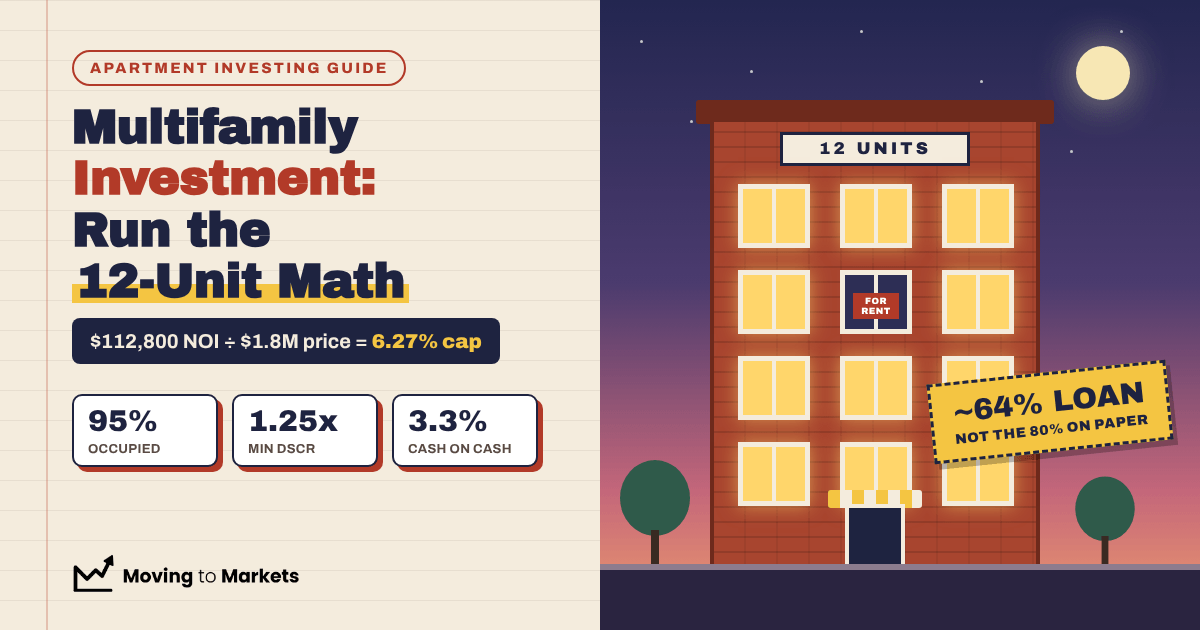
A 12-unit building priced at $1.8 million, with average 2025 rents and costs, earns about $112,800 NOI, a 6.27% cap rate. At a 6.75% loan rate, the 1.25x debt coverage rule limits the loan to about $1.16 million, so you need about $695,000 in cash and earn roughly 3.3% cash-on-cash in year one.
Here’s the full math, using NAA’s 2025 averages for rent and costs.
The building: 12 units, $1,800,000 price ($150,000 a unit), $1,545 average rent.
| Line | Yearly amount |
|---|---|
| Gross potential rent (12 × $1,545 × 12) | $222,480 |
| Vacancy and credit loss (5%) | −$11,124 |
| Effective gross income | $211,356 |
| Operating costs (12 × $8,213) | −$98,556 |
| Net operating income | $112,800 |
| Cap rate ($112,800 ÷ $1,800,000) | 6.27% |
Now the loan. Fannie Mae’s multifamily term sheet allows up to 80% loan-to-value with a minimum 1.25x DSCR. Most people see “80%” and stop reading. Watch what happens.
| Loan at 75% LTV | Loan sized by 1.25x DSCR | |
|---|---|---|
| Loan amount | $1,350,000 | $1,159,000 |
| Rate / amortization | 6.75% / 30 years | 6.75% / 30 years |
| Monthly payment | $8,756 | $7,517 |
| Yearly debt service | $105,073 | $90,207 |
| DSCR (NOI ÷ debt service) | 1.07x, fails | 1.25x, passes |
The 75% loan fails because the building’s 6.27% cap rate is lower than the 6.75% loan rate. When that happens, the bank cuts the loan until the income covers the payment 1.25 times. Here that’s about 64% of the price.
Your cash and return:
- Down payment: $1,800,000 − $1,159,000 = $641,000
- Closing costs, roughly 3%: $54,000 (lender fees, third-party reports, title, legal)
- Total cash in: $695,000
- Year-one cash flow: $112,800 − $90,207 = $22,593
- Cash-on-cash return: $22,593 ÷ $695,000 = 3.3%
- Principal paid down in year one: $12,352 (equity, but not cash in your pocket)
That 3.3% is less than a high-yield savings account pays. This is why so many apartment deals in 2026 only work if you can raise the income, which is what “value-add” means. It’s also why you should never buy based on the seller’s asking cap rate without rebuilding the expenses yourself.
How do you finance a 5+ unit apartment building?
Most 5+ unit buildings are financed with an agency loan (Fannie Mae or Freddie Mac), a HUD 223(f) loan or a bank loan. Agency loans go up to 80% LTV at 1.25x DSCR with 5 to 30 year terms. HUD allows 87% LTV at 1.15x DSCR for market-rate buildings, but takes longer to close.
| Loan | Max LTV | Min DSCR | Term / amortization | Personal liability | Good fit for |
|---|---|---|---|---|---|
| Fannie Mae multifamily (5+ units) | 80% | 1.25x | 5 to 30 years / up to 30 | Non-recourse on most loans over $750,000 | Stabilized buildings, 90% occupied for 90 days |
| HUD/FHA 223(f), market rate | 87% | 1.15x | Up to 35 years, fully amortizing | Non-recourse | Long-term holds, lowest payment |
| HUD/FHA 223(f), affordable | 90% | 1.11x | Up to 35 years | Non-recourse | Buildings with rent limits or rental assistance |
| Bank or credit union | Often 70% to 75% | Often 1.20x to 1.30x | 5 to 10 years, often with a balloon | Usually personal guarantee | Smaller buildings, faster closes, light rehab |
A few rules that trip up first-time buyers:
- HUD costs more upfront. HUD 223(f) charges a 0.25% mortgage insurance premium at closing and 0.25% a year after that, plus an application fee of $3 per $1,000 of loan. The building also needs at least 85% average occupancy over the six months before you apply. HUD lowered its market-rate DSCR from 1.176x to 1.15x and raised LTV from 85% to 87% in January 2025.
- Prepaying isn’t free. Agency fixed-rate loans usually charge yield maintenance or a prepayment premium if you pay off early. If you plan to sell in three years, a 10-year fixed loan can cost you tens of thousands to exit.
- Rates follow the 10-year Treasury. KeyBank’s November 10, 2026 sheet showed the 10-year Treasury at 4.99% and 10-year fixed agency loans at 5.94% to 6.54%, for loans of $6 million and up. Smaller loans usually carry a higher spread.
- Agency volume is capped. The FHFA set 2026 multifamily purchase caps at $88 billion each for Fannie Mae and Freddie Mac, with at least half of that going to affordable housing.
- Your own finances still matter. Lenders check your net worth and cash after closing. Many want net worth at least equal to the loan amount and several months of payments in reserve.
Floating-rate bridge loans are the other option, and they’re how a lot of buyers got burned in 2022 and 2023. They bought with cheap variable loans, rates jumped, and payments outran rents. If you use a bridge loan, buy a rate cap and plan your exit before you close.
How do you add value to an apartment building?
You add value by raising NOI: higher rents after upgrades, new income like parking or laundry, or lower costs like separate utility meters. Because buildings are priced on NOI, every extra $1 of yearly income is worth about $16 of value at a 6.27% cap rate.
Back to the 12-unit example. Say you spend money updating kitchens as units turn over and get $75 more per unit per month:
- Extra NOI: 12 × $75 × 12 = $10,800 a year
- New NOI: $123,600
- Value at the same 6.27% cap rate: $123,600 ÷ 6.27% ≈ $1,971,000, about $172,000 more than you paid
- DSCR on the same loan: 1.37x
- Cash-on-cash: ($123,600 − $90,207) ÷ $695,000 = 4.8%
Other ways owners raise NOI:
- Bill back utilities. A ratio utility billing system (RUBS) splits water and trash costs among tenants. Check your state’s rules first; some limit it.
- Add small income. Covered parking, storage lockers, pet rent, coin-free laundry.
- Cut turnover. NAA found turnover costs rose 17.5% in 2024. Keeping a good tenant one more year often beats a $50 rent bump.
- Appeal the property tax. Taxes take about 10 cents of every rent dollar. If the county assessed the building at a higher value than you paid, appeal.
- Shop the insurance every year. With premiums up 57.9% over five years, a new quote can save thousands.
Be honest about the upgrade cost. If those kitchens cost $15,000 each across 12 units, that’s $180,000 for $172,000 of added value. You’d break even on value and still take on the work. The best value-add deals are buildings where rents are low because the owner got lazy, not because the neighborhood won’t pay more.
How do you invest in multifamily without buying a building?
You can own part of apartment buildings through a syndication (a private deal run by a sponsor), apartment REITs you buy in a brokerage account, or crowdfunding platforms. Syndications often ask for $50,000 or more and accredited investor status; REITs cost the price of one share.
Syndications. A sponsor (the “general partner”) finds the building, gets the loan and runs it. You put in money as a “limited partner” and get a share of the cash flow and sale profit. As one example, Willowdale Equity’s FAQ lists:
- Minimum investment of about $50,000
- An 8% preferred return: on $100,000, you get the first $8,000 of yearly profit before the sponsor takes a split
- Profit split of 70/30 or 60/40 (investors/sponsor) after the preferred return
- Acquisition fee of 1% to 3% of the price and an asset management fee of 1% to 3% of revenue
- Hold of 5 to 7 years, and you can’t pull money out early
Most syndications are sold under SEC Regulation D. To join many of them you must be an accredited investor: $1 million net worth not counting your home, or income over $200,000 ($300,000 with a spouse) for the past two years. Before you sign, ask the sponsor how their past deals did in 2022 and 2023, when rates jumped. Many 2021 deals with floating-rate loans paused distributions or lost investor money.
Apartment REITs. These are public companies that own thousands of apartments. You can buy one share, sell any trading day, and you get a 1099-DIV instead of a K-1. You don’t get depreciation on your own return.
Crowdfunding. Some platforms sell shares of apartment deals to non-accredited investors under SEC Regulation Crowdfunding, often with low minimums. If your income or net worth is under $124,000, the SEC caps your crowdfunding investments at the greater of $2,500 or 5% over 12 months.
What tax breaks are specific to apartment buildings?
Apartment owners can use cost segregation to move parts of the building into 5, 7 and 15-year depreciation classes, then deduct 100% of those parts in year one with bonus depreciation. The July 2025 tax law made 100% bonus depreciation permanent for property acquired and placed in service after January 19, 2025.
Here’s how it works:
- Normal depreciation. The building (not the land) is depreciated over 27.5 years. On $1,440,000 of building value, that’s about $52,364 a year.
- Cost segregation study. An engineer splits the price into parts. Appliances, carpet, cabinets and some fixtures become 5 or 7-year property. Parking lots, landscaping and site lighting become 15-year property.
- 100% bonus depreciation. Anything with a life of 20 years or less can be written off entirely in the year you buy it, if you acquired it after January 19, 2025. The building shell itself stays on 27.5 years.
This can create a large paper loss in year one. But passive loss rules usually stop that loss from cutting your W-2 taxes unless you qualify as a real estate professional or fall under the $25,000 allowance for smaller incomes. And when you sell, the depreciation you took is taxed back (recapture). Some states don’t follow the federal bonus rules either. Our article on whether real estate is a good investment explains passive loss limits, recapture and 1031 exchanges. Talk to a CPA who works with landlords before you pay for a cost segregation study.
What are the biggest risks of multifamily investing?
The biggest risks are negative borrowing (loan rates above cap rates), fast-rising expenses, too much new supply in your city, floating-rate debt, rent control laws and bad property management. Each one can turn a building that looks profitable on paper into one that needs cash from you every month.
- Loan rate above cap rate. In the example, a 6.27% cap rate against a 6.75% loan meant borrowing more lowered your return. That’s normal in 2026, and it’s why 35% to 40% down is common.
- Expenses outrunning rent. Operating costs rose 32.4% from 2021 to 2025 while revenue rose 26.6% (Trepp). Rent grew just 1.7% in the past year.
- Local oversupply. San Antonio’s 92.5% occupancy shows what happens when too many new buildings open at once. Check how many units are under construction within a few miles before you buy. Yardi counted 961,350 apartments under construction nationwide.
- Rent control. California caps yearly increases on many older buildings at 5% plus local inflation, never more than 10% (AB 1482). Oregon, parts of New York, New Jersey and other cities have their own rules. Read the local law before you underwrite rent growth.
- Refinance risk. If your loan comes due in five years and rates are higher or the value is lower, you may not be able to refinance without adding cash.
- Management. A 12-unit building will get a 2 a.m. leak call. Property managers usually charge a percentage of collected rent plus leasing fees. Budget for it even if you plan to self-manage, because the bank will.
How do you buy your first apartment building?
To buy your first 5+ unit building: get your cash and net worth in order, pick one market, get a lender’s sizing on a sample deal, rebuild every listing’s numbers yourself, make offers, then use the inspection period to check rents, expenses and the physical building before you close.
- Know your cash. For a $1.8 million building, plan on about $695,000 including closing costs, plus reserves. If that’s out of reach, start with a 2 to 4 unit property or a syndication.
- Pick one market. One you can drive to. Pull occupancy and new construction for that metro, not the national average.
- Talk to a lender first. Send them a sample deal and ask how they’d size the loan. You’ll learn the real DSCR and rate before you fall in love with a property.
- Rebuild the numbers. Ignore the broker’s pro forma. Use actual rent rolls, the last 12 months of expenses, the new tax bill after sale and a fresh insurance quote.
- Make offers with an inspection period. 30 to 60 days is common on small apartment deals.
- Do the due diligence. Walk every unit. Match leases to the rent roll. Check bank deposits against reported rent. Get a property condition report and an environmental report if your lender asks for one.
- Close and set up operations. Separate LLC and bank account, landlord insurance, a manager or your own system for rent collection and repairs.
FAQ
Is multifamily a good investment in 2026?
It can be, but the numbers are tight. National occupancy is 95% and new supply is falling, which helps rents. But most buildings trade at cap rates below today’s 6% to 7% loan rates, so you need a large down payment or a plan to raise income.
How much money do you need to buy a 5 unit apartment building?
Usually 25% to 40% of the price plus 2% to 4% for closing costs and reserves. On a $900,000 five-unit building, expect roughly $250,000 to $400,000 in cash, depending on how the lender’s debt coverage test works out.
What is a good cap rate for multifamily?
A good cap rate is one that’s higher than your loan rate and fits the building’s age and location. Newer buildings in strong cities trade at lower cap rates than older buildings in smaller markets. CBRE’s H1 2026 survey found cap rates mostly flat, with older Class B and C buildings getting more expensive.
What DSCR do lenders require for apartment buildings?
Fannie Mae requires at least 1.25x for most multifamily loans, meaning the building’s NOI must be 25% higher than the yearly mortgage payment. HUD 223(f) allows 1.15x for market-rate buildings and 1.11x for affordable ones.
Can I use an FHA loan for an apartment building?
Not a regular FHA home loan. FHA home loans cover 1 to 4 units you live in. For 5 or more units, HUD has a separate multifamily program, 223(f), which allows up to 87% LTV for market-rate buildings with a 35-year fixed loan.
Is multifamily better than single-family rentals?
Multifamily spreads vacancy over more units, so one empty apartment in a 12-unit building costs you about 8% of rent instead of 100%. It also lets you raise value by raising income. Single-family homes are easier to buy, sell and finance for beginners.
How do multifamily syndications pay investors?
You usually get a preferred return first (8% a year in one sponsor’s example), then a split of the remaining profit, such as 70/30 in your favor. Most of the profit comes when the building is sold or refinanced, often after 5 to 7 years.
Do I need to be accredited to invest in multifamily?
For many private syndications, yes: $1 million net worth excluding your home, or $200,000 income ($300,000 joint). Apartment REITs and Regulation Crowdfunding deals are open to everyone.