We all know that one person whose wallet has three insurance cards in it. Maybe it’s your dad, a retired Army sergeant who still works part time, has Medicare and has TRICARE. Maybe it’s your kid, covered by your plan, your spouse’s plan and Medicaid. Then a bill shows up and everybody asks the same thing: who pays this, and in what order?
Short answer: Tertiary insurance is the third health or dental plan that pays on a claim, after your primary and secondary plans have paid their share. It only pays what’s left, only up to its own limits, and all three plans together can’t pay more than the allowed cost of the service. Medicaid and TRICARE For Life are the most common third payers.
What is tertiary insurance?
Tertiary insurance is any third plan that covers you for the same service. You don’t buy a special “tertiary” product. A plan becomes tertiary because of coordination of benefits rules, which rank your plans as first, second and third payer. The third plan sees the claim only after the first two have paid or denied it.
The word just means “third.” The same plan can be primary for one person and tertiary for another. Your employer plan can pay first for you and third for your child, depending on the rules below.
Insurers use these rules, called coordination of benefits (COB), so nobody gets paid twice for the same bill. Most states base theirs on the NAIC Coordination of Benefits Model Regulation. Medicare, Medicaid and TRICARE follow federal rules, which line up with the NAIC rules in most cases.
You’ll also see “tertiary” in business insurance, where it means a third layer of liability coverage on top of a primary and an excess policy. That’s a different thing. This article covers health and dental plans, which is what you’re dealing with if a hospital or dentist asked for your third card.
How does the order of payment work with three plans?
Your primary plan pays first under its normal terms. The secondary plan then gets the leftover balance and pays up to what it would have paid as primary. The tertiary plan gets what’s still left and pays up to its own limits. You owe whatever remains, unless a rule bars the provider from billing you.
Here’s the flow on one claim:
- The provider bills your primary plan. It pays its share, applying its deductible, copay or coinsurance as if no other plan existed.
- The primary sends an explanation of benefits (EOB). The provider (or you) sends the claim plus that EOB to the secondary plan.
- The secondary plan pays some or all of the balance. Under the NAIC rule, it never pays more than it would have paid as the primary plan.
- The claim and both EOBs go to the tertiary plan. It pays some or all of what’s left.
- You get a bill for the rest, if anything is left.
Two caps apply every time. All plans combined can’t pay more than 100% of the allowable expense for the claim (NAIC MO-120, Section 7). And no plan has to pay more than it would have paid as primary (Section 9.D). That second rule is why a third plan sometimes pays nothing at all.
Who decides which plan is primary, secondary or tertiary?
For private plans, state rules based on the NAIC model decide the order. The plan that covers you as the employee pays before the plan that covers you as a dependent. An active-employee plan pays before a retiree, laid-off or COBRA plan. If no other rule settles it, the plan that covered you longer pays first.
The NAIC rules go in order. The first rule that applies decides it:
| Rule | Who pays first | Who pays later |
|---|---|---|
| Plan has no COB clause | The plan without the clause (by default) | The plan that has one |
| You vs. dependent | Plan covering you as employee, member or subscriber | Plan covering you as someone’s spouse or child |
| Dependent child | Birthday rule (next section) | |
| Active vs. retired or laid off | Plan from your current job | Retiree or laid-off plan |
| COBRA or state continuation | Your regular plan | The COBRA plan |
| Length of coverage | Plan that covered you longer | Newer plan |
| Nothing above applies | Plans split the allowable expense equally |
So say you work at a hospital, your spouse works at a school district, and you also kept COBRA from your last job. For you, your hospital plan is primary, your spouse’s plan is secondary (you’re a dependent there), and COBRA is tertiary.
Honestly, if you have COBRA and two active plans, look hard at whether you need the COBRA premium at all. It’ll rarely pay much as the third payer.
How does the birthday rule work for kids?
When parents are married or live together, the plan of the parent whose birthday comes first in the calendar year pays first for the kids. Only the month and day count, not the year or who’s older. If both parents share a birthday, the plan that has covered either parent longer pays first.
A mom born on March 9 and a dad born on July 22: mom’s plan is primary for the kids, even if dad is 10 years older. Some ranking pages say the birthday rule uses “month and year.” It doesn’t. The NAIC model defines birthday as “month and day in a calendar year” and says it “does not include the year.”
Divorced, separated or never-married parents who don’t live together follow a different order:
- A court order that names one parent as responsible for health coverage wins, once the plan knows about it.
- If there’s no order, the custodial parent’s plan pays first.
- Then the custodial parent’s spouse’s plan.
- Then the non-custodial parent’s plan.
- Then the non-custodial parent’s spouse’s plan.
That’s how a kid ends up with a tertiary plan. A child living with mom and stepdad, with coverage through dad too, has three plans in that exact order. If the child also has Medicaid or CHIP, Medicaid goes after all of them.
How does tertiary insurance work with Medicare?
Medicare can be first, second or third, depending on why you have the other coverage. If you’re 65 or older and covered through a current job at an employer with 20 or more workers, the employer plan pays first and Medicare second. At smaller employers, or with retiree coverage, Medicare pays first.
These are the CMS Medicare Secondary Payer rules:
| Your situation | Pays first | Pays second |
|---|---|---|
| 65+, job-based plan, employer has 20+ employees | Employer plan | Medicare |
| 65+, job-based plan, employer has fewer than 20 | Medicare | Employer plan |
| Under 65 with disability, employer has 100+ employees | Employer plan | Medicare |
| Under 65 with disability, employer has fewer than 100 | Medicare | Employer plan |
| End-stage renal disease, first 30 months of Medicare | Employer plan or COBRA | Medicare |
| Retiree coverage | Medicare | Retiree plan |
| COBRA (65+) | Medicare | COBRA |
| Workers’ comp, auto no-fault or liability claim | That insurer, for the injury | Medicare |
| Medicaid | Medicare | Medicaid (last) |
The 20-employee test counts the employer, not your plan size. An employer with exactly 20 workers makes its plan primary. One blog in the current results gets this backwards.
Add a third plan on top of any row and it pays after both. Retiree plan plus Medicaid? Medicare first, retiree plan second, Medicaid third.
If your primary insurer sits on a claim, Medicare has a backstop. Medicare.gov says that if the other insurer doesn’t pay promptly, usually within 120 days, your provider may bill Medicare, which can make a “conditional payment” and recover it later from the plan that should have paid. Questions about who pays first go to Medicare’s Benefits Coordination & Recovery Center at 1-855-798-2627 (TTY 1-855-797-2627).
One thing to watch: if your job-based plan is secondary to Medicare, it may refuse to pay unless you have Part B. Medicare.gov warns about this, and a retiree plan can deny claims for any time you could have had Medicare but didn’t sign up.
How does TRICARE For Life work as a third payer?
TRICARE For Life (TFL) always pays last when you have Medicare and other health insurance, except for Medicaid. If you still work at a company with 20 or more employees, your employer plan pays first, Medicare second and TFL third. With a Medigap or retiree plan, Medicare pays first, that plan second, and TFL last.
TFL is TRICARE’s coverage for people who have Medicare Part A and Part B. You need Part B to keep it. TRICARE’s newsroom notes the Part B late penalty adds 10% for each 12-month period you go without it, so don’t drop Part B to save money.
| Your coverage | 1st | 2nd | 3rd |
|---|---|---|---|
| Medicare + TFL | Medicare | TFL | |
| Current job plan (20+ employees) + Medicare + TFL | Employer plan | Medicare | TFL |
| Current job plan (fewer than 20) + Medicare + TFL | Medicare | Employer plan | TFL |
| Medigap or retiree plan + Medicare + TFL | Medicare | Medigap or retiree plan | TFL |
| Active duty with Medicare | TRICARE | Medicare |
The last row trips people up. Healthline says TRICARE is the primary payer for Medicare services, but that’s only for active duty. Retirees on TFL get Medicare first.
Here’s a real question to ask yourself if you have TFL: why are you paying for a Medigap plan? TFL already picks up most Medicare deductibles and coinsurance for services both programs cover. A Medigap premium often runs more than $100 a month, and as the second payer it mostly takes over bills TFL would have paid anyway. Check your own claims first, though, especially if you travel or use care TFL doesn’t cover.
Is Medicaid always the last payer?
Almost always. Federal law makes Medicaid the “payer of last resort,” so Medicare, employer plans, TRICARE, workers’ comp and auto insurance all pay before it. If you have two other plans plus Medicaid, Medicaid is your tertiary payer. A few federal programs, like the Indian Health Service and the Ryan White program, pay after Medicaid.
The rule comes from Social Security Act section 1902(a)(25) (42 U.S.C. 1396a(a)(25)). The Medicaid.gov COB handbook says Medicaid “only pays claims for covered items and services if there are no other liable third party payers.”
Medicaid pays before these programs, per the same handbook:
- Indian Health Service
- Ryan White HIV/AIDS Program
- Crime Victims Compensation funds
- WIC
- IDEA (special education) Parts B and C
- Certain veterans’ benefits
- Title V maternal and child health grantees
- State vocational rehab agencies
- The World Trade Center Health Program
With Medicare and Medicaid both, Medicare.gov is direct: “Medicaid never pays first for services Medicare covers.” If you’re a Qualified Medicare Beneficiary (QMB), providers who take Medicare can’t bill you for Medicare’s deductibles and coinsurance, even if Medicaid pays them less than the full amount. If you get a bill like that, call the provider and tell them you’re QMB.
What does a three-payer claim look like in dollars?
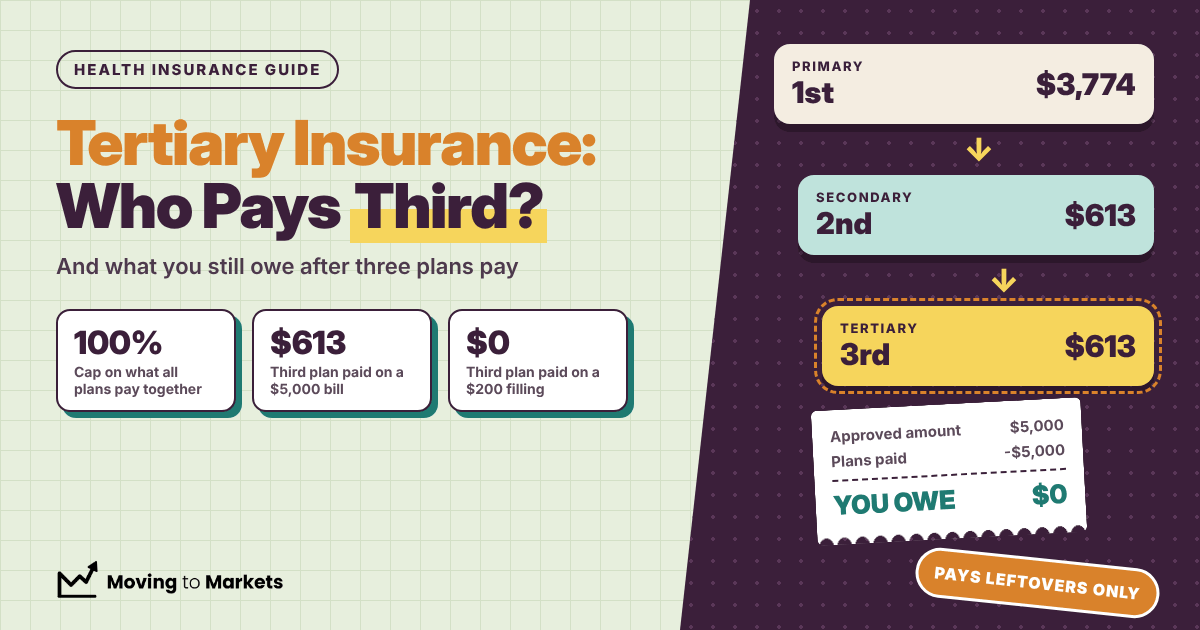
A third plan usually pays a small slice, often a few hundred dollars, because the first two plans already covered most of the bill. On a $5,000 Medicare-approved procedure with a retiree plan and TFL, Medicare pays about $3,774, the retiree plan pays part of the rest and TFL covers what’s left, so you owe $0.
Example 1: Retired veteran, age 68, with Medicare, a former employer’s retiree plan and TFL. Outpatient knee procedure, Medicare-approved amount $5,000. He hasn’t met his 2026 Part B deductible ($283).
| Step | Who pays | Amount | Left over |
|---|---|---|---|
| Medicare-approved amount | $5,000 | ||
| Medicare applies the $283 deductible, then pays 80% of $4,717 | Medicare (1st) | $3,773.60 | $1,226.40 ($283 deductible + $943.40 coinsurance) |
| Retiree plan pays 50% of the balance (example terms) | Retiree plan (2nd) | $613.20 | $613.20 |
| TFL pays remaining Medicare cost share | TFL (3rd) | $613.20 | $0 |
| You owe | $0 |
Without the third plan, he’d owe $613.20. Without the second and third, he’d owe $1,226.40. The 2027 Part B deductible goes up to $292, so next year’s math shifts by $9.
Example 2: Child with both parents’ dental plans and a third plan. A $200 filling.
| Step | Who pays | Amount | Left over |
|---|---|---|---|
| Primary pays 80% | Mom’s plan (birthday rule) | $160 | $40 |
| Secondary pays the $40 balance (its own benefit would be $160, so $40 fits) | Dad’s plan | $40 | $0 |
| Tertiary | Stepdad’s plan | $0 | $0 |
The third plan pays nothing, because 100% of the allowed cost is already paid. If you’re paying premiums to add a kid to a third dental plan, numbers like these are the reason to stop.
How do you file a claim with three insurance plans?
Give every provider all three cards at check-in, ranked in order. The provider bills the primary, then the secondary with the first EOB, then the tertiary with both EOBs. If the provider only bills one plan, you can send the rest yourself. Keep every EOB until the last plan pays.
- Tell each plan about the others. Most insurers send a yearly “other coverage” questionnaire. Fill it out, or claims get held.
- Give the front desk all three cards and say the order. Write “primary,” “secondary” and “tertiary” on a note if you have to. Billing software has a separate field for each.
- Watch for the primary EOB. It shows the allowed amount and what you owe. That number is what the secondary plan works from.
- Send the claim to the secondary plan if the provider doesn’t. Attach the primary EOB.
- Send to the tertiary plan with both EOBs. For TFL, Medicare usually sends the claim over on its own. If you also have other insurance between them, TRICARE’s trifold says to send a DD Form 2642, the Medicare Summary Notice and the other plan’s EOB to the TFL claims processor.
- Check timely filing limits. Each plan has its own deadline, counted from the date of service or from the previous payer’s EOB. A claim that sits on someone’s desk can miss the third plan’s window.
- Pay only what’s left after all three. If the provider bills you before the tertiary plan has processed, ask them to hold the bill.
If a plan denies because it thinks it should be secondary, call it and ask which rule it used. Order mix-ups are a common reason three-plan claims get stuck.
Is it worth buying a third insurance plan?
Usually not, if the third plan is another major medical plan. Two plans already cover most bills, and the third one only pays leftovers. It’s worth it when the third plan costs you nothing or very little, like Medicaid, CHIP or TRICARE For Life, or when it covers things the first two don’t.
Ask yourself these four questions before paying a third premium:
- What’s my out-of-pocket max on the first two plans? If your primary plan caps you at $4,000 a year and the secondary covers most of that, the third plan can only save you a few hundred dollars at most.
- What does it cost? A $150-a-month plan costs $1,800 a year. It has to pay more than that in leftovers to make sense.
- Does it cover something different? Dental, vision or hearing coverage that your other plans skip is a fair reason.
- Is it free? TFL has no enrollment fee (you pay for Part B). Medicaid and CHIP are free or close to it. Keep those.
Fixed-benefit plans like hospital indemnity or accident insurance are a different kind of product. They pay you a set amount, like $500 for a hospital day, no matter what your other plans pay, so they don’t stack in COB order. We cover those in our guide to medical expense insurance. If you have a high-deductible plan, an HSA can pay the leftovers too. See whether your HSA rolls over each year.
What is tertiary insurance in liability insurance?
In business and liability insurance, tertiary means a third layer of coverage. A primary policy pays first up to its limit, an excess or umbrella policy pays next, and a tertiary layer pays only after both are used up. A company with $1 million primary and $1 million excess might buy a third layer for claims over $2 million.
Construction firms, trucking companies and hospitals buy these layers for large lawsuits. If you’re an individual asking about your medical bills, you can ignore this meaning.
Frequently asked questions
What does tertiary insurance mean?
Tertiary insurance is the third plan that pays on a claim, after your primary and secondary insurance. It pays only the balance left after the first two, up to its own limits.
Can you have three health insurance plans?
Yes. It’s legal to have three plans. Common setups are Medicare plus a retiree plan plus TRICARE For Life, or a child covered by two parents’ plans plus Medicaid or CHIP.
Does tertiary insurance pay the deductible?
It can. If your primary and secondary plans leave a deductible unpaid, the tertiary plan may pay it, up to what it would have paid as primary. TRICARE For Life pays most Medicare deductibles and coinsurance for services both programs cover.
Is Medicaid primary, secondary or tertiary?
Medicaid pays last. If you have Medicaid and one other plan, it’s secondary. If you have two other plans, it’s tertiary. A few programs, like the Indian Health Service, pay after Medicaid.
Is TRICARE For Life primary or secondary to Medicare?
TRICARE For Life pays after Medicare. If you also have other insurance, like a current employer plan or a Medigap plan, TFL pays last as the third payer.
What is the birthday rule for insurance?
For kids covered by both parents’ plans, the plan of the parent whose birthday comes first in the calendar year pays first. Only the month and day count. If the birthdays match, the plan that covered a parent longer pays first.
Can three insurance plans pay more than the bill?
No. Coordination of benefits rules cap the total at 100% of the allowable expense. You can’t make money from having three plans.
What happens if my secondary insurance doesn’t cover the balance?
The balance goes to your tertiary plan if you have one. If not, you may owe it. Medicare.gov says if the secondary payer doesn’t cover the remaining balance, “you may be responsible for the rest of the costs.”
Who decides the order of my insurance plans?
State insurance rules, mostly based on the NAIC Coordination of Benefits Model Regulation, set the order for private plans. Federal rules set it for Medicare, Medicaid and TRICARE.