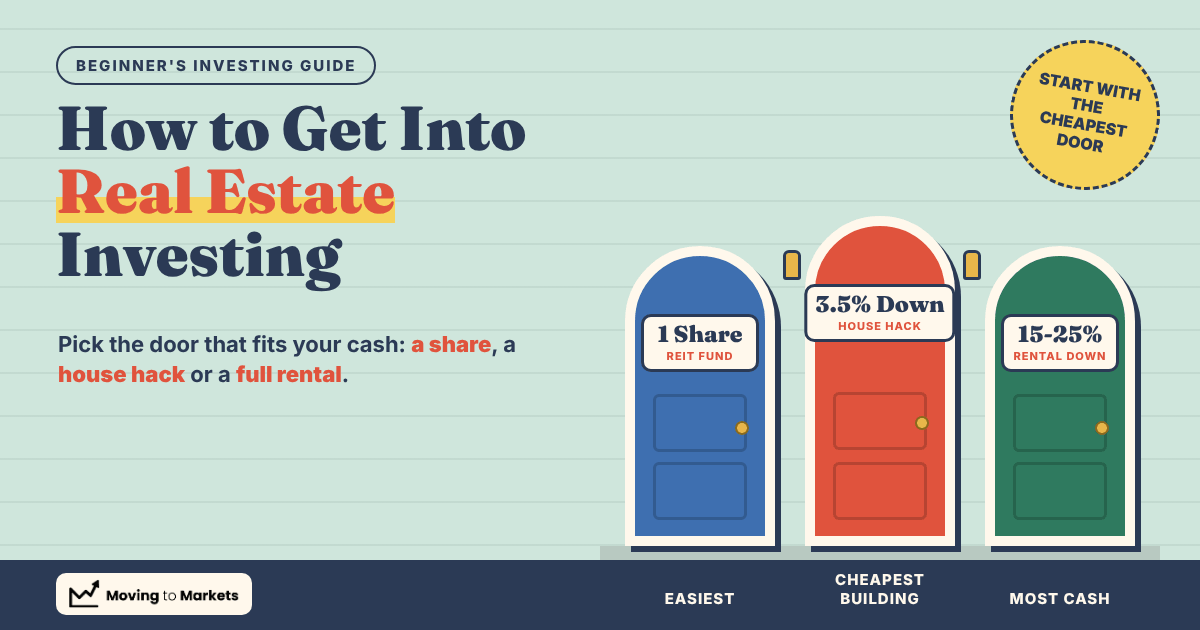
The cheapest way to get into real estate investing is a REIT fund, which you can buy for the price of one share in a regular brokerage account. The cheapest way to own a building is house hacking: buy a 2 to 4 unit home with an FHA loan (3.5% down) or a Fannie Mae loan (5% down), live in one unit and rent the others. A normal rental property usually needs 15% to 25% down plus closing costs and cash reserves.
We all know that one person who bought a small house in 2012, rented it out and now talks about “passive income” at every barbecue. You hear it and you think, ok, how do I even start? You don’t have $100,000 lying around and the 7% mortgage rates on the news don’t help.
Good news is you have more doors in than most people think. Some cost $50. Some cost $15,000 and a roommate who pays you rent. Some cost $90,000 and a lot of weekend calls about a leaking water heater. This guide lines them all up with real 2026 numbers, so you can pick the one that fits your money and your patience.
What’s the easiest way to get into real estate investing?
The easiest way is to buy a REIT index fund or ETF in a brokerage account. A REIT owns buildings like apartments, warehouses and data centers and must pay out at least 90% of its taxable income as dividends. Equity REITs yielded 3.77% at the end of October 2026, and you can start with one share.
A real estate investment trust (REIT) is a company that owns or finances property. When you buy a REIT fund you own a small slice of hundreds of buildings. You don’t fix toilets, find tenants or sign a mortgage.
Here’s where REITs sit right now, from Nareit’s November 9, 2026 update:
| Measure | Number |
|---|---|
| Equity REIT dividend yield (end of Oct 2026) | 3.77% |
| S&P 500 dividend yield | 1.04% |
| Equity REIT return, January to October 2026 | +13.0% |
| Total US stock market, same period | +11.7% |
| Mortgage REIT return, January to October 2026 | -16.3% |
Put $1,000 into an equity REIT fund at a 3.77% yield and you’d get about $37.70 a year in dividends. $10,000 gets you about $377. That’s not life changing, but it’s real estate income on day one with no loan.
Two things to know before you buy. REIT dividends are mostly taxed as ordinary income, not at the lower qualified dividend rate, so a Roth IRA or 401(k) is a good place to hold them. And mortgage REITs, the ones paying 16.59% yields, lend money instead of owning buildings. Their price fell 16.3% this year. A high yield there often means high risk.
If you already buy index funds, the setup is the same. Our S&P 500 investing guide walks through opening an account and placing the order.
How much money do you need to start investing in real estate?
You can start with the price of one REIT share, often under $100. Crowdfunding sites start around $10 to $500. Owning a building takes much more: about $29,000 cash for a $450,000 duplex with FHA’s 3.5% down, and $60,000 or more for a $300,000 rental at 20% down once you add closing costs.
| Route | Typical cash to start | Do you need a mortgage? | Your time each month |
|---|---|---|---|
| REIT fund or ETF | Price of 1 share | No | None |
| Real estate crowdfunding (Reg CF) | About $10 to $500 minimum | No | Almost none |
| House hack with FHA (2 to 4 units) | 3.5% down + closing costs. About $29,250 on a $450,000 duplex | Yes | A few hours (you’re the landlord) |
| House hack with Fannie Mae 5% down | 5% down + closing. About $36,000 on a $450,000 duplex | Yes | A few hours |
| Single-family rental (investment loan) | 15% to 25% down + closing + reserves. About $54,000 to $69,000 on $300,000 | Yes | 2 to 10 hours, less with a manager |
| Fix and flip | 10% to 25% down + full repair budget | Usually a short-term loan | Many hours |
Down payment rules for investment properties come from Fannie Mae’s April 1, 2026 matrix: 85% max loan-to-value on a 1-unit investment property (15% down) and 75% on 2 to 4 units (25% down). Closing costs in the table use 3% of the price.
Notice the gap between living in the property and not living there. On the same duplex, you’d put down $15,750 as an owner with FHA and $112,500 as an investor at 25%. That one rule is why house hacking is the most common way regular people buy their first rental.
Should you get your finances ready before you invest?
Yes. Before buying property, pay off credit card debt, keep 3 to 6 months of expenses in savings and get your credit score to at least 580 for FHA or 620 for most conventional loans. A rental with no cash cushion can turn one broken furnace into new credit card debt.
Real estate is slow money. You can’t sell a bathroom when your car breaks down. So check these first:
- High-interest debt is gone. Paying off a card at 22% APR beats almost any rental return.
- Emergency fund is in place. Three to six months of your own expenses, separate from the property fund. Our paycheck savings guide has a simple way to build it.
- Credit score is ready. FHA allows 3.5% down at 580 and up, 10% down at 500 to 579. Better scores get lower rates on every loan type.
- Debt-to-income fits. Lenders add your new mortgage to your car loan, student loans and card minimums. See Is a Mortgage Considered Debt? for the limits lenders use.
- Job history is steady. Lenders usually want two years of income they can document.
If two or more of these aren’t done, start with REITs while you fix them. You still get real estate in your portfolio and you’re not stuck with a building you can’t afford to hold.
What is house hacking, and how does it work with an FHA loan?
House hacking means you buy a 2 to 4 unit home, live in one unit and rent out the rest. Because you live there, you can use an FHA loan with 3.5% down. On a $450,000 duplex at 7.11%, the full payment is about $3,784 a month, and a $1,650 tenant cuts your share to about $2,134.
FHA loans can be used on homes with up to four units, as long as you move in within 60 days of closing and plan to live there for at least a year. You can’t use FHA for a pure investment property.
Here’s a full example on a $450,000 duplex:
Purchase: – Price: $450,000 – Down payment (3.5%): $15,750 – Closing costs (about 3%): $13,500 – Cash you bring: about $29,250 – Base loan: $434,250 – FHA upfront mortgage insurance (1.75%), added to the loan: $7,599 – Total loan: $441,849 at 7.11% for 30 years
Monthly cost:
| Line | Monthly |
|---|---|
| Principal and interest | $2,972 |
| FHA annual mortgage insurance (about 0.55%) | $199 |
| Property tax (1.1% a year) | $413 |
| Homeowners insurance ($2,400 a year) | $200 |
| Total payment | $3,784 |
| Rent from the other unit | -$1,650 |
| What you pay to live there | $2,134 |
For comparison, the median asking rent for a vacant US rental was $1,541 in Q3 2026 (Census). So in this example you pay about $600 more than a typical renter. The difference is that you’re paying down a loan on a $450,000 building, and the other unit’s rent rises over time while your principal and interest stay fixed.
Run the same numbers on your own market. In many Midwest cities a duplex costs $250,000 to $300,000 and the tenant’s rent covers most of the payment. In San Diego or Boston it can look much worse.
A few FHA details people miss:
- Mortgage insurance sticks around. With less than 10% down, FHA’s annual premium lasts for the life of the loan. You’d need to refinance to drop it. A conventional loan’s PMI can be cancelled once you hit enough equity; see How to Get Rid of PMI.
- 2026 FHA loan limits are higher for more units. In low-cost counties the cap is $541,287 for one unit, $693,050 for two, $837,700 for three and $1,041,125 for four. High-cost counties go up to $1,249,125, $1,599,375, $1,933,200 and $2,402,625 (HUD, effective January 1, 2026).
- Triplexes and fourplexes must pass a self-sufficiency test. Take 75% of the total expected rent from all units, including yours. That number has to cover the full monthly payment. Example: $4,000 total market rent × 75% = $3,000. If the payment is $2,900, you pass. If it’s $3,100, FHA won’t do the loan.
- After a year you can move out and keep the property as a rental. Then you can do it again with a new primary home, which is how many people end up owning three or four small buildings.
FHA or Fannie Mae 5% down: which loan works better for a house hack?
FHA needs only 3.5% down and accepts credit scores from 580, but its mortgage insurance usually lasts the life of the loan. Since November 2023, Fannie Mae allows 5% down on owner-occupied 2 to 4 unit homes, with mortgage insurance you can cancel and no self-sufficiency test on 3 and 4 units.
| FHA | Fannie Mae conventional | |
|---|---|---|
| Down payment on 2 to 4 units | 3.5% (580+ score) | 5% |
| Minimum credit score | 580 for 3.5% down, 500 with 10% down | Usually 620 |
| Upfront mortgage insurance | 1.75% of the loan | None |
| Monthly mortgage insurance | Life of the loan with under 10% down | Can be cancelled with enough equity |
| Self-sufficiency test on 3 to 4 units | Yes | No |
| Cash down on a $450,000 duplex | $15,750 | $22,500 |
| Principal and interest at 7.11% | $2,972 (with UFMIP added) | $2,876 (before PMI) |
With a score under about 680, FHA is often the only option that works. With a score of 720+ and a bit more cash, the 5% conventional loan usually costs less over time because the mortgage insurance can come off. Ask a lender to price both on the same property before you decide.
How do you buy your first rental property?
To buy your first rental: save 15% to 25% down plus closing costs and reserves, get preapproved for an investment loan, pick one market you know, test each listing with the 1% rule and a full expense budget, then make offers. Expect investment loan rates above the 7.11% owner average.
If you’re not going to live in the property, here’s the order most first-time investors follow:
- Save the cash. On a $300,000 house: $45,000 (15%) to $75,000 (25%) down, about $9,000 in closing costs, plus several months of payments in reserve. Lenders check that reserve.
- Get preapproved for an investment loan. Investment loans carry higher rates than owner loans. Ask the lender for a quote on an “investment property, 1 unit” so you see the real rate.
- Pick one market. Your own city or one you can drive to. You’ll know which streets rent fast and which don’t.
- Run the numbers on every listing. Start with the 1% rule: monthly rent should be about 1% of the price. A $300,000 house should rent for about $3,000. Most homes in 2026 don’t pass, and that’s fine. It filters out the ones that will cost you money each month.
- Budget every cost. Mortgage, tax, insurance, repairs (1% of the price a year), vacancy (the national rental vacancy rate was 7.6% in Q3 2026), property management (8% to 10% of rent) and a reserve for big repairs.
- Make offers and get inspected. A $500 inspection can save you a $12,000 roof.
- Set up the business side. Separate bank account, landlord insurance policy, written lease, and a plan for who answers repair calls.
We ran a full year-one rental example in Is Real Estate a Good Investment?. The short version: a $350,000 rental with 25% down at 7.75% lost about $820 a month at $2,300 rent. It needed rent of about $3,325 to break even. That’s why step 4 matters so much.
Can you invest in real estate with $500 or less?
Yes. REIT funds cost the price of one share, and real estate crowdfunding platforms that use SEC Regulation Crowdfunding take non-accredited investors, often starting at $10 to $500. If your income or net worth is under $124,000, the SEC caps your crowdfunding at the greater of $2,500 or 5% over 12 months.
Real estate crowdfunding lets you put money into a specific building or a pool of loans alongside other investors. Fundrise, for example, has had minimums as low as $10. Some deals are open only to accredited investors, which the SEC defines as:
- Net worth over $1 million, not counting your home, or
- Income over $200,000 ($300,000 with a spouse or partner) in each of the last two years, or
- Holding a Series 7, 65 or 82 license.
If you aren’t accredited, Reg CF deals are open to you but with limits over any 12 months:
| Your situation | Max you can invest in all Reg CF deals |
|---|---|
| Income or net worth under $124,000 | Greater of $2,500 or 5% of the higher of the two |
| Both income and net worth $124,000 or more | 10% of the higher of the two, max $124,000 |
Example: you earn $60,000 and your net worth is $40,000. 5% of $60,000 is $3,000, which is more than $2,500, so your limit is $3,000 a year.
Crowdfunding has a real catch. Your money is often locked up for 3 to 7 years with no easy way to sell, and fees on some platforms run 1% to 2.5%. A REIT fund you can sell any trading day. For most beginners, REITs make more sense first.
What about flipping, BRRRR and wholesaling?
Flipping, BRRRR and wholesaling are active strategies that need either a lot of cash or a lot of time. Flipping means buying, renovating and selling within months. BRRRR means buy, rehab, rent, refinance, repeat. Wholesaling means selling your contract on a house to another buyer for a fee, and some states now require a license.
Flipping. You buy a run-down house, fix it and sell it. Investors use the “70% rule”: pay no more than 70% of the after-repair value minus repair costs. For a house worth $300,000 fixed up that needs $40,000 of work, the max price is $300,000 × 70% − $40,000 = $170,000. Short-term loans for flips usually cost more than a regular mortgage, and every extra month you hold the house costs interest, taxes and utilities. Profits on a flip are taxed as ordinary income if you hold under a year.
BRRRR. Buy a house below market, rehab it, rent it, refinance at the new higher value to pull your cash back out, and repeat. It worked great when rates were 3%. At 7%+, the refinance often doesn’t give back all your cash, and the new bigger loan can wipe out the rent profit. Run the refinance numbers before you buy, not after.
Wholesaling. You get a house under contract, then sell that contract to another investor for a fee, often a few thousand dollars. It needs little cash but lots of marketing and phone calls. Some states treat it as brokering without a license. Illinois and Oklahoma were among the first to add rules, and others have followed. Check your state’s real estate commission before you sign any contract.
A side route some people take: get a real estate license. You learn the market from the inside and save on commissions on your own deals.
What tax breaks do new real estate investors get?
Rental owners can deduct mortgage interest, property tax, insurance, repairs and management fees, and can depreciate the building (not the land) over 27.5 years. On a $300,000 rental where the land is worth $60,000, that’s about $8,727 a year in depreciation you can deduct against rent.
Depreciation is the big one. The IRS lets you write off the cost of a residential rental building over 27.5 years, even while the property goes up in value. Example:
- Price: $300,000
- Land value (not depreciable): $60,000
- Building value: $240,000
- Yearly depreciation: $240,000 ÷ 27.5 = $8,727
If your rent minus expenses is $8,000, depreciation can turn that into a paper loss, so you owe no tax on the rent that year. You pay some of it back when you sell, through depreciation recapture.
REIT dividends work differently. They’re mostly taxed as regular income, though many REIT dividends get a 20% deduction under section 199A. Holding REITs inside an IRA or 401(k) avoids the yearly tax bill.
Taxes on rentals get complicated quickly once you add passive loss rules and 1031 exchanges. Pay a CPA for your first year’s return. It usually costs a few hundred dollars and can save you much more.
What mistakes do beginners make?
The most common beginner mistakes are underestimating repair and vacancy costs, buying with no cash reserve, trusting the seller’s rent numbers, picking a market far away without visiting it, and assuming prices will rise fast enough to cover monthly losses. Home prices rose only 2.1% in the year to Q2 2026 (FHFA).
- Budgeting $0 for repairs. Something always breaks. Plan for about 1% of the price a year, more on houses built before 1980.
- No reserve. One empty month plus one furnace can cost $6,000. If that goes on a credit card at 22%, your rental just got a lot more expensive.
- Trusting the listing’s rent. Check rentals on Zillow or Apartments.com for the same street and size. Call a local property manager and ask what it would really rent for.
- Out-of-state “turnkey” deals you never see. Some are fine. Some are houses nobody local wanted. Fly out or hire an inspector you chose yourself.
- Counting on appreciation. At 2% a year growth, a house that loses $500 a month takes a long time to catch up.
- Skipping landlord insurance. A regular homeowners policy may not cover a property you rent out.
What should you do this week?
This week: check your credit score, add up how much cash you could invest without touching your emergency fund, open a brokerage account and buy a small REIT fund position, then get one lender quote on an FHA or 5% down duplex in your area to see the real numbers.
- Pull your free credit reports at AnnualCreditReport.com and check your score with your bank or card app.
- Write down your cash: emergency fund on one line, money you could invest on another.
- If you have under $15,000 to invest, open a brokerage or Roth IRA and buy a REIT index fund. Set up an automatic monthly buy.
- If you have $15,000 to $40,000 and you’d move, look up 2 to 4 unit listings in your area and send one to a lender for an FHA and a 5% down quote.
- If you have $60,000+ and don’t want to move, run three local single-family listings through the 1% rule and a full expense budget.
- Talk to one local landlord. Ask what surprised them in year one. You’ll learn more in 20 minutes than from ten YouTube videos.
Real estate rewards people who start small and run the numbers honestly. Your first move doesn’t need to be a building. It can be one REIT share and one lender call. If you have questions about your numbers, send us a message through the Contact Us page.
FAQ
How do I get into real estate investing with no money?
You can’t buy property with zero dollars, but you can start with very little. A REIT fund costs the price of one share. If you want to own a building, an FHA house hack needs 3.5% down plus closing costs, about $29,000 on a $450,000 duplex. Some people partner with a friend who has cash while they do the work.
What is the best real estate investment for beginners?
For most beginners, a REIT index fund is the best first step because it needs no loan, no repairs and very little money. If you want to own property, house hacking a 2 to 4 unit home is usually the cheapest way in, because owner-occupied loans allow 3.5% to 5% down instead of 15% to 25%.
Can I use an FHA loan to buy an investment property?
Not a pure investment property. FHA loans are for homes you live in, but the home can have up to four units. You must move in within 60 days of closing, and you can rent the other units from day one. Triplexes and fourplexes must pass FHA’s self-sufficiency test.
How much do you need to put down on a rental property?
Fannie Mae’s April 2026 matrix allows 15% down on a 1-unit investment property and 25% on 2 to 4 units. On a $300,000 house that’s $45,000 to $75,000, plus about 3% in closing costs and several months of payments in reserve. Living in the property drops the down payment to 3.5% to 5%.
Is real estate crowdfunding safe?
It’s legal and regulated by the SEC, but it isn’t low risk. Your money is often locked up for years, deals can lose money, and some platforms charge fees of 1% to 2.5%. Non-accredited investors face SEC limits, starting at the greater of $2,500 or 5% of income or net worth if either is under $124,000.
Do REITs count as real estate investing?
Yes. A REIT owns or finances real property, and by law must pay out at least 90% of its taxable income as dividends. Equity REITs yielded 3.77% at the end of October 2026 and returned 13.0% from January through October, compared with 11.7% for the total US stock market (Nareit).
What credit score do I need to buy an investment property?
FHA house hacks allow 580 for 3.5% down. Most conventional loans, including Fannie Mae’s 5% down option on 2 to 4 units, usually need at least 620. Investment property loans often price better at 680 to 740 and above, so a higher score saves money every month.