Tax value is the price your county puts on your home to figure your property tax. Market value is the price a real buyer would pay today. Use market value to buy, sell, refinance or insure. Use tax value only to check and budget your tax bill. When the county’s market value is higher than what similar homes sold for, you can challenge it before the deadline on your notice.
You open the envelope from the county and it says your house is worth $410,000. Two days later your neighbor sells a nearly identical house for $382,000. Or the opposite happens, your notice says $240,000 and agents keep texting you that they can get $400,000 for it. So which one is “right”?
Both, kind of. The county and the buyer are answering different questions. The county wants a number it can apply a formula to, for every house in the county, on the same day. A buyer wants to know what this one house is worth to them, right now. Once you know which question you are asking, picking the right number is easy, and you might find a few hundred dollars a year you were overpaying.
Which number should you use for your decision?
Use market value for anything involving a sale, a loan or insurance, because buyers, appraisers and lenders all work from recent sales. Use tax value only to estimate or challenge your property tax bill. The two get mixed up most often when you buy a house and budget from the seller’s old tax bill.
| Your situation | Number to use | Why | Common mistake |
|---|---|---|---|
| Pricing your home to sell | Market value (recent sales nearby) | Buyers compare your house to what sold last month | Listing at the tax value because “the county said so” |
| Making an offer | Market value | Your lender’s appraiser checks the price against sales | Thinking a low tax value means the house is overpriced |
| Budgeting taxes on a home you’re buying | Your price and the local tax rules | Many states reset the tax value after a sale | Using the seller’s current tax bill |
| Refinancing or a HELOC | Appraised value | The lender orders its own appraisal | Expecting the lender to use the county figure |
| Homeowners insurance | Rebuild cost | Insurers cover the cost to rebuild, not the land or the sale price | Insuring for the tax value or the sale price |
| Checking your tax bill | Tax value and your exemptions | That’s what the tax rate is applied to | Ignoring a notice that’s thousands too high |
| Running numbers on a rental | Market value for price, post-sale tax for expenses | The tax bill often jumps after you buy | Using the seller’s tax bill in your cash flow math |
If you only remember one row, make it the third one. That’s where people lose real money.
How do you read your property tax notice?
Most notices list a market value (sometimes called fair market value or true cash value), an assessed value, a list of exemptions and a taxable value. Your tax is the taxable value times your local tax rate. Check the market value line against recent sales first, because every other line starts from it.
Notices look different in every county, but they usually walk through the same five lines in this order:
- Market value. The county’s estimate of what your home would sell for. Georgia calls it fair market value, Michigan calls it true cash value. This is the line you can argue with.
- Assessed value. Market value times your state’s assessment ratio. In Georgia that’s 40%. In Michigan the state equalized value (SEV) is 50%.
- Exemptions. Homestead, senior, veteran and disability exemptions come off here. If you live in the house and don’t see a homestead exemption, call the county today.
- Taxable value. What’s left after the ratio, any cap and the exemptions. This is the number the rate gets applied to.
- Tax rate. Usually listed in mills. One mill is $1 for every $1,000 of taxable value, so 30 mills is 3%.
Here’s a Georgia home worked through all five lines. The 30-mill rate is a round number for the example; your bill lists your real rates for the county, city and school district.
- Fair market value on the notice: $350,000
- Assessed at 40%: $140,000
- Exemptions: none, to keep it simple
- Taxable value: $140,000
- Tax at 30 mills: $140,000 ÷ 1,000 × 30 = $4,200 a year
That $4,200 is 1.2% of the $350,000 market value. That percentage is your effective tax rate, and it’s the fairest way to compare places. ATTOM’s 2025 property tax report, published April 9, 2026, put the national effective rate at 0.9% and the average single-family bill at $4,427. Illinois was highest at 1.84%, then New Jersey at 1.58%. Hawaii was lowest at 0.33%, then Idaho at 0.39%.
How far apart can tax value and market value get?
It depends on three things your state controls: the assessment ratio, how often values get updated, and whether yearly increases are capped. A state with a low ratio and a cap, like South Carolina, can tax a home on a small fraction of what it would sell for. A full-value state with yearly updates keeps them close.
| State | Assessment ratio for your home | Cap on yearly growth | What resets it |
|---|---|---|---|
| Georgia | 40% of fair market value | HB 581: assessed value of a homestead can rise only by last year’s inflation, unless your local government opted out | Sale, or adding to the house |
| Michigan | SEV is 50% of true cash value | Taxable value rises by inflation or 5%, whichever is less (1.027 for 2026) | Sale (“uncapping”) |
| South Carolina | 4% of fair market value for a legal residence | Reassessment increases limited to 15% over five years | An “assessable transfer of interest,” like a sale |
| Texas | 100% of market value | Homestead 10% a year; other property worth $5.32 million or less, 20% a year through 2026 | Losing the homestead, a sale |
A few things in that table need a closer look.
Georgia’s HB 581 took effect January 1, 2025. It works off a base year (2024 for homes that got it in its first year) and lets the assessed value climb only by the prior year’s inflation. Say your 2024 assessed value was $140,000, prices jumped 9% and inflation was 3%. Without the exemption your assessed value would be $152,600. With it, the most it can be is $144,200. That’s $8,400 less taxable value, or $252 a year at 30 mills. The catch: each county, city and school district had until March 1, 2025 to opt out, and an opt-out is permanent. Some metro Atlanta school systems voted to opt out, the Atlanta Journal-Constitution reported, so you may get the cap on your county tax and not on your school tax. Your notice shows which.
South Carolina’s 15% limit is per five-year reassessment, not per year. Picture a $300,000 home assessed at 4%, so $12,000 of assessed value. The county reassesses and says it’s now worth $390,000, a 30% jump. The cap holds the taxable market value to $345,000, so assessed value goes to $13,800 instead of $15,600. When you sell, the buyer starts over at their own price.
Michigan has the most confusing version, so it gets its own section.
Why does the tax bill jump after a home sells?
In capped states, the cap belongs to the owner, not the house. When the house sells, the county can reset the tax value to current market levels. In Michigan, taxable value “uncaps” to the state equalized value the year after the sale. A buyer can pay thousands more a year than the seller did.
Here’s how it plays out in Michigan. The 45-mill rate is a round number for the example.
- The seller has owned the house for 15 years. Their taxable value has crept up with inflation to $110,000.
- The assessor puts true cash value at $300,000, so the SEV is $150,000.
- The seller’s tax: $110,000 ÷ 1,000 × 45 = $4,950 a year.
- You buy the house in 2026. In 2027, taxable value uncaps to that year’s SEV. If it’s still $150,000, your tax is $150,000 ÷ 1,000 × 45 = $6,750 a year.
That’s $1,800 more a year, about $150 a month, on the same house. Lots of buyers find out when their escrow comes up short in year two.
Two details trip people up. First, Michigan uncaps to the SEV, not to your purchase price. The City of Portage’s 2026 guide spells this out: “a property does not uncap to the selling/purchase price but to the SEV in the year following the transfer.” Second, the cap starts again right after. If the market rises 8% the next year, SEV goes to $162,000, but your taxable value can only rise to $150,000 × 1.027 = $154,050 (using the 2026 multiplier for the example).
You also have paperwork. Michigan wants a Property Transfer Affidavit within 45 days of the sale. File late and it’s $5 a day, up to $200.
What to do before you buy, in any state:
- Look up how your state treats a sale. Search your county assessor’s site for “transfer of ownership” or “reassessment after sale.”
- Estimate your own bill. Multiply your price by the local effective rate, or use the county’s tax estimator if it has one.
- Give that number to your lender. Property tax goes into your monthly payment and your debt-to-income ratio.
- File for your homestead exemption as soon as you move in.
If you’re putting less than 20% down, your payment also carries mortgage insurance. Our guide on how to get rid of PMI shows when you can drop it.
How is a rental taxed differently from your home?
Most states give homestead protections only to the home you live in. In Texas, your homestead’s appraised value can rise at most 10% a year, while a rental gets the 20% “circuit breaker” cap if it’s worth $5.32 million or less. That 20% cap is set to expire on December 31, 2026.
Take two Texas houses, each appraised at $280,000 last year. This year the appraisal district says each is worth $360,000.
| Your homestead | Your rental | |
|---|---|---|
| Last year’s appraised value | $280,000 | $280,000 |
| District’s market value this year | $360,000 | $360,000 |
| Cap | 10% | 20% (circuit breaker) |
| Highest appraised value allowed | $308,000 | $336,000 |
| Value without any cap | $360,000 | $360,000 |
At a 2% total tax rate, the circuit breaker saves the rental owner $480 this year ($24,000 × 2%). The homestead owner saves $1,040 ($52,000 × 2%), before exemptions even come off.
The circuit breaker threshold rises with inflation each year. The Comptroller lists it at $5 million for 2024, $5.16 million for 2025 and $5.32 million for 2026. The law that created it, Tax Code section 23.231, ends on December 31, 2026. Unless lawmakers extend it, your 2027 notice on a rental could show the full jump with no cap at all. Plan your rent and cash flow for that.
This is also why investors should never use the seller’s tax bill. If you’re buying a rental, our guide on multifamily investing show where taxes go in the math.
How can you tell if your tax value is too high?
Compare the county’s market value to three to five homes like yours that sold close to the county’s valuation date. If the county’s number is more than about 5% above the middle of those sales, or your property record has wrong details, you likely have a case worth filing.
This takes about 15 minutes.
- Pull your property record from the assessor’s website. Check square footage, bedrooms, bathrooms, garage, basement and lot size. A finished basement you don’t have, or 300 extra square feet, is the easiest fix there is.
- Find 3 to 5 sales of homes with similar size, age and condition, ideally on your street or in your subdivision. Use sales from around the date the county values homes (often January 1).
- Find the middle price. Put the sales in order and take the one in the middle.
- Compare. Divide the county’s market value by that middle price.
- Do the dollar math before you spend a Saturday on it.
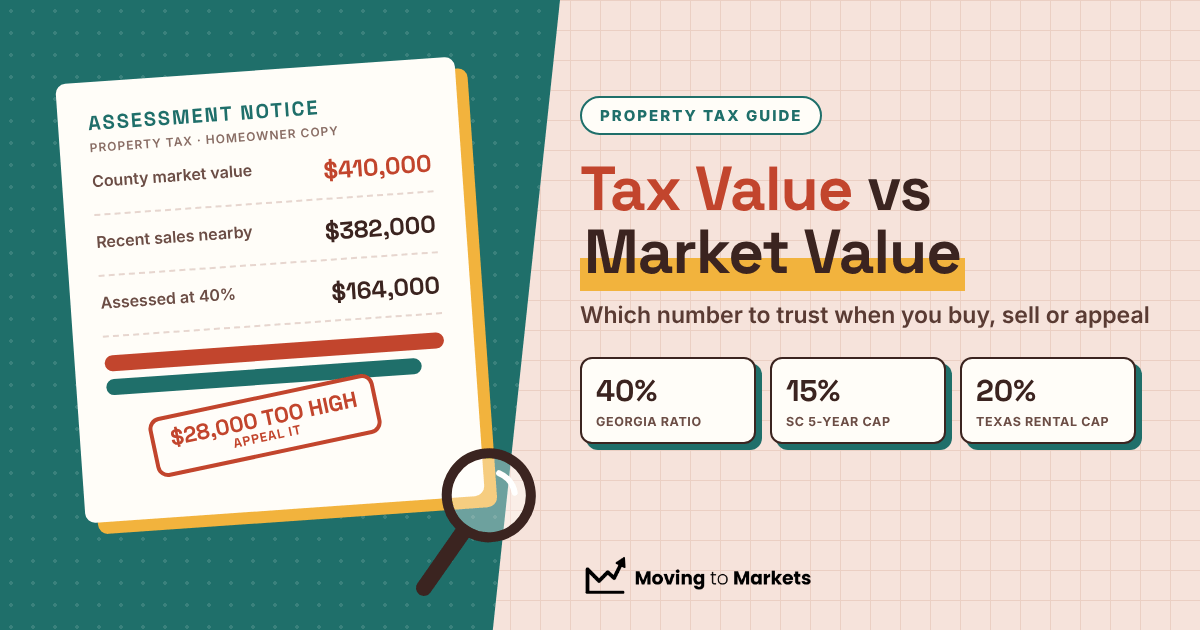
Example: the county says $410,000. Your four sales are $372,000, $379,000, $385,000 and $391,000, so the middle is $382,000 (the average of the two middle sales). The county is $28,000 high, about 7.3%. At a 1.5% effective tax rate, that’s $420 a year. Over five years, $2,100. And in a capped state, a lower starting value keeps paying off because future increases build on it.
Other good reasons to file: the house needs a roof, has foundation cracks or flood damage, or your value went up much more than your neighbors’ did.
When is the deadline to challenge your tax value?
Deadlines are short and printed on your notice. Texas gives you until May 15 or 30 days after the notice was delivered, whichever is later. California’s 2026 window ran July 2 to September 15 in 11 counties and runs to November 30, 2026 in the rest. Michigan appeals start at the March Board of Review.
| State | When to file | Where |
|---|---|---|
| Texas | May 15 or 30 days after your notice was delivered, whichever is later (Tax Code 41.44) | Appraisal review board. You can ask for an informal meeting with the appraisal district first. |
| California | July 2 to September 15 in Alameda, Alpine, Inyo, Kings, Mono, Placer, San Francisco, San Luis Obispo, Santa Clara, Sierra and Ventura. July 2 to November 30 in every other county, including Los Angeles, Orange, San Diego and Riverside (2026) | County assessment appeals board, on form BOE-305-AH |
| Michigan | March Board of Review (Portage’s 2026 board started March 9). Residential appeals to the Michigan Tax Tribunal by July 31 | Local Board of Review first |
| Georgia | The deadline printed on your annual notice | County board of equalization, a hearing officer or arbitration |
| Everywhere else | Check the notice | Usually the assessor first, then a local board |
If you’re in a California county with a November 30, 2026 deadline, you still have time this year. Bring your sales, your corrected property record and photos of any damage. Keep the hearing about your house’s value. Boards can’t lower your tax because taxes feel too high in general.
Does tax value change what your house sells for?
No. Buyers and appraisers price a home from recent comparable sales. Tax value matters in a quieter way: buyers look at the tax line on a listing to guess their payment. A low tax value can make a listing look cheaper to own than it will be after the sale.
When you sell, don’t lean on a low tax bill as a selling point if your state resets values after a sale. The buyer’s lender will figure taxes at the new level, and a sharp buyer’s agent will too. If your county number is way above market, though, it’s worth telling buyers why, because it can spook people reading the listing.
FAQ
Is a low tax value a good thing?
For your tax bill, yes. It doesn’t mean your house is worth less. It usually means your state caps increases or taxes only part of the value, and the low number often disappears when the house sells.
Can my tax value go down when home prices fall?
Yes. Assessors update market value based on sales. In capped states, if market value falls below your capped value, your taxable value can come down to match it.
Why did my property taxes go up after I bought my house?
Many states reset the tax value after a sale. Michigan uncaps taxable value to the state equalized value the year after you buy, and Georgia, South Carolina and Texas caps don’t carry over to a new owner.
What is the difference between assessed value and taxable value?
Assessed value is market value times your state’s ratio, such as 40% in Georgia. Taxable value is what’s left after caps and exemptions. Your tax rate is applied to taxable value.
Do mortgage appraisers use the county tax value?
No. Lenders order their own appraisal based on recent sales and an inspection of the home. They use your tax bill only to figure your monthly payment and escrow.
Does Zillow’s estimate use my tax value?
Online estimates use public records, which include tax data, along with recent sales. They are rough guesses. Neither the county nor a lender uses them to set your tax or loan.
Is it still too late to appeal in California this year?
Not in most counties. For 2026, the deadline is November 30 in every county except the 11 that closed September 15: Alameda, Alpine, Inyo, Kings, Mono, Placer, San Francisco, San Luis Obispo, Santa Clara, Sierra and Ventura.
Do rental properties get the same tax caps as my home?
Usually not. Homestead caps cover the home you live in. Texas rentals worth $5.32 million or less get a 20% yearly cap instead of 10%, and that rule expires December 31, 2026.