We all know someone who bought a house with less than 20% down, looked at their first mortgage statement and said “wait, what’s this $190 for?” That’s PMI. It protects the lender, not you, and you keep paying it until somebody makes it stop.
The good news is you don’t have to wait forever. The law takes it off at some point on its own, and you can ask for it to come off a lot sooner if you know which numbers your servicer is looking at.
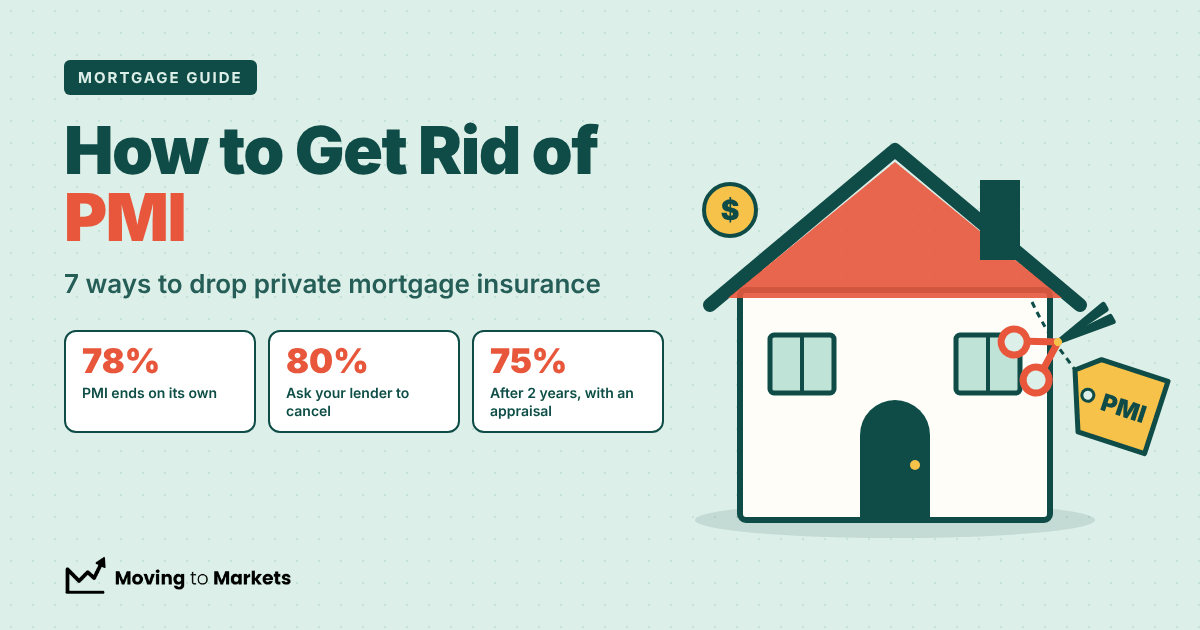
The short answer: on a conventional loan, PMI ends automatically when your balance is scheduled to hit 78% of your home’s original value. You can ask to cancel it at 80%, or earlier using a new appraisal if your home has gone up in value: 75% loan-to-value after 2 years, or 80% after 5 years. FHA mortgage insurance follows different rules and often needs a refinance.
PMI removal rules at a glance
| Way to drop PMI | Loan-to-value you need | Waiting period | Who starts it | Cost to you |
|---|---|---|---|---|
| Automatic termination | 78% of original value (on schedule) | None | Servicer, by law | $0 |
| Midpoint termination | Any | Halfway through the loan term (year 15 on a 30-year) | Servicer, by law | $0 |
| Request at 80% | 80% of original value | None | You, in writing | Possibly a valuation |
| Current value, loan 2 to 5 years old | 75% of today’s value | 2 years | You | Appraisal or BPO, often $300 to $500 |
| Current value, loan over 5 years old | 80% of today’s value | 5 years | You | Appraisal or BPO |
| Improvements you made | 80% of today’s value | None | You | Appraisal or BPO |
| Refinance | Usually 80% of today’s value | None | You | Closing costs, 2% to 6% of the loan |
These are Fannie Mae’s rules for a one-unit home you live in or a second home. Freddie Mac uses the same 75% and 80% tests. Two to four unit homes and investment properties need 70%.
What is PMI and how much does it cost?
PMI, or private mortgage insurance, is a monthly fee on a conventional loan when you put down less than 20%. It pays the lender if you stop paying. Freddie Mac says it usually costs about $30 to $70 a month for every $100,000 you borrow, so a $380,000 loan runs roughly $114 to $266 a month.
Your exact rate depends on your credit score, your down payment and the insurer. You’ll find the real number on page 1 of your Closing Disclosure, or on your monthly statement under escrow.
For the rest of this guide, we’ll use one example so the numbers stay comparable:
- Home price: $400,000
- Down payment: 5% ($20,000)
- Loan: $380,000, 30-year fixed at 7.11% (Freddie Mac’s average on November 12, 2026)
- Principal and interest: $2,556 a month
- PMI: $190 a month ($50 per $100,000, the middle of Freddie Mac’s range)
When does PMI go away on its own?
Under the Homeowners Protection Act, your servicer must cancel PMI automatically when your balance is scheduled to reach 78% of your home’s original value, as long as you’re current on payments. If that hasn’t happened by the halfway point of your loan term, PMI ends the month after that midpoint.
“Original value” means the lower of your purchase price or the appraisal when you bought. If you refinanced, it’s the appraised value at the refinance. These rules cover loans on a primary home that closed on or after July 29, 1999.
Here’s how long that takes on our example loan if you just make normal payments:
| Milestone | Balance | When you hit it | PMI paid by then |
|---|---|---|---|
| 80% of $400,000 | $320,000 | Month 131 (about 10 years 11 months) | $24,890 |
| 78% of $400,000 | $312,000 | Month 143 (about 11 years 11 months) | $27,170 |
| Midpoint of a 30-year loan | Not needed | Month 181 (start of year 16) | Backstop only |
So waiting costs you about $27,000. Most people can do better than that.
One catch on automatic termination: “current” means the payment due the month before was paid by the end of the month it was due. If you’re behind, PMI stays until you catch up. Fannie Mae’s guide also says the servicer can’t charge you a fee to process it.
How do you request PMI removal at 80%?
You can ask your servicer in writing to cancel PMI once your balance reaches 80% of the original value, either on schedule or because you paid extra. You need a good payment history, no second mortgage or HELOC on the home, and proof the home hasn’t dropped in value. The servicer must answer within 30 days.
On our example loan, asking at 80% instead of waiting for 78% saves 12 months of PMI, which is $2,280. Here’s how to do it:
- Find your 80% number. Multiply your original value by 0.80. For a $400,000 home that’s $320,000. Check your balance on your statement or your servicer’s app.
- Check your payment record. Fannie Mae requires no payment 30 or more days late in the last 12 months and no payment 60 or more days late in the last 24 months.
- Check for second liens. The CFPB says you have to certify there’s no junior lien, such as a HELOC or a second mortgage.
- Send a written request. Call first and ask for the servicer’s PMI cancellation form or mailing address. Many servicers take it through their online message center.
- Let them check the value. Fannie Mae servicers first run an automated valuation. If it comes in at or above your original value, PMI is cancelled. If it’s lower, you can order a broker price opinion (BPO) or appraisal, or pay the loan down further.
- Watch your next statement. Fannie Mae gives servicers 30 days to stop charging PMI after you qualify, and you should get written notice.
A simple request letter works fine:
I’m requesting cancellation of private mortgage insurance on loan number [your number] for the property at [address]. My principal balance is now [balance], which is 80% or less of the original value of [original value]. I am current on my payments, and there are no other liens on the property. Please let me know if you need a valuation or any other documents.
Can you remove PMI based on your home’s current value?
Yes. If your home has gone up in value, Fannie Mae and Freddie Mac let you cancel PMI using a new appraisal. Your loan-to-value must be 75% or less if the loan is 2 to 5 years old, or 80% or less if it’s more than 5 years old. You usually pay for the appraisal, often $300 to $500.
This is the fastest route for a lot of people who bought in 2020 to 2022, since home prices rose a lot after that. Here’s what it looks like on our example loan:
| Loan age | Balance | LTV you need | Home value you need | Rise from $400,000 |
|---|---|---|---|---|
| 2 years | $372,164 | 75% | $496,219 | 24% |
| 5 years 1 month | $357,683 | 80% | $447,104 | 12% |
| 6 years | $352,731 | 80% | $440,914 | 10% |
A few things to know before you pay for an appraisal:
- Seasoning means the loan’s age. Fannie Mae’s guide says “seasoning of the mortgage loan,” so the clock starts at your closing date. If you refinanced last year, you’re at year one again.
- Check comps first. Look up 3 or 4 recent sales of similar homes on your street. If they don’t support the value you need, hold off and save the $300 to $500.
- Ask your servicer which valuation they accept. Fannie Mae requires one that inspects the inside and outside of the home, ordered through its system. Don’t order your own appraisal without asking, because the servicer may not accept it.
- Your payment record matters here too. Same test: no 30-day late in 12 months, no 60-day late in 24 months.
How much do extra payments speed up PMI removal?
Extra principal payments move your balance toward the 80% mark faster, and you can request cancellation the month you get there. On a $380,000 loan at 7.11%, adding $300 a month reaches 80% in about 6 years 7 months instead of 10 years 11 months, saving about $9,880 in PMI.
| Extra payment each month | Time to reach 80% | PMI saved vs. normal 80% date |
|---|---|---|
| $0 | 10 years 11 months | $0 |
| $200 | 7 years 7 months | About $7,600 |
| $300 | 6 years 7 months | About $9,880 |
| $500 | 5 years 2 months | About $13,110 |
Mark the extra money as “principal only” so the servicer doesn’t treat it as an early payment. And don’t pull money out of your emergency fund or your 401(k) to do this. Owing less on a house you can’t afford to repair is not a win.
Does a lump sum or loan recast remove PMI?
A lump sum works the same as extra payments: once your balance is at 80% of the original value, you can ask for cancellation. A recast goes one step further and re-figures your monthly payment on the lower balance. Not every loan allows a recast, and servicers charge a fee for it.
On our example loan, here’s the lump sum you’d need to hit $320,000:
- After 3 years (balance $367,810): about $47,810
- After 5 years (balance $358,117): about $38,117
That’s a lot of cash to drop PMI that costs $2,280 a year. Compare it with what that money earns elsewhere. If it’s sitting in a savings account, our guide on how a high-yield savings account works and the difference between APY and interest rate will help you run the numbers. If you’d invest it instead, see how to invest in the S&P 500.
Can home improvements get rid of PMI faster?
Yes, if the improvements raised your home’s value. Fannie Mae waives the 2-year wait when you made improvements that added value, but then your loan-to-value must be 80% or less based on the new appraisal. Repairs and normal upkeep don’t count.
Fannie Mae’s guide describes improvements as work that “substantially” improves the home, such as a kitchen or bathroom renovation or added square footage. A new roof that replaces an old one counts as maintenance in most cases. Keep receipts, permits and before-and-after photos, because you’ll have to list what you did since closing.
Should you refinance to get rid of PMI?
Only if the new rate is about the same as your current rate or lower. With 30-year rates averaging 7.11% in November 2026, anyone who locked in lower loses money refinancing just to drop PMI. Closing costs of 2% to 6% can take 3 to 9 years of PMI savings to pay back.
Here’s the math on our example loan after 6 years, with a $352,731 balance:
- Closing costs at 2%: $7,055, or 37 months of PMI
- Closing costs at 6%: $21,164, or 111 months of PMI
A current-value appraisal gets the same result for $300 to $500 if your home has gone up enough. So try that first. Refinancing makes more sense if you’re also moving from an FHA loan to conventional, or if rates have dropped well below what you have.
How do you get rid of FHA mortgage insurance (MIP)?
FHA loans charge MIP, not PMI, and the 78% and 80% rules don’t apply. If you put down 10% or more, MIP ends after 11 years. If you put down less than 10%, it lasts for the life of the loan, and the only way out is to refinance into a conventional loan or sell.
HUD’s Mortgagee Letter 2023-05 set the current rates for 30-year FHA loans endorsed on or after March 20, 2023:
| Down payment (base loan up to $726,200) | Annual MIP | How long you pay |
|---|---|---|
| 10% or more (LTV 90% or less) | 0.50% | 11 years |
| 5% to under 10% | 0.50% | Life of the loan |
| Under 5% (the usual 3.5% down) | 0.55% | Life of the loan |
You also pay 1.75% upfront, which most people roll into the loan.
The dollar difference is big. On a $400,000 home with 3.5% down ($386,000 base loan), MIP starts at about $177 a month and adds up to about $42,450 over 30 years at 7.11%. With 10% down ($360,000 loan), it starts at $150 a month and ends after 11 years, at about $18,430 total.
If your FHA case number was assigned before June 3, 2013, older rules apply: MIP comes off at 78% LTV, and on loans longer than 15 years you also need at least 5 years of payments.
To refinance out of FHA, you’ll want at least 20% equity based on today’s value so the new conventional loan has no PMI. Run the closing cost math from the section above first.
What changed for PMI in 2026?
Two things. Since September 16, 2026, Fannie Mae lets mortgage servicers contact you when your loan is close to or past the cancellation limits. And Executive Order 14438, signed October 22, 2026, asks the FHFA to consider a pilot for automatic PMI cancellation. That pilot hasn’t started and would only cover new loans.
Before September, Fannie Mae’s guide told servicers they “must not solicit” borrowers to cancel PMI based on current value. Freddie Mac’s guide already allowed outreach, and the FHFA told Fannie Mae to match it. The rules for qualifying didn’t change. You still need the same payment record, loan age and valuation.
The executive order, “Decreasing Housing Costs for the American People,” asks Fannie Mae and Freddie Mac to look at automated valuations to cancel PMI with less paperwork. It applies only to mortgages made after the pilot begins, it has no start date, and it doesn’t cover FHA MIP. If you have PMI today, nothing about your loan changed because of it.
What can stop your PMI cancellation request?
The most common reasons for a denial are a late payment in the last 12 to 24 months, a HELOC or second mortgage on the home, an appraisal that comes in too low, a loan that isn’t old enough for the current-value route, or a property type that needs 70% instead of 80%.
- Late payments. One payment 30 days late in the last year is enough for Fannie Mae to say no. Fannie Mae does ignore late payments tied to a disaster if you followed a forbearance or repayment plan.
- A HELOC. You have to certify there are no junior liens for the 80% request. Paying off and closing a small HELOC first can make sense.
- Low value. If the home is worth less than your original value, the 80% request based on original value fails until you pay down more.
- Rentals and multi-unit homes. For a 1 to 4 unit investment property or a 2 to 4 unit home you live in, Fannie Mae wants 70% LTV, and automatic termination only comes at the midpoint.
- Assumed loans. If you took over someone else’s mortgage, Fannie Mae requires a 24-month payment history under your name.
If you’re denied, the servicer has to tell you why in writing, including the valuation result.
What about lender-paid PMI, VA and USDA loans?
Lender-paid PMI can’t be cancelled because it’s built into your interest rate, so only a refinance removes it. VA loans have no monthly mortgage insurance, just a one-time funding fee. USDA loans charge an annual fee of 0.35% that lasts for the life of the loan.
If you’re not sure what kind you have, look at your Closing Disclosure. Borrower-paid PMI shows up as a monthly line in your projected payments. Lender-paid PMI won’t show up as its own line.
How to get rid of PMI: a quick plan
- Pull your Closing Disclosure and note your original value, PMI amount and closing date.
- Divide your current balance by your original value. If you’re at 80% or below, send the written request now.
- If you’re not, check what nearby homes sold for. Divide your balance by that value. If it’s 75% or less (loan 2 to 5 years old) or 80% or less (over 5 years), call your servicer and ask how to order the valuation.
- If neither works, figure out what extra monthly payment gets you to 80% and set it up as automatic principal-only.
- Put a reminder on your calendar for the month your balance hits 78%. If PMI is still on your statement after that, call.
Got a question about your own loan numbers? Send us a message on our Contact Us page. And if this helped, share it with the friend who just closed on a house with 5% down, they’ll need it in a couple of years.
Frequently asked questions
Can I get rid of PMI without refinancing?
Yes. Most people drop PMI without refinancing. You can ask at 80% of your original value, use a new appraisal after 2 years (75% LTV) or 5 years (80% LTV), or wait for automatic termination at 78%.
How long do you have to pay PMI?
On a conventional loan with normal payments, until your balance is scheduled to hit 78% of the original value. On a 30-year loan at about 7% with 5% down, that’s roughly 12 years. Extra payments or a rise in home value can cut that to 2 to 6 years.
Does PMI automatically go away at 20% equity?
No. At 20% equity (80% LTV) you have to ask for it in writing. It goes away on its own at 22% equity (78% LTV), based on your original payment schedule, as long as you’re current.
How much does it cost to remove PMI?
Automatic termination is free. Requesting at 80% may need a valuation. A current-value request usually needs an appraisal or broker price opinion, which NerdWallet puts at about $300 to $500. Refinancing costs 2% to 6% of the loan.
Can I get rid of PMI after 2 years?
Yes, if your home has gone up in value. Fannie Mae and Freddie Mac allow cancellation at 75% loan-to-value based on a new appraisal once the loan is 2 years old. On a $372,000 balance, your home would need to appraise at about $496,000.
Does a HELOC stop PMI removal?
It can. To cancel PMI at 80% of the original value, the CFPB says you must certify there are no junior liens, such as a HELOC or second mortgage, on the home.
Can you remove MIP on an FHA loan?
Sometimes. If you put down 10% or more, MIP ends on its own after 11 years. If you put down less than 10% on a loan endorsed after June 3, 2013, MIP lasts the life of the loan, and you’d need to refinance into a conventional loan to remove it.
Will my lender tell me when I can cancel PMI?
Maybe. Since September 16, 2026, Fannie Mae allows servicers to contact borrowers who are close to the cancellation limits, and Freddie Mac already allowed it. They aren’t required to, so track your own balance.