We all know that one coworker who rushes to buy three pairs of prescription glasses and a year’s supply of contact lens solution every December. They’re scared the money in their health account disappears on January 1. If you have an HSA, you can relax. That rule doesn’t apply to you.
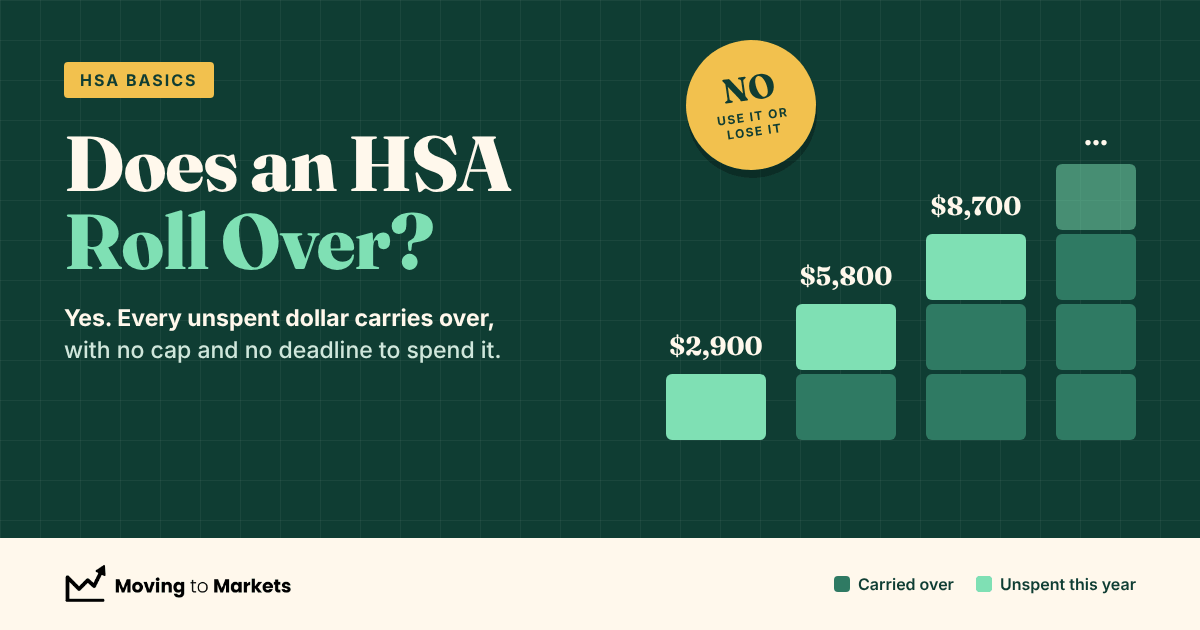
Yes, an HSA rolls over. Every dollar you don’t spend stays in the account and carries into next year, and the year after, with no cap on how much can build up. The account belongs to you, not your employer, so it stays yours when you change jobs, switch insurance or retire. The “use it or lose it” rule people panic about belongs to the FSA, which is a different account.
Below you’ll find how the rollover works, the 2026 and 2027 limits, the new 2026 rule that made millions more people eligible, and the few rules that can still cost you money.
What “roll over” means for an HSA
Say you put $4,400 into your HSA in 2026 and spend $1,500 on a dentist visit and some prescriptions. The other $2,900 stays in the account on January 1, 2027. Nothing happens to it. You don’t fill out a form or ask anyone. In 2027 you add a new year’s contribution on top of that $2,900, and the balance keeps growing.
There’s no limit on how much can carry over. The limit only applies to what you put in each year. Plenty of people have big balances now: Devenir counted 4.4 million HSAs holding $10,000 or more and about 1.9 million holding $25,000 or more in June 2026. Across all 42.6 million accounts, Americans hold nearly $192 billion, which works out to roughly $4,500 per account.
One thing to watch: the word “rollover” also has a tax meaning. When the IRS says “rollover,” it means moving money from one HSA to another. We cover that further down, because it has its own rules.
HSA vs FSA vs HRA: which ones roll over?
A lot of the confusion comes from people mixing up three accounts with similar names. Here’s how they compare:
| HSA | Health FSA | HRA | |
|---|---|---|---|
| Who owns it | You | Your employer | Your employer |
| Rolls over? | Yes, all of it, forever | Only up to $680 (2026 plan year), or a grace period of up to 2.5 months. Your employer picks one or neither | Only if your employer allows it |
| 2026 limit | $4,400 self-only, $8,750 family | $3,400 | Set by employer |
| Can you invest it? | Yes | No | No |
| Keep it if you leave your job? | Yes | No (except COBRA) | Usually no |
| Need a high-deductible plan? | Yes | No | No |
So if you have an FSA, December spending makes sense. If you have an HSA, you don’t need to spend anything. You can keep the money and let it grow.
2026 and 2027 HSA contribution limits
The IRS sets new limits every year. These are the numbers you need right now:
| 2026 | 2027 | |
|---|---|---|
| HSA limit, self-only coverage | $4,400 | $4,500 |
| HSA limit, family coverage | $8,750 | $9,000 |
| Catch-up contribution (age 55+) | $1,000 | $1,000 |
| HDHP minimum deductible, self-only | $1,700 | $1,750 |
| HDHP minimum deductible, family | $3,400 | $3,500 |
| HDHP out-of-pocket max, self-only | $8,500 | $8,700 |
| HDHP out-of-pocket max, family | $17,000 | $17,400 |
A few things people miss about these limits:
- Employer money counts. If your employer puts in $1,000 for 2026, you can add $3,400 more on a self-only plan, not $4,400.
- You have until tax day. You can still make 2026 contributions until April 15, 2027.
- The catch-up is per person. If you and your spouse are both 55 or older, each of you needs your own HSA to put in the extra $1,000.
- Employer contributions are yours right away. Unlike a 401(k) match, HSA money from your employer has no vesting schedule. You keep it even if you quit next week.
New in 2026: more people can open an HSA
The One Big Beautiful Bill Act, signed in July 2025, changed who can have an HSA. Three changes matter if you’re trying to figure out whether you even qualify:
Bronze and catastrophic plans count now. Starting January 1, 2026, every bronze and catastrophic plan qualifies for an HSA, whether you buy it on HealthCare.gov or off the Marketplace. KFF found that HealthCare.gov went from 406 HSA-compatible plans in 2025 to more than 5,000 in 2026. The share of HealthCare.gov enrollees in an HSA-eligible plan jumped from 2% to nearly 43%. The catch: the average bronze deductible is now close to $7,500, so having money in an HSA to cover it helps a lot.
Direct primary care is allowed. You can pay a direct primary care doctor a monthly membership fee of up to $150 ($300 for a family) and still contribute to your HSA. You can also pay that fee with HSA money. At $150 a month, that’s $1,800 a year of doctor visits paid with pre-tax dollars.
Telehealth before the deductible is permanent. For plan years starting in 2025 or later, your high-deductible plan can cover virtual visits before you meet the deductible, and you stay HSA-eligible.
If you signed up for a bronze plan this year and someone told you to open an HSA, this is why. And yes, whatever you don’t spend by December rolls over just like any other HSA.
How to make your rollover money grow
Here’s where the rollover gets interesting. Most HSA providers let you invest your balance in mutual funds or ETFs once it passes a minimum, often $1,000 or $2,000. Growth isn’t taxed, and if you spend it on medical costs, you never pay tax on it.
Say you put $4,400 a year into your HSA for 20 years, invest it and earn 6% a year. You’d end up with about $162,000. If that same money sat in cash earning close to nothing, you’d have about $88,000, the amount you put in.
Most people leave it in cash. Devenir found that only 11% of HSAs hold any investments, even though those accounts hold over half of all HSA money. If your balance is more than you’d need for one year’s deductible, it’s worth looking at the investment option in your account.
Pay yourself back years later
This is the part almost nobody tells you. There’s no deadline to reimburse yourself from your HSA. The only rule is that the expense has to happen after you opened the account.
So you could do this: you pay a $1,200 dental bill out of your checking account in 2026. You leave the HSA money invested. Ten years later, in 2036, you take $1,200 out of the HSA tax-free to pay yourself back for that bill.
To make this work, save the receipt and the explanation of benefits from your insurer. A folder on your phone or a spreadsheet works fine. The IRS can ask you to prove the expense, even years later.
Rules that can cost you money
The rollover itself has no catch. These rules do.
The 20% penalty before age 65
If you take HSA money out for something that isn’t a medical expense before you turn 65, you pay income tax on it plus a 20% penalty.
Example: you’re 50, in the 22% tax bracket, and pull $2,000 out for a vacation. You owe $440 in income tax and $400 in penalty. That’s $840 gone from a $2,000 withdrawal.
At 65 the penalty goes away. The same $2,000 withdrawal at 66 costs you $440 in income tax, the same as taking money from a traditional IRA. Medical withdrawals stay tax-free at any age.
Putting in too much
If you go over the annual limit, the extra money gets hit with a 6% tax every year it stays in the account. This happens a lot to people who change jobs mid-year and get employer contributions from two places.
The fix: ask your HSA provider for an “excess contribution removal” before your tax filing deadline, including extensions. They’ll pull out the extra money plus whatever it earned, and you report the earnings as income.
The last-month rule and the testing period
If you’re HSA-eligible on December 1, the IRS lets you contribute the full year’s limit, even if you only had a high-deductible plan for one month. But you then have to stay eligible through December 31 of the next year.
Example: you switch to a high-deductible plan on December 1, 2026, and put in the full $4,400. In June 2027 you move to a regular plan. You only earned one month of eligibility for 2026, so about $4,033 (11/12 of $4,400) gets added to your income, plus a 10% extra tax. If you aren’t sure you’ll keep the plan, contribute only for the months you’re covered.
California and New Jersey tax your HSA
Federal law treats HSAs as tax-free. California and New Jersey don’t. In both states, your contributions get added back to your state income, and any interest, dividends or gains get taxed every year.
A Californian in the 9.3% bracket who puts $4,400 into an HSA pays about $409 in state tax on it. The HSA is still worth having for the federal savings, but you’ll need to track your earnings each year for your state return.
What happens to your HSA when you leave your job
The money stays yours. Your employer can’t take it back, including what they put in.
What changes:
- Your employer stops paying the fees. Many employers cover the monthly account fee while you work there. Once you leave, the provider may charge you directly, often $2 to $5 a month. A $3 fee on a $500 balance eats 7.2% of it every year.
- You can only contribute if you’re still HSA-eligible. If your new job’s health plan isn’t a high-deductible plan, you can’t add money, but you can still spend what’s there on medical costs, tax-free.
- You can move it. If your old provider charges fees or has weak investment options, move the money to a provider with no monthly fee.
Moving your HSA to another provider
You have two ways to move an HSA, and they follow different rules:
Trustee-to-trustee transfer. Your new provider pulls the money directly from your old one. You never touch it. There’s no limit on how many times you can do this, and it doesn’t count as a contribution. This is the safer choice.
Indirect rollover. Your old provider sends you a check, and you deposit it into the new HSA yourself. You have 60 days to do it, and you can only do one per 12 months. Miss the 60 days and the IRS treats the whole amount as a withdrawal: income tax, plus the 20% penalty if you’re under 65.
You can also move money from a traditional or Roth IRA into your HSA once in your lifetime, up to that year’s contribution limit. It counts toward your limit for the year, and the same testing period applies. It’s a way to fill your HSA in a year when you don’t have spare cash.
What happens at 65 and when you sign up for Medicare
Turning 65 doesn’t touch your balance. Signing up for Medicare does change what you can put in.
Once you enroll in any part of Medicare, including premium-free Part A, you can’t add new money to your HSA. Here’s the part people get wrong: if you sign up for Part A after 65, your coverage can start up to six months earlier than your sign-up date (but not before the month you turned 65). Any HSA contributions you made in those months become excess contributions. To stay safe, stop contributing six months before you apply for Medicare or Social Security.
You can keep spending the money you rolled over, tax-free, on:
- Medicare Part B and Part D premiums
- Medicare Advantage premiums
- Deductibles, copays and prescriptions
- Dental, vision and hearing costs Medicare doesn’t cover
You can’t use HSA money tax-free for Medigap (Medicare Supplement) premiums.
What happens to your HSA when you die
It depends on who you name as your beneficiary:
- Your spouse: the account becomes their HSA, with the same tax-free treatment.
- Anyone else: it stops being an HSA. The full balance counts as their taxable income that year. They can lower that amount by paying any of your medical bills within one year of your death. They don’t owe the 20% penalty.
- Your estate (or no one named): the balance gets taxed on your final tax return.
Log into your HSA today and check who’s listed. It takes five minutes, and most people have never done it.
What to do with leftover HSA money in December
You don’t need to do anything. That’s the whole point of the rollover. If you want to get more out of the account, here’s an order that works for most people:
- Max out next year’s contribution. $4,500 self-only or $9,000 family in 2027.
- Keep about one year’s deductible in cash so you can cover a surprise bill.
- Invest the rest in a low-cost fund through your HSA provider.
- Save receipts for medical bills you pay out of pocket, so you can pay yourself back later.
- Only buy what you need. Stocking up on bandages and sunscreen in December is an FSA habit, not an HSA one.
Frequently asked questions
Does HSA money expire? No. HSA money never expires. It stays in your account until you spend it, even if you stop having a high-deductible plan.
Is there a limit on how much can roll over? No. The IRS limits how much you put in each year, not how much the account can hold.
Do employer contributions roll over? Yes. Money your employer puts in belongs to you the day it hits the account and rolls over the same as your own money.
Can I lose my HSA if I lose my job? No. The account is yours. You may start paying a monthly fee, so check your provider’s fee schedule after you leave.
Can I use my HSA if I no longer have a high-deductible plan? Yes. You can’t add new money, but you can spend what’s there on medical expenses, tax-free, for the rest of your life.
Can I roll my HSA into a 401(k) or IRA? No. You can move IRA money into an HSA once, but not the other way. After 65, though, you can take HSA money for any reason and only pay income tax, the same as an IRA.
Can I have two HSAs? Yes, but your total contributions across all of them can’t go over the annual limit. Many people merge them with a trustee-to-trustee transfer to save on fees.
Does my HSA roll over if I switch insurance? Yes. The account isn’t tied to your insurance company. If your new plan isn’t HSA-eligible, you just stop adding money.
The bottom line
Your HSA rolls over every year, all of it, for as long as you live. You don’t lose money on December 31, you don’t lose it when you quit, and you don’t lose it at 65. What can cost you is a non-medical withdrawal before 65, putting in too much, or forgetting to name a beneficiary.