We all know that one moment at the checkout. The cashier asks “debit or credit?” and you just pick whatever card is on top of your wallet. Most people never think about it again, until a fraud charge drains their checking account the day before rent is due, or a $6 coffee turns into a $40 coffee because of an overdraft fee.
Both cards look the same, swipe the same and get tapped the same. What happens behind them is very different, and so is what happens to you when something goes wrong.
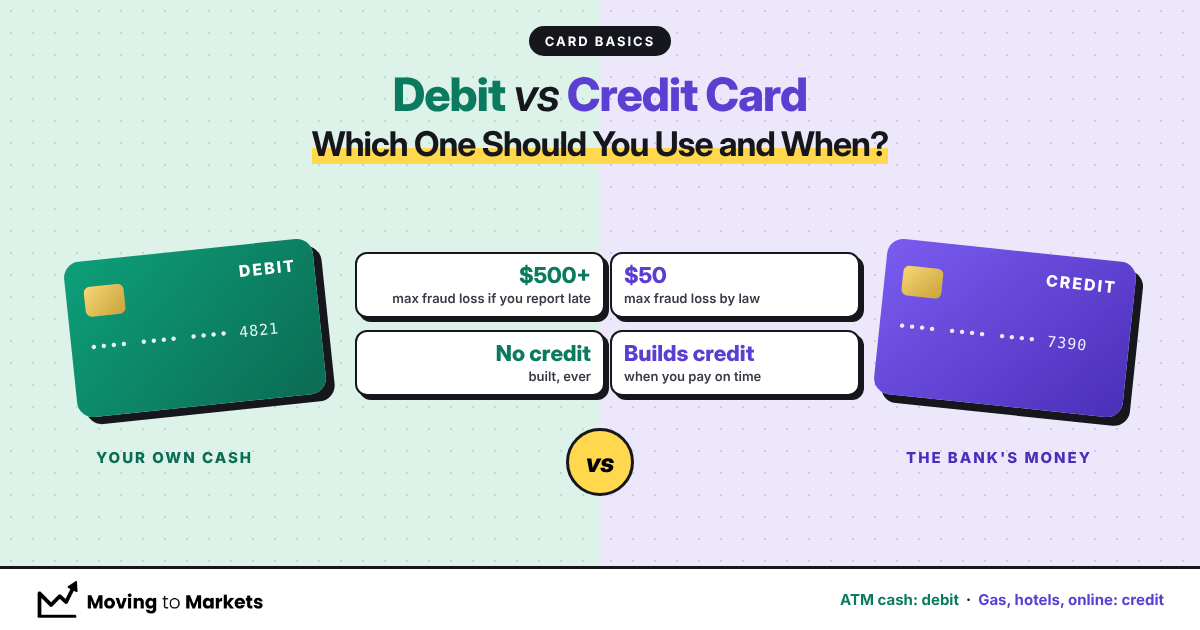
The short answer: a debit card spends money that is already in your checking account, while a credit card borrows the bank’s money that you pay back later. Use a credit card for most everyday spending, online shopping, travel, gas and hotels if you pay the full balance every month. Use a debit card for ATM cash and if you know you will carry a balance.
Below you will find the real differences in dollars, the fraud rules from federal law, and a table of which card to use where.
What is the difference between a debit card and a credit card?
A debit card takes money straight out of your checking account when you pay. A credit card lets you borrow up to a set limit from the card issuer, and you get a bill later. Pay the full bill by the due date and a credit card costs $0 in interest. Debit never charges interest, but it never builds credit either.
Here is how they compare side by side.
| Debit card | Credit card | |
|---|---|---|
| Whose money you spend | Yours, from checking | The bank’s, paid back later |
| Spending limit | Your account balance (plus overdraft coverage if you opted in) | Your credit limit |
| Interest | None | 21.19% average APR on all accounts (Fed, Nov 2026) if you carry a balance |
| Builds your credit score | No | Yes, if the card reports to the bureaus and you pay on time |
| Max loss if card is stolen (federal law) | $0, $50, $500 or more, depending on how fast you report | $50, and most big issuers offer $0 |
| Fraud money missing while bank investigates | Yes, from your checking | No, it is the bank’s money |
| Rewards | Rare | Common, often 1% to 2% cash back or more |
| Approval needed | No, comes with your checking account | Yes, credit check in most cases |
| Main fee risk | Overdraft fees ($34 to $35 at Chase and Wells Fargo) | Interest, late fees, cash advance fees |
The cards look alike because both usually run on the same networks, Visa or Mastercard. The network just moves the payment. Where the money comes from is the whole difference.
Which card is safer if it gets stolen?
A credit card is safer. Federal law caps your loss at $50 on a stolen credit card, and most issuers cut that to $0. A stolen debit card can cost you $50, $500 or more depending on how fast you report it, and the stolen money comes out of your own checking account while the bank investigates.
Read Also: How Many Credit Cards Should You Have? A Real Answer
The limits come from two different laws. Credit cards fall under the Truth in Lending Act and its Regulation Z. Debit and ATM cards fall under the Electronic Fund Transfer Act and its Regulation E. Here is what each one says, based on the FTC’s consumer page and the regulation text.
| When you report a lost or stolen card | Debit card (Regulation E) | Credit card (Regulation Z) |
|---|---|---|
| Before anyone uses it | $0 | $0 |
| Within 2 business days of learning it’s gone | Up to $50 | Up to $50 |
| More than 2 business days later, but within 60 days of your statement | Up to $500 | Up to $50 |
| More than 60 days after your statement is sent | All money taken after that point, and possibly more | Up to $50 |
| Card still in your wallet, only the number was stolen | $0 if reported within 60 days of your statement | $0 |
The dollar caps are only half of it. Say a thief uses your debit card number to spend $900 on a Friday. That $900 is gone from your checking account right now. Your rent autopay hits on Monday and bounces, and you may get an overdraft or returned payment fee on top. Banks usually return the money once they finish reviewing the claim, but you wait without it.
Same $900 on a credit card? Your checking account doesn’t move. You report the charge, it gets taken off your bill, and your rent goes through like normal.
If you do use a debit card, turn on transaction alerts in your bank app. The 2 business day clock starts when you learn about the loss, so the sooner you know, the less you can lose.
What happens if you need to dispute a purchase?
Credit cards give you federal dispute rights. You have 60 days after the statement showing the charge to dispute it in writing, and you don’t have to pay the disputed amount while the issuer checks. Debit cards have no matching federal right for a merchant dispute, so you rely on your bank’s policy.
Under the Fair Credit Billing Act, which lives inside Regulation Z (12 CFR 1026.13), a billing error dispute on a credit card works like this:
- Send a written dispute to the issuer’s billing error address within 60 days after the first statement that shows the charge.
- The issuer has to acknowledge it within 30 days.
- The issuer has to resolve it within 2 billing cycles, and never more than 90 days.
- While it’s open, you don’t have to pay the disputed amount, and the issuer can’t try to collect it.
There is one more right that people rarely hear about. If you buy something with a credit card and it turns out broken or not as promised, you can hold back payment on that item after you try to fix it with the seller. The purchase generally has to be over $50 and made in your home state or within 100 miles of your address (Regulation Z 1026.12(c)).
Debit cards do get some help from Visa and Mastercard rules and from your bank, and many banks will open a dispute for you. But that’s the bank’s policy, not federal law, and your money stays out of your account in the meantime.
Does using a debit card build credit?
No. Debit card spending never shows up on your credit report, because you aren’t borrowing anything. A credit card builds credit when you pay on time, since payment history makes up 35% of your FICO score and the amounts you owe make up 30%.
You could swipe a debit card 1,000 times a year for ten years and your credit score wouldn’t move one point. That matters when you want to rent an apartment, finance a car or get a mortgage, because lenders check your credit, not your checking account.
A credit card used for one small bill, like a $15 streaming subscription paid in full every month, is enough to build a score.
How much does each card cost you?
Paid in full every month, a $0 annual fee credit card costs nothing. Carry a balance and it gets expensive: the average rate on accounts charged interest is 22.36%. A debit card costs nothing unless you overdraw your account, where one overdraft can cost $34 to $35 at Chase or Wells Fargo.
Here is what those numbers mean in real dollars.
Credit card interest. The Fed’s G.19 release from November 6, 2026 puts the average APR at 21.19% for all credit card accounts and 22.36% for accounts that actually pay interest. – Carry $1,000 for one month at 22.36%: about $18.38 in interest. – Carry that $1,000 for a full year: around $250, because credit card interest compounds daily.
You avoid all of this by paying your full statement balance by the due date.
Debit card overdraft fees. If you opted in to overdraft coverage and spend more than you have, your bank can approve the purchase and charge a fee. Checked November 14, 2026: – Chase: $34 per overdraft, up to 3 a day, with no fee if you’re overdrawn by $50 or less. – Wells Fargo: $35 per overdraft, up to 3 a day. – Bank of America: $10 per overdraft, up to 2 a day. – Capital One: no overdraft fees.
So a $6 latte that puts you $4 under at Wells Fargo costs $41. The CFPB’s 2024 rule to cap overdraft fees at big banks was repealed in May 2025, so there’s no federal cap coming.
Cash advances. Taking cash from an ATM with a credit card is a cash advance. Most cards charge a fee, a higher APR, and start interest the same day with no grace period. Use your debit card for cash.
Foreign transaction fees. Many debit and credit cards add a fee on purchases abroad, often around 3%. Some credit cards charge none. Check your cardmember agreement before you travel and pack the card with no foreign fee.
Why do credit cards pay rewards and debit cards mostly don’t?
Stores pay a fee every time you swipe a card, and that fee funds rewards. Since 2011, the Durbin Amendment has capped those fees on debit cards from big banks, so most debit cards have no rewards. Credit card fees aren’t capped, which pays for cash back and points.
What does that look like in a year? Say you put $1,500 a month of groceries, gas and bills on a 2% cash back credit card and pay it off every month. That’s $30 a month, or $360 a year, for spending you were doing anyway. The same $1,500 on a typical debit card earns $0.
The catch: one month of carrying $1,500 at 22.36% costs about $27.57 in interest, which wipes out almost the whole month’s rewards. Rewards only make sense if you pay in full.
When should you use a debit card vs a credit card?
Use a credit card for gas, hotels, rental cars, online shopping, travel and subscriptions, because holds and fraud hit your credit limit instead of your cash. Use a debit card for ATM cash, and for everyday spending only if you know you’d carry a credit card balance.
| Where you’re paying | Better card | Why |
|---|---|---|
| Gas pump | Credit | The pump places a hold for an estimated amount before you fill up. On debit that hold locks real cash in checking |
| Hotel check-in | Credit | Hotels hold extra for incidentals. On debit, that money can be stuck for days after you check out |
| Rental car | Credit | Many rental counters ask for more ID, a credit check or a bigger deposit if you pay by debit |
| Online shopping | Credit | $50 max fraud loss, and your checking account isn’t exposed |
| Subscriptions and free trials | Credit | Easier to dispute a charge you didn’t expect, and it builds credit |
| Travel abroad | Credit with no foreign fee | Better fraud protection far from your bank, and some cards skip the foreign fee |
| Big purchase (TV, laptop, furniture) | Credit | Dispute rights if it arrives broken, and some cards add extended warranty |
| ATM cash | Debit | Credit card cash advances cost a fee and charge interest right away |
| Groceries and everyday spending | Credit if you pay in full, debit if you don’t | Rewards and credit building vs. no chance of interest |
| You already carry a credit card balance | Debit | New purchases start charging interest right away once you carry a balance |
A word on holds, since this is where debit users get burned the most. Say you check in to a hotel for two nights at $150 and the hotel holds an extra $100 a night for incidentals (example amount; every hotel sets its own). That’s $500 tied up.
On a debit card, $500 of your checking balance is frozen until the hotel releases it, which can take days after checkout. If your balance was $600, you now have $100 to spend, and the next swipe might overdraft. On a credit card, the same hold just takes $500 off your available credit.
Which card is right for you?
If you pay your full bill every month, use a credit card for most spending and keep the debit card for cash. If you’ve carried a balance before or you’re trying to control spending, use debit for daily buys and keep one credit card for gas, hotels and online orders.
Ask yourself these four questions:
- Did I pay my credit card in full the last three months? If yes, a credit card is the better daily card for you. If no, switch daily spending to debit until the balance is gone.
- Do I have a credit score yet? If not, put one small bill on a credit card and pay it in full each month. Debit won’t build anything.
- Do I keep a cushion in checking? If your balance often drops under $100, debit holds and fraud charges can cause overdrafts. Use credit for gas and hotels at the very least.
- Do I check my accounts every week? With debit, the 2 business day reporting window matters. If you don’t check often, credit gives you more room.
Most people end up using both. Keep a $0 annual fee credit card for the purchases in the table above, keep your debit card for ATM cash, and pay the credit card from checking in full every month.
How do Americans pay today?
Credit cards are now the most used payment in the US. The Atlanta Fed’s 2025 Survey and Diary of Consumer Payment Choice found credit cards made up 34% of payments, debit cards 31% and cash 14%. Cards together covered 67% of all payments.
The same report, published in May 2026, counted about 16 credit card payments and 15 debit card payments per person per month in October 2025. So you’re not alone if both cards get a workout.
FAQ
Is it better to use a debit card or a credit card?
A credit card is better for most purchases if you pay the full balance every month. You get $50 maximum fraud liability, federal dispute rights, rewards and a credit score. A debit card is better for ATM cash and if you would otherwise carry a credit card balance.
Is a debit card safer than a credit card?
No. A stolen debit card can cost you $50, $500 or more under Regulation E depending on how fast you report it, and the money leaves your checking account during the investigation. A credit card caps your loss at $50 by law, and most issuers charge $0.
Does using a debit card hurt your credit score?
No. Debit card use doesn’t appear on your credit report at all, so it can’t hurt or help your score. Overdrafts don’t show up either unless you leave a negative balance unpaid and the bank sends it to collections.
Should I choose debit or credit when I use my debit card at checkout?
It’s your debit card either way, so the money comes out of checking either way. Choosing “debit” usually means you enter your PIN. Choosing “credit” signs for it and runs it on the Visa or Mastercard network. Neither choice builds credit.
Why does a gas station put a hold on my debit card?
The pump doesn’t know how much gas you’ll buy, so it holds an estimated amount before you start. The hold drops to your real total once the payment settles. On a debit card, that hold ties up cash in your checking account, which is why many people pay for gas with credit.
Can I rent a car or book a hotel with a debit card?
Often yes, but expect a larger hold on your checking account and sometimes extra ID or a credit check at rental counters. Check the company’s policy before you book. A credit card avoids locking up your cash.
Do debit cards have rewards?
A few do, but most don’t. The Durbin Amendment caps the swipe fees big banks earn on debit cards, which leaves little money to pay rewards. Credit cards commonly pay 1% to 2% cash back or more.
Is it bad to use a credit card for everything?
Only if you can’t pay it off. Putting everything on a credit card and paying the full statement balance each month costs $0 in interest and earns rewards. Carrying a balance at the 22.36% average rate costs about $18 a month on every $1,000.
Use the right card for each swipe
You don’t have to pick one card forever. Put gas, hotels, travel, online orders and bills on a $0 annual fee credit card, pay it in full from checking every month, and keep your debit card for the ATM. That way fraud and holds hit the bank’s money, not your rent money.