We all know that person who traded in their car after two years and found out they still owed $6,000 on it. Or worse, the one whose car got totaled six months after buying it, and the insurance check didn’t even pay off the loan. They had no car, a loan still running, and a bill for a car sitting in a junkyard.
That gap between what your insurer pays and what you still owe is exactly what gap insurance covers.
You need gap insurance if you owe more on your car than it’s worth, or you will soon. That usually means you put down less than 20%, took a loan of 72 months or longer, or rolled an old loan into the new one. If you paid cash or put down a big down payment, you don’t need it.
This guide walks you through a 60-second check, shows how long a typical buyer stays upside down, and tells you what gap costs from the dealer versus your insurer.
Gap insurance at a glance
| Question | Answer |
|---|---|
| What it pays | The difference between your car’s value and your loan or lease balance after a total loss or theft |
| Who needs it | Under 20% down, loans of 72+ months, rolled-in negative equity, leases (often included) |
| Who doesn’t | Cash buyers, 20%+ down, short loans, anyone who owes less than the car is worth |
| Cost from your insurer | $24 to $238 a year in CarInsurance.com’s April 2026 sample |
| Cost from a dealer | About $400 to $700 one time, usually added to your loan |
| Required by law? | No state requires it. A lender or lease contract can |
| When to drop it | Once your loan balance falls below your car’s value minus your deductible |
What is gap insurance?
Gap insurance pays the difference between what your car insurance pays after a total loss and what you still owe on your loan or lease. Your regular policy pays only the car’s actual cash value, which drops fast. If your loan balance is higher, gap pays the shortfall so you aren’t making payments on a car you no longer have.
Here’s how it plays out. Say your car gets totaled and it was worth $32,000. You have a $500 deductible, so your insurer sends $31,500 to your lender. But you still owe $36,000.
- Without gap: you owe the lender $4,500 out of pocket.
- With most insurer gap policies: gap pays the $4,000 between the value and the loan, and you pay your $500 deductible.
Gap only kicks in when the car is a total loss or stolen and never found. It doesn’t pay for repairs, and it only works if you carry collision and comprehensive coverage. Without those, there’s no payout for gap to top up.
Who needs gap insurance?
You need gap insurance if your loan balance is higher than your car’s value, or will be in the first few years. The usual signs are a down payment under 20%, a loan of 72 months or longer, negative equity rolled in from an old car, or a car that loses value quickly.
Check yourself against this list. If one or more fits you, gap is worth pricing:
- You put down less than 20%. A new car loses more than 10% of its value in the first month, according to Carfax data cited by Experian. With little down, you’re upside down the day you drive off.
- Your loan is 72 months or longer. Long loans pay down slowly in the early years. The average new car loan was 69.5 months in Q2 2026 (Experian), so plenty of people are here.
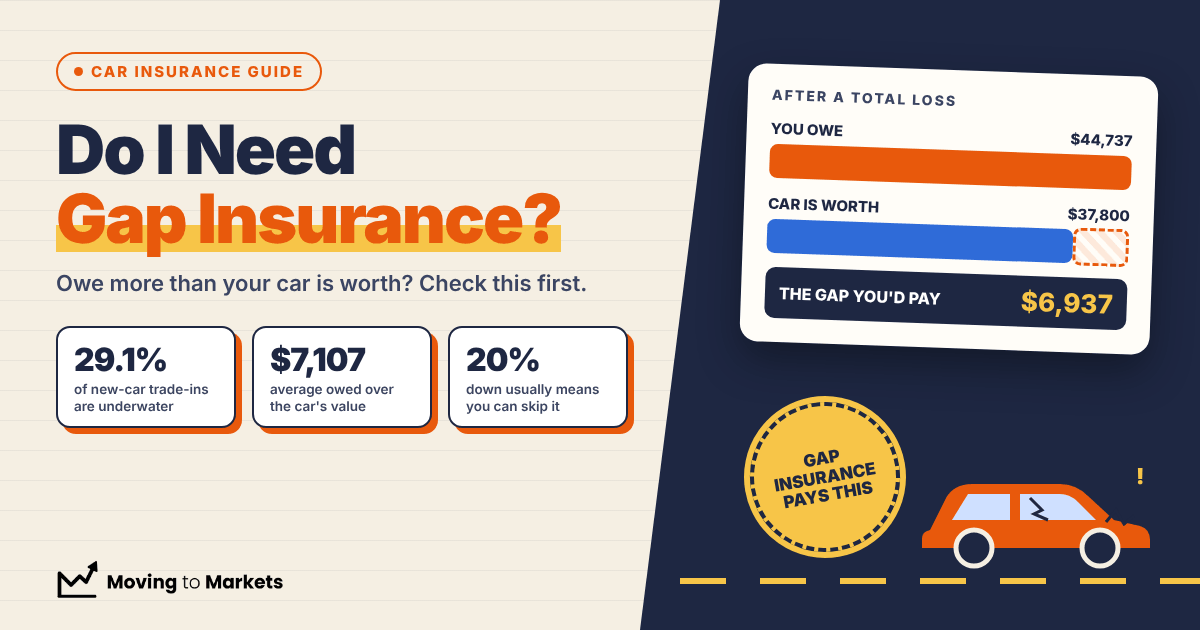
- You rolled your old loan into the new one. Edmunds found 29.1% of new-car trade-ins in Q3 2026 were underwater, owing $7,107 on average. If that money went into your new loan, you start thousands behind.
- You drive a lot. High mileage, roughly 15,000 miles a year or more, pulls your car’s value down faster.
- You financed taxes, fees and add-ons. Every dollar of sales tax, dealer fees or extended warranty you put in the loan is a dollar the car itself isn’t worth.
- You’re leasing. Lease contracts make you responsible for the gap unless they waive it. Many leases already include a gap waiver; check before you pay for a second one.
Edmunds’ numbers show how common this has become. In early 2022, only 14.7% of trade-ins were underwater. By Q3 2026 it was 29.1%, and buyers who rolled that debt into a new car financed $57,235 on average at $952 a month.
Who doesn’t need gap insurance?
You don’t need gap insurance if you paid cash, put down 20% or more, took a short loan of 48 to 60 months, or already owe less than your car is worth. In those cases your insurance check would cover the loan, so gap would pay nothing.
You can also skip it if:
- You bought a used car that already took its big depreciation hit and you put money down.
- Your lease already has a gap waiver built in (it’s often listed as “GAP waiver” or “gap amount waiver” in the contract).
- You have enough savings to cover a few thousand dollars if the car is totaled, and you’d rather take that risk than pay for coverage.
How long will you be upside down on a new car loan?
On a $45,000 car with $0 down and a 72-month loan at 6.35%, you’d owe about $836 more than the car is worth after one year, and roughly break even around year two. Roll in $7,107 of old negative equity and you stay underwater for more than three years.
Here’s the math. The car is $45,000 out the door, the loan is 72 months at 6.35% (Experian’s Q2 2026 average new-car rate), and the value follows KBB’s average depreciation: down 16% in year one, then 12%, 11% and 9%.
| End of year | Car value | Owed with 10% down ($678/mo) | Owed with $0 down ($753/mo) | Owed with $7,107 rolled in ($872/mo) |
|---|---|---|---|---|
| 1 | $37,800 | $34,772 | $38,636 | $44,737 |
| 2 | $32,400 | $28,669 | $31,855 | $36,886 |
| 3 | $27,450 | $22,168 | $24,631 | $28,521 |
| 4 | $23,400 | $15,241 | $16,935 | $19,609 |
What this tells you:
- 10% down: you stay ahead of the car the whole time by KBB’s average. A car that drops faster than average or a high deductible could still put you close in the first few months.
- $0 down: you’re about $4,000 underwater after the first month (Carfax’s 10% first-month drop) and about $836 behind at year one. Add a $500 deductible and the real hole is bigger. You cross over during year two.
- $7,107 rolled in: you’re $6,937 behind at year one, $4,486 at year two and still $1,071 behind at year three. This is the buyer gap insurance is made for.
Keep in mind these are averages. Some cars, especially luxury models and some EVs, lose value faster than KBB’s average. Others, like many trucks, hold value better. Look up your own car’s value instead of trusting the table.
How do I check if I need gap insurance right now?
Get your loan payoff amount from your lender, look up your car’s private-party or trade-in value on Kelley Blue Book or Edmunds, then subtract your deductible from that value. If the payoff is higher than what’s left, you need gap. If it’s lower, you can skip it or cancel it.
- Get your payoff quote. Log in to your lender’s app or call them. Use the payoff amount, not the “current balance,” since payoff includes interest owed to date.
- Look up your car’s value. Use Kelley Blue Book or Edmunds with your real mileage, trim and condition. Your insurer pays actual cash value, which is usually closer to trade-in value than to the dealer’s sticker.
- Subtract your deductible. If your collision deductible is $500, take $500 off the value.
- Compare. Say your car is worth $32,400 and your deductible is $500, so the insurer would pay $31,900. A payoff of $31,855 means you’re $45 ahead, so gap isn’t doing much. A payoff of $36,886 means you’re $4,986 short, and gap would cover most of that.
- Repeat every 6 to 12 months. Each time your policy renews is a good moment to check again.
How much does gap insurance cost?
Gap insurance from your car insurer usually costs $24 to $238 a year, based on CarInsurance.com’s April 2026 rate sample. A dealer or lender gap waiver usually costs $400 to $700 as a one-time charge, often added to your loan, where you also pay interest on it.
| Where you buy it | Price | How you pay | What happens when you’re done |
|---|---|---|---|
| Your car insurer | $24 to $238 a year (CarInsurance.com, 40-year-old driver, April 2026). Progressive $53, USAA $51, Erie $238. ValuePenguin’s Illinois typical: $144 | Added to your premium | Remove it any time; you stop paying |
| Dealer or lender gap waiver | About $400 to $700 one time (MoneyGeek, CarInsurance.com) | Usually rolled into your loan | You get a prorated refund only if you cancel and ask for it |
Here’s what the dealer version really costs. A $600 gap waiver rolled into a 72-month loan at 6.35% adds about $10 to your monthly payment and $723 in total. If you buy gap from your insurer at $53 a year and drop it after three years, you pay about $159. That’s a $564 difference for the same protection.
Not every insurer sells gap. CarInsurance.com lists Geico among the companies that don’t, and ValuePenguin says some insurers only cover new cars or cars you bought recently. If yours doesn’t offer it, a credit union or your lender is usually the next cheapest option. If you’re shopping for a new policy anyway, our list of the cheap car insurance companies is a good place to start.
Should I buy gap insurance from the dealer or my insurer?
Buy gap from your car insurer if it offers it. It’s cheaper, you pay it in small amounts, and you can drop it the day you no longer need it. Go with the dealer only if your insurer doesn’t sell gap or your dealer waiver covers something you need, like your deductible.
Things to know before you sign at the dealer:
- It’s optional. In the Fed’s GAP study, about 20% of people who bought gap thought it was required. Unless your loan contract says so, it isn’t. (The study, by Durkin, Elliehausen and Miller, was funded by an industry group, so take its high satisfaction numbers with that in mind.)
- You can say no and buy it later. Many insurers let you add gap after you buy the car, though some set limits, like the car being new or only a few years old. Call your insurer before you go to the dealership so you know.
- The price can be negotiated. Dealers mark up add-ons. If you want the dealer’s gap, ask them to cut the price or take it off.
- No federal rule is stopping the upsell. The FTC’s CARS Rule, which targeted add-ons that give buyers no benefit, was thrown out by the Fifth Circuit on January 27, 2025.
One case where the dealer version can win: some dealer gap waivers pay your deductible too. Ally’s, for example, covers up to $1,000 of it where state law allows. Most insurer gap does not.
What does gap insurance not cover?
Gap insurance doesn’t pay your deductible (on most insurer policies), overdue loan payments, late fees, extended warranties or service contracts you financed, repairs, or damage to other people. Some policies also won’t pay negative equity rolled in from your old car, and many cap the payout.
Read these lines in any gap contract before you pay:
- Payout cap. Loan/lease payoff coverage from insurers often caps out around 25% of the car’s value. On a car worth $37,800, that’s $9,450. Dealer waivers set their own limits, so read that line too.
- Rolled-in negative equity. Some contracts exclude the part of the loan that came from your old car. If you rolled in $7,107, make sure your gap covers it, or you could still owe that.
- Missed payments. If you’re behind, the gap payout usually drops by the amount you owe in late payments.
- Lapsed coverage. If your collision or comprehensive coverage lapsed, gap pays nothing.
Do I need gap insurance on a lease?
Many leases already include gap coverage, often called a gap waiver, because the leasing company owns the car and wants that protection. Read your lease contract for a gap waiver line before buying separate gap insurance. If it’s there, you’d be paying twice.
If your lease doesn’t include it, the leasing company may require you to buy it. In New York, the law goes further: under Personal Property Law Section 335, a lessor that can get lessor gap insurance has to offer to waive your gap liability, and it can’t make the lease depend on you buying gap insurance yourself.
For more on how lease payments, residual value and fees work, see our guide on how leasing a car works.
Is gap insurance required by law?
No state requires you to buy gap insurance. Your lender or leasing company can require it in your contract, and some states require dealers to offer it. If it isn’t written into your loan or lease, gap is optional, and you can buy it elsewhere.
What states require is liability insurance. Your lender will usually also require collision and comprehensive coverage while you have a loan, and you need those for gap to work anyway.
When should I cancel gap insurance, and how do I get a refund?
Cancel gap insurance once your loan payoff is lower than your car’s value minus your deductible. If you prepaid dealer gap, you’re usually owed a prorated refund when you cancel, pay off the loan early, refinance, sell or trade in. Ask for it in writing.
- Insurer gap: call your insurer or remove it in the app. You stop paying from that day, and if you prepaid six or twelve months you should get the unused part back.
- Dealer or lender gap: contact the dealer, lender or gap company named in your contract. Ask for a written cancellation and a prorated refund.
- Paid off early or traded in? Don’t assume the refund comes automatically. Ask your old lender for it.
- Refinanced? Dealer gap usually ends with the original loan. Ask for that refund, and check whether your new loan needs its own gap.
Lenders haven’t always paid these refunds. In November 2023, the CFPB ordered Toyota Motor Credit to pay $60 million, including nearly $32 million to people who never got refunds on gap and similar products after paying off a loan or ending a lease early. The order said Toyota Motor Credit sent cancellation calls to a “retention hotline” and pushed products until people had asked to cancel three times. (The CFPB ended that order on May 12, 2025.) The CFPB’s October 2024 auto finance report found other servicers failing to refund unearned gap premiums too.
If your lender drags its feet, you can file a complaint with the CFPB at consumerfinance.gov/complaint or with your state attorney general.
Gap insurance FAQ
Is gap insurance worth it?
It’s worth it if you owe more than your car is worth. Insurer gap cost $24 to $238 a year in one April 2026 sample, which is small next to a $4,000 to $7,000 shortfall after a total loss.
Does gap insurance cover my deductible?
Most insurer gap policies don’t. Some dealer gap waivers do, Ally’s covers up to $1,000 where state law allows. Check your contract.
Can I buy gap insurance after I buy the car?
Often yes, from your insurer, but some limit it to new cars or cars bought in the last year or so. Call before you sign at the dealership.
Does gap insurance cover theft?
Yes, if the car is stolen and never recovered, and your comprehensive coverage pays a total loss claim.
Do I need gap insurance on a used car?
Usually not if you put money down, since the car already took its biggest drop in value. You may need it with $0 down, a long loan, or rolled-in negative equity.
Do I need gap insurance if I have full coverage?
Yes, if you’re upside down. Full coverage pays your car’s value, not your loan balance. Gap pays the difference.
How long should I keep gap insurance?
Until your loan payoff falls below your car’s value minus your deductible. For a $0-down, 72-month loan, that’s often around year two.
What is the difference between gap insurance and loan/lease payoff coverage?
They do the same job. Loan/lease payoff is some insurers’ version, and it often caps the payout around 25% of the car’s value.
If you put down less than 20%, took a long loan or rolled in an old car, you probably need gap for the first two or three years. Get it from your insurer if you can, it’s cheaper. Check your payoff against your car’s value once a year, and drop gap the moment you’re ahead.