We all know that one coworker who never talks about stocks, never checks the market and somehow has the biggest 401(k) in the office. You ask what they own and they say “just one fund, I don’t really touch it.” Turns out the boring answer is usually the right one.
The hard part is picking which fund. There are thousands of mutual funds in the US, and a lot of them look the same on a fund page until you look at the fees. A fund that charges 0.74% a year takes $74 from every $10,000 you have in it, every year. A fund that charges 0.015% takes $1.50. Over 30 years that gap gets big, and it comes out of your money whether the fund goes up or down.
Below is a top 10 mutual funds comparison with the numbers that actually matter: what each fund costs, how much you need to start, and what it returned over 1, 5 and 10 years. Every return is as of October 31, 2026, so you are comparing all ten on the same day.
Not financial advice. This article compares public fund data for general information. It isn’t a recommendation to buy or sell any fund. Past returns don’t promise future returns, and every fund here can lose money. Read the fund’s prospectus and, if you can, talk to a licensed financial advisor before you invest.
Top 10 Mutual Funds at a Glance
Returns are average yearly total returns, after fees, as of October 31, 2026. “n/a” means the fund is too young to have a 10-year record.
| # | Fund (ticker) | Type | Expense ratio | Minimum to start | 1-year | 5-year | 10-year |
|---|---|---|---|---|---|---|---|
| 1 | Fidelity 500 Index (FXAIX) | S&P 500 index | 0.015% | $0 | 12.1% | 12.0% | 15.4% |
| 2 | Vanguard 500 Index Admiral (VFIAX) | S&P 500 index | 0.04% | $3,000 | 12.1% | 12.0% | 15.4% |
| 3 | Schwab S&P 500 Index (SWPPX) | S&P 500 index | 0.02% | $0 | 12.04% | 12.02% | 15.41% |
| 4 | Vanguard Total Stock Market Index Admiral (VTSAX) | Total US market index | 0.04% | $3,000 | 12.05% | 10.93% | 14.86% |
| 5 | Fidelity ZERO Total Market Index (FZROX) | Total US market index | 0.00% | $0 | 12.1% | 11.2% | n/a |
| 6 | Vanguard Total International Stock Index Admiral (VTIAX) | International index | 0.09% | $3,000 | 13.0% | 8.0% | 9.0% |
| 7 | Vanguard Total Bond Market Index Admiral (VBTLX) | US bond index | 0.04% | $3,000 | -0.1% | -0.2% | 1.4% |
| 8 | Vanguard Wellington Admiral (VWENX) | Balanced, about 2/3 stocks | 0.16% | $50,000 | 7.2% | 7.4% | 10.1% |
| 9 | Fidelity Contrafund (FCNTX) | Active large growth | 0.74% | $0 | 11.8% | 13.0% | 17.7% |
| 10 | Dodge & Cox Stock (DODGX) | Active large value | 0.51% | $2,500 | 13.3% | 9.6% | 12.9% |
Sources: AAII fund data as of 10/31/26 for FXAIX, VFIAX, FZROX, VTIAX, VBTLX, VWENX, FCNTX and DODGX. Schwab Asset Management for SWPPX. Schwab research for VTSAX. The FXAIX and VTSAX expense ratios come from StockAnalysis (checked October 2026).
A few things jump out right away. The three S&P 500 funds have basically the same returns, because they own the same 500 companies. The only real difference between them is the fee and the minimum. Contrafund has the best 10-year number on the list, but it also charges about 50 times more than FXAIX. And the bond fund has been flat for five years, which is normal for bonds after the 2022 rate hikes, not a sign that something broke.
1. Fidelity 500 Index Fund (FXAIX)
If you want the cheapest way to own the S&P 500 in a mutual fund, this is it. FXAIX costs 0.015% a year, which works out to $1.50 a year on $10,000. There’s no minimum, so you can start with $50 if that’s what you have.
It returned 12.1% over the past year and 15.4% a year over the past 10 years, as of October 31, 2026. That means $10,000 put in 10 years ago would be worth roughly $42,000 today. The fund is huge, with about $858 billion in assets according to StockAnalysis.
Good for: Anyone with a Fidelity account who wants one simple US stock fund. The catch: It’s easiest to buy at Fidelity. Other brokers may charge a fee to buy it, so check before you order.
2. Vanguard 500 Index Fund Admiral Shares (VFIAX)
VFIAX is the original. Vanguard launched the first index fund for regular investors in 1976, and this is the Admiral share class of that same fund. It tracks the same S&P 500 as FXAIX and the returns are the same to one decimal: 12.1% for one year and 15.4% a year for 10 years.
The expense ratio is 0.04% (StockAnalysis lists it as 0.038%), so you pay about $4 a year per $10,000. You need $3,000 to get in.
Good for: Vanguard customers who want the S&P 500 and already have $3,000 to start. The catch: The $3,000 minimum. If you are starting smaller, Vanguard’s ETF version (VOO) has no $3,000 minimum.
3. Schwab S&P 500 Index Fund (SWPPX)
Schwab’s version sits right between the other two. It charges 0.02% and has no minimum at all, per Schwab’s own fund page. Returns as of October 31, 2026 were 12.04% for one year, 12.02% a year over five years and 15.41% a year over 10. That’s the same as FXAIX and VFIAX within a few hundredths of a percent.
It’s a smaller fund, with about $147 billion as of November 9, 2026, but for an index fund that doesn’t change much. Size matters more for active funds.
Good for: Schwab customers and people starting with small amounts. The catch: Same as FXAIX. It’s cheapest to buy at the company that runs it.
4. Vanguard Total Stock Market Index Fund Admiral Shares (VTSAX)
The S&P 500 holds 500 big companies. VTSAX holds the whole US stock market, small and mid-size companies included. In most years the returns are close to the S&P 500 because big companies make up most of the market anyway.
The last few years show the gap though. As of October 31, 2026, VTSAX returned 12.05% for one year, 10.93% a year over five years and 14.86% a year over 10, according to Schwab’s research page. That’s about a percent a year behind the S&P 500 over five years, because the biggest tech companies did better than small companies over that stretch. In years when small companies win, it goes the other way.
It costs 0.04% and needs $3,000 to start (both from StockAnalysis only). Counting its ETF twin VTI, the fund holds around $2.3 trillion.
Good for: People who want every US stock in one fund and don’t want to bet only on the biggest companies. The catch: The $3,000 minimum, and it has lagged the S&P 500 for the past five years.
5. Fidelity ZERO Total Market Index Fund (FZROX)
FZROX charges nothing. Zero. A $100,000 balance costs you $0 a year in fund fees. It holds US stocks of all sizes, similar to VTSAX, and as of October 31, 2026 it returned 12.1% over one year and 11.2% a year over five years. It started in August 2018, so there’s no 10-year number yet.
Good for: Fidelity customers who want the whole US market at the lowest possible cost, especially inside an IRA. The catch: You can only hold it at Fidelity. If you ever move your account to another broker, you’d have to sell it first, and in a taxable account that can mean paying capital gains tax. That’s why a lot of people keep it in retirement accounts only.
6. Vanguard Total International Stock Index Fund Admiral Shares (VTIAX)
Everything above is US stocks. VTIAX holds thousands of companies outside the US, in Europe, Japan, the UK, Canada and emerging markets like China, India and Taiwan.
For most of the past decade international stocks did worse than US stocks. The 10-year return is 9.0% a year, compared with 15.4% for the S&P 500. But over the last year it beat every US index fund on this list, at 13.0% as of October 31, 2026. That’s the reason people keep some money overseas: you don’t know which side will win the next 10 years.
It costs 0.09% and needs $3,000.
Good for: Adding international stocks so not all your money depends on the US. The catch: A long record of trailing the US, and more ups and downs from currency moves.
7. Vanguard Total Bond Market Index Fund Admiral Shares (VBTLX)
This is the only bond fund on the list, and the returns look bad: -0.1% for one year, -0.2% a year for five years and 1.4% a year for 10, as of October 31, 2026. The five-year number includes 2022, when interest rates jumped and bond prices fell hard.
So why is it here? Because people don’t buy bonds to get rich. They buy them so that when stocks drop 30%, part of the portfolio doesn’t. With higher rates now, new bonds the fund buys also pay more than they did five years ago.
It costs 0.04% and needs $3,000.
Good for: People closer to retirement, or anyone who wants a calmer part of their portfolio. The catch: Low returns, and bond prices still fall when interest rates rise.
8. Vanguard Wellington Fund Admiral Shares (VWENX)
Wellington is one of the oldest mutual funds in the US, running since 1929. It’s a balanced fund, so the managers keep about two-thirds in stocks and one-third in bonds, and they pick them instead of copying an index.
As of October 31, 2026 it returned 7.2% over one year, 7.4% a year over five and 10.1% a year over 10. That’s lower than an all-stock fund, which you’d expect with a third in bonds. The point is a smoother ride in one fund.
It charges 0.16%, cheap for an actively managed fund. The big problem is the $50,000 minimum for Admiral shares.
Good for: Someone who wants stocks and bonds in a single fund and has $50,000 to put in. The catch: The minimum. The Investor share class (VWELX) has a lower minimum but charges more, so check its current fee and minimum on Vanguard before you buy.
9. Fidelity Contrafund (FCNTX)
Contrafund is the opposite of an index fund. A team picks the stocks, and William Danoff has run it since 1990 (AAII lists Jason Weiner and Asher Anolic as co-managers since 2025). It mostly buys large growth companies.
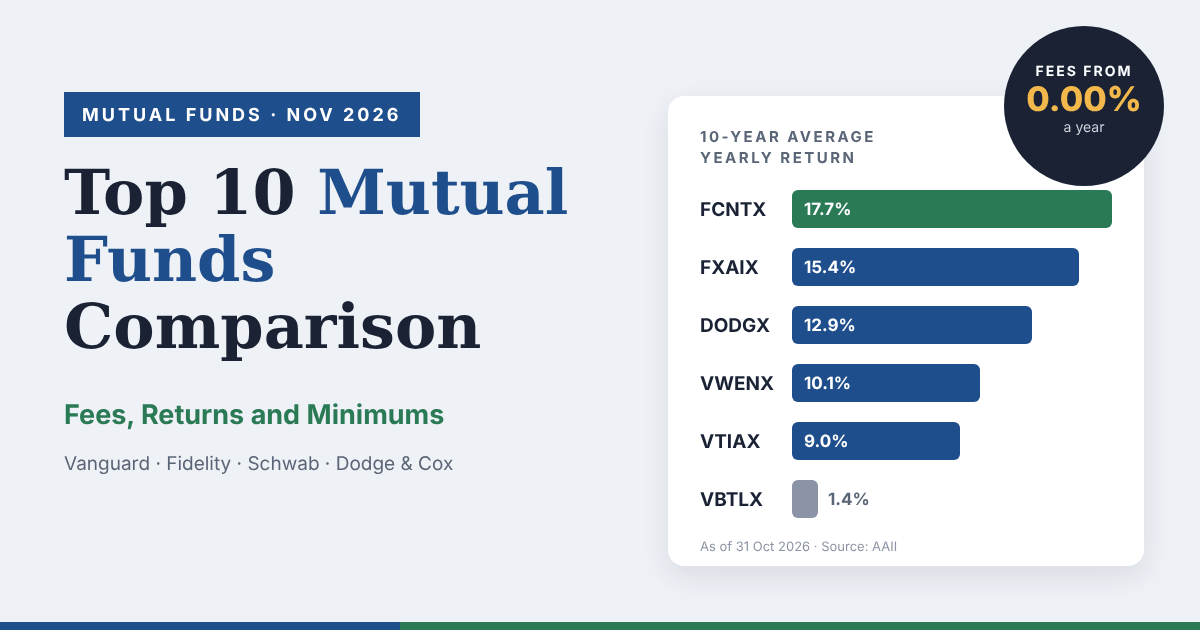
And over 10 years, it worked. Contrafund returned 17.7% a year, compared with 15.4% for the S&P 500 funds, after fees, as of October 31, 2026. Over five years it’s 13.0% against 12.0%. Over the past year it slightly trailed, at 11.8%.
You pay for that. The expense ratio is 0.74% on AAII (StockAnalysis shows 0.725%), so about $74 a year per $10,000, compared with $1.50 for FXAIX. There’s no minimum.
Good for: Investors who want an active growth fund with a long-time manager, as a piece of a bigger portfolio. The catch: High fees, and much of its record is tied to one manager who has been there 36 years. S&P’s SPIVA reports have found for years that most active large-company funds trail the S&P 500 over 10 years, so a strong past doesn’t guarantee the next decade.
10. Dodge & Cox Stock Fund (DODGX)
Dodge & Cox Stock is an active fund too, but it buys the other kind of company: cheaper, out-of-favor large companies, what investors call “value” stocks. It’s a nice balance next to a growth fund like Contrafund.
As of October 31, 2026 it returned 13.3% over one year, the best of any stock fund on this list for that period. Over five years it returned 9.6% a year, and over 10 years 12.9% a year. That’s behind the S&P 500 over the longer stretches, mostly because value stocks lagged big tech.
It charges 0.51% on AAII (0.52% on StockAnalysis) and needs $2,500 to start, or $1,000 for an IRA.
Good for: People who want value stocks or who think the S&P 500 is too heavy in a few tech companies. The catch: It has trailed the S&P 500 over 5 and 10 years, and it charges much more than an index fund.
How to Pick the Right Mutual Fund for You
Most people don’t need 10 funds. Many need two or three. Here’s a simple way to narrow it down:
- Start with where your account is. If you’re at Fidelity, FXAIX or FZROX is the obvious pick. At Schwab, SWPPX. At Vanguard, VFIAX or VTSAX. Buying another company’s fund often adds a fee.
- Check the expense ratio first. Multiply it by your balance. At $50,000, the gap between 0.74% and 0.015% is about $360 a year.
- Look at the minimum. If you have less than $3,000, the Fidelity and Schwab funds let you start with any amount.
- Decide how much you want in bonds. A common starting point is fewer bonds when you are young and more as you get closer to needing the money. Someone 25 might hold almost none, someone 60 might hold 40%.
- Add international if you want. VTIAX for 20% to 30% of your stocks is a common split, but plenty of investors hold only US stocks.
- Use 10-year returns, not 1-year. One year tells you very little. VTIAX beat all the US index funds over one year and trailed every stock fund here over 10.
A simple three-fund setup could be VTSAX for US stocks, VTIAX for international, and VBTLX for bonds. Total yearly cost on that mix is under 0.1%.
Frequently Asked Questions
What is the best mutual fund to buy right now?
There isn’t one best fund for everyone. For most beginners, a low-cost S&P 500 or total market index fund is the usual starting point. On this list, FXAIX (0.015%), SWPPX (0.02%) and FZROX (0%) are the cheapest and have no minimum.
Is FXAIX or VFIAX better?
They own the same 500 stocks and had the same returns to one decimal as of October 31, 2026: 12.1% for one year, 12.0% a year for five years and 15.4% a year for 10. FXAIX is a bit cheaper and has no minimum. VFIAX needs $3,000. Pick the one your broker sells for free.
Which mutual fund had the highest 10-year return?
On this list, Fidelity Contrafund, at 17.7% a year as of October 31, 2026. It also has the highest expense ratio here, at 0.74%.
How much money do I need to start investing in a mutual fund?
FXAIX, SWPPX, FZROX and Contrafund have no minimum. Most Vanguard Admiral funds need $3,000, Dodge & Cox Stock needs $2,500 ($1,000 for an IRA), and Vanguard Wellington Admiral needs $50,000.
What is a good expense ratio for a mutual fund?
For an index fund, under 0.10% is good, and the big ones here charge 0.04% or less. For an active fund, under 0.75% is reasonable. Anything over 1% needs a very good reason.
Are mutual funds or ETFs better?
Index mutual funds and ETFs that track the same index have almost the same returns. ETFs trade during the day and often have no minimum beyond one share. Mutual funds let you buy exact dollar amounts and set up automatic investing easily. Many people use either one without any problem.
Start With One Fund This Week
You don’t need to own all ten. Pick one low-cost fund from the top of this list that your broker sells, set up an automatic investment, even $100 a month, and let it run. That coworker with the big 401(k) didn’t get there by picking stocks every week. They just kept putting money in.