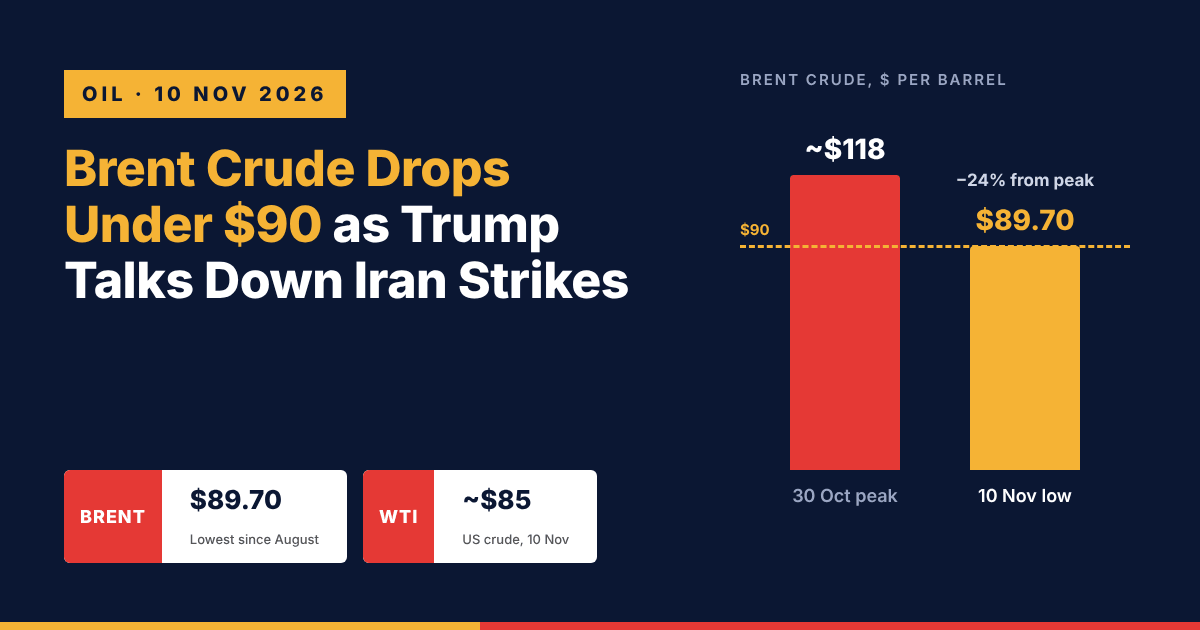
Less than two weeks ago oil was the scariest number on the market. Brent crude, the price most of the world uses for oil, was sitting near $118 a barrel and everyone was talking about $5 gas and more Fed rate hikes. Early Tuesday morning, 10 November 2026, it dropped under $90.
It didn’t stay there long. But it’s the first time Brent has been that low since August, and the slide behind it is one of the fastest in years.
How far oil has fallen
Brent traded below $90 around 5 a.m. ET on Tuesday, the first time since 31 August, according to Cornerstone Futures. Oilprice.com had the front-month contract at $89.70 in the early European morning.
Then it bounced a little. The National had Brent back at $90.32 by 1:33 p.m. UAE time, and by 6:20 a.m. ET Cornerstone had the January contract at $91.20, down $1.37 or 1.5% on the day.
US crude, called West Texas Intermediate or WTI, is already well under $90. It traded at $84.77, down 2.27%, in The National’s report, and at $85.85 in Cornerstone’s later update.
Here’s the bigger picture:
| Brent | |
|---|---|
| Peak, 30 October | about $118 |
| Monday 9 November | settled down 5.85% |
| Tuesday low | below $90 |
| Drop from the peak | roughly 23% to 25% |
Brent fell about 16% to 17% last week alone. Oilprice.com called it the biggest weekly drop since 2020, when COVID lockdowns crushed demand. Euronews says both Brent and WTI have lost around 20% so far this month.
Why oil is falling
Trump is talking down new strikes on Iran
The war with Iran is what sent oil flying in the first place, and talk of it ending is what’s bringing it down.
On Monday, after meeting Qatar’s Prime Minister Sheikh Mohammed bin Abdulrahman at the White House, President Trump said “taking the military action doesn’t seem to be a very necessary thing,” The National reported. He added: “I think it’s going to be ending fairly soon.”
In a Truth Social post, Trump said there was “positive momentum” toward ending the war. He said the US was still “locked and loaded” but that more strikes were “quite unlikely,” because Gulf allies “would prefer the status quo,” Euronews reported.
Before the midterm elections last week, a lot of traders expected Trump to restart strikes on Iran this month. Now they’re betting the other way.
Ole Hansen, head of commodity strategy at Saxo Bank, told Oilprice.com that “President Trump added to the optimism by suggesting further strikes on Iran would not be necessary.”
Oil is flowing again
The other half of the story is supply. Hansen said “crude oil flows have almost returned to pre-war levels.”
A Reuters survey cited by Cornerstone found OPEC pumped more oil in October, led by Saudi Arabia, Kuwait and Iraq. JPMorgan estimates the world produced about 1.4 million barrels a day more than it used in October. When there’s more oil than buyers, the price drops.
China is buying more, which helps a bit. Its crude imports hit 9.88 million barrels a day in October, the highest since March. But that’s still 13.3% below a year earlier.
Could oil go back up?
Yes, and pretty quickly. Cornerstone put it simply: “A pause in strikes is not a deal.”
The risks are still there:
- Shipping attacks. Attacks on ships around the Strait of Hormuz haven’t stopped. Tim Waterer of KCM said they just haven’t gotten bad enough to push prices up again, according to Cornerstone.
- Houthi strikes on Saudi oil. The Houthis hit Saudi Arabia’s East-West pipeline in their latest attack. A Saudi energy ministry official said it caused a “limited fire” that was put out, per Oilprice.com.
- No signed agreement. Qatar is helping push the talks along, but nothing is signed yet. If talks fall apart, the price that’s come off in the past two weeks can come right back.
That’s also why Brent popped back above $90 within hours. The market wants something on paper.
What it means for you
Gas prices should follow, just not overnight. Pump prices usually lag crude by a couple of weeks, because stations are still selling fuel they bought at the higher price. If Brent holds near $90, you could start seeing it at the pump before Thanksgiving on 26 November.
Diesel may stay expensive. Hansen said refined product supplies “remain constrained, keeping prices elevated, particularly for diesel.” That matters if you drive a truck, and it matters for shipping costs that end up in grocery prices.
It could help with inflation. In September, gasoline jumped 9.1% and drove more than half of that month’s price increase. In October gas rose only 1.0%. Cheaper oil in November could pull the next inflation number down, which we covered in our October inflation report breakdown. The Fed decides on rates on 9 December, and the November CPI comes out on 10 December.
For investors, energy stocks have had a rough two weeks, while airlines and shipping companies tend to do better when fuel gets cheaper. If you’ve been moving money into safer sectors, see our piece on defensive stocks during the AI bull market.
What to watch next
- Any news from US-Iran talks. A signed deal could push Brent into the $80s. Collapsed talks could send it back to $100 fast.
- Weekly US gas prices. The AAA national average is the easiest way to see whether cheaper oil is reaching you.
- 13 November: producer price index for October.
- 9 December: Fed rate decision.
Got a question about oil prices or what they mean for your money? Send it through our Contact Us page, and keep checking our market coverage for updates.