We all know that one road on the way to work that has had orange cones on it for what feels like two years. Every morning you sit in the same traffic and wonder who is actually getting paid for all this. Turns out a few companies on the stock market are, and right now a lot of them are getting paid more than ever.
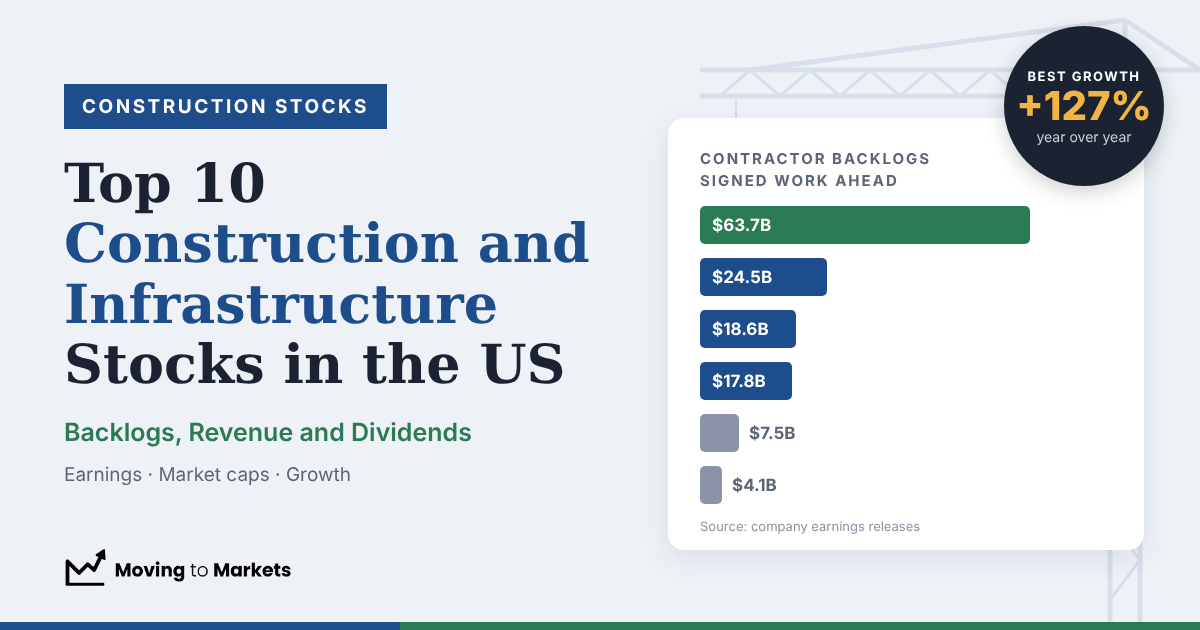
A lot of US construction spending in 2026 doesn’t go to roads and houses. The biggest money in 2026 is going into data centers, power lines and the electrical and cooling systems that keep those buildings running. Caterpillar said its power generation sales rose 30% last quarter “primarily in data center applications.” Quanta Services ended September with a $63.7 billion backlog, up from $39.2 billion a year before. That’s work already signed and waiting to be done.
Below are the top 10 construction stocks in the USA, ordered by market cap. For each one you get what the company actually does, how its last quarter went, how much work it has lined up, and what could go wrong. All the earnings numbers come from the companies’ own results for the quarter ended September 30, 2026.
Not financial advice. This article is for general information only. It isn’t a recommendation to buy or sell any stock. Stocks can lose value, and construction stocks can swing hard. Do your own research and, if you can, talk to a licensed financial advisor before you invest.
Top 10 US Construction Stocks at a Glance
Market cap is the end-of-day figure from CompaniesMarketCap on the date shown, unless marked. Revenue is for the latest reported quarter, compared with the same quarter a year earlier. Dividend yield is from StockAnalysis on late October prices.
| # | Company (ticker) | What it does | Market cap (date) | Latest quarter revenue | Backlog | Dividend yield |
|---|---|---|---|---|---|---|
| 1 | Caterpillar (CAT) | Construction equipment, engines, power generators | $274.0B (Nov 9) | $20.68B (+17%) | $78B* | 1.17% |
| 2 | Quanta Services (PWR) | Power grid and utility contractor | $81.5B (Nov 8) | $12.01B (+57%) | $63.7B | 0.07% |
| 3 | D.R. Horton (DHI) | Largest US homebuilder by homes closed | $41.0B (Oct 26)* | $9.37B (-3%) | n/a | 1.23% |
| 4 | Comfort Systems USA (FIX) | Mechanical and electrical contractor (HVAC, plumbing) | $38.9B (Nov 10) | $3.77B (+54%) | $17.81B | 0.32% |
| 5 | Vulcan Materials (VMC) | Crushed stone, sand and gravel | $36.9B (Nov 10) | $2.18B (-5%) | n/a | 0.80% |
| 6 | Martin Marietta (MLM) | Crushed stone, lime and specialty minerals | $36.9B (Nov 6) | $2.37B (+28%) | n/a | 0.62% |
| 7 | EMCOR Group (EME) | Electrical and mechanical contractor | $28.6B (Nov 9) | $5.54B (+29%) | $18.57B | 0.24% |
| 8 | MasTec (MTZ) | Power lines, pipelines, telecom, renewables | $14.9B (Oct 30) | $5.15B (+30%) | $24.55B | None |
| 9 | Sterling Infrastructure (STRL) | Site work for data centers and factories | $7.45B (Nov 5) | $1.56B (+127%) | $4.14B | None |
| 10 | Granite Construction (GVA) | Highway and civil contractor, plus quarries | About $4.7B (Oct) | $1.77B (+23%) | $7.5B (CAP) | 0.48% |
* Single source, see the notes for each stock below.
One thing to know before you read on. Construction stocks move a lot, and fast. On November 5, 2026, Quanta closed at $509.06 after closing at $580.44 the day before, a drop of about 12% in one session. Sterling fell from $283.66 to $244.34 that same day and Caterpillar from $591.30 to $553.64, according to StockAnalysis price history. If a 12% day would keep you up at night, size your position with that in mind.
1. Caterpillar (CAT)
You have seen the yellow machines on every job site. Caterpillar makes the excavators, loaders and bulldozers, and it also makes engines and generators. That second business is where a lot of the growth is coming from now.
In the third quarter of 2026, Caterpillar’s total sales and revenues were $20.68 billion, up 17% from $17.64 billion. Construction Industries, the equipment segment, sold $7.98 billion, up 18%, and North American sales in that segment rose 23%. Power & Energy sales hit $8.78 billion, and power generation alone grew 30%. The company says that came mainly from data centers, which need big backup generators. Adjusted profit per share was $7.20 against $4.95 a year earlier.
Construction Dive reported a record backlog of $78 billion, almost double the year before, and a full-year sales growth outlook of “mid-to-high teens” percent. Both figures come only from Construction Dive’s report on the earnings call.
At about $274 billion, it’s the biggest company on this list by far, and it pays the most reliable dividend of the ten. StockAnalysis lists the annual dividend at $6.52 a share.
Good for: People who want a large, dividend-paying company tied to construction and data center power. The catch: Tariffs. Caterpillar expects about $2.2 billion of tariff costs in 2026, per Construction Dive. Its 52-week range on StockAnalysis runs from $537.08 to $1,073.46, so the stock has already been cut almost in half from its high.
2. Quanta Services (PWR)
Quanta is the company utilities call when they need new power lines, substations and grid upgrades. When a data center needs a giant electricity hookup, there is a good chance Quanta builds part of it.
Revenue in the third quarter was $12.01 billion, up about 57% from $7.63 billion. Adjusted earnings per share were $6.06, up from $3.33. Backlog reached $63.7 billion, up 63% in a year. The CEO said demand is “broadening across utility, power generation, industrial and technology customers.”
Quanta raised its 2026 forecast to $41.3 billion to $41.6 billion in revenue and $17.90 to $18.30 in adjusted EPS.
Good for: Investors who believe the US will keep spending on its power grid for years. The catch: You pay up for it. StockAnalysis shows a forward P/E of about 30 on late October prices, the highest on this list along with Martin Marietta. The dividend is tiny, around 0.07%. This is a growth stock, not an income stock.
3. D.R. Horton (DHI)
D.R. Horton builds more homes than any other US builder. It closed 84,202 homes in its fiscal year that ended September 30, 2026. If you have driven past a new subdivision in Texas, Florida or the Carolinas, there is a good chance it was a Horton project.
This one is the odd one out on the list, because housing is going the other way. Fourth-quarter revenue was $9.37 billion, down about 3% from $9.68 billion. Diluted EPS dropped 12% to $2.67, and full-year EPS fell 13% to $10.11. Net sales orders in the quarter were down 7%. High mortgage rates are keeping buyers on the fence.
So why is it here? Size, cash and price. Horton bought back $3.6 billion of its own stock in fiscal 2026, raised its quarterly dividend 11% to $0.50 a share, and plans about $3.0 billion more in buybacks in fiscal 2027. StockAnalysis showed a forward P/E of about 13.7 in late October, among the cheapest here. For fiscal 2027 the company guides to $30 billion to $32 billion of revenue and 79,000 to 84,000 homes closed.
Good for: Investors who think mortgage rates will come down and want to be early. The catch: Earnings are shrinking right now, and the 2027 guidance has a low end below this year’s home count. The $41.0 billion market cap is from StockAnalysis on October 26 only.
4. Comfort Systems USA (FIX)
Comfort Systems does the heating, cooling, plumbing and electrical work inside big buildings. Data centers produce a lot of heat, and someone has to install all that cooling equipment. That’s a big part of why this company has grown so fast.
Third-quarter revenue was $3.77 billion against $2.45 billion a year earlier, about 54% growth. (The CEO’s quote in the release says 50%. The table numbers give 54%.) Diluted EPS was $13.91, up from $8.25. Backlog was a record $17.81 billion, compared with $9.38 billion a year ago and $14.06 billion just three months earlier. The CEO called it “relentless demand.”
The company paid $0.90 a share in dividends in the quarter, up from $0.50.
Good for: People who want a direct way to own the data center build-out through the trades doing the work inside. The catch: It has been one of the most volatile names here. StockAnalysis lists a 52-week range of $841.66 to $2,073.99, and Finviz noted after earnings that shares sat near 30% below their high.
5. Vulcan Materials (VMC)
Every road, bridge and concrete slab needs crushed stone, sand and gravel. Vulcan and Martin Marietta are the two biggest US suppliers of it. Heavy rock is expensive to truck far, so a quarry close to a growing city has very little competition.
The third quarter was flat to a little weaker. Revenue was $2.18 billion, down about 5% from $2.29 billion. Aggregates shipments fell 3% to 62.7 million tons. Price held up better: the freight-adjusted price was $22.84 a ton, up from $22.01. Adjusted EPS was $2.83 against $2.84. Vulcan still expects about $2.4 billion of adjusted EBITDA for 2026, and the CEO said he expects “another year of earnings growth” in 2027 with “mid- to high- single digit pricing gains.”
It returned $417 million to shareholders in the quarter through $67 million of dividends and $350 million of buybacks.
Good for: Long-term holders who like a steady, boring business with pricing power. The catch: Volumes are down, and the stock isn’t cheap. StockAnalysis showed a forward P/E around 28 in late October.
6. Martin Marietta Materials (MLM)
Martin Marietta is Vulcan’s closest rival in crushed stone, and it just got much bigger. On August 21, 2026, it closed the purchase of Lhoist North America, a lime and industrial minerals producer with 20 quarries and production sites. The price was $12.9 billion, paid with $7.0 billion of cash and about $5.9 billion of Martin Marietta stock.
That deal is why revenue jumped 28% to $2.37 billion in the third quarter. Aggregates shipments rose 16% to 67.1 million tons, mostly from acquisitions. The heritage business looks softer: the average price per ton fell 4% to $22.41, and adjusted EPS dropped 11% to $5.47 because of interest on the new debt. Martin Marietta now expects 2026 revenue of about $7.80 billion and adjusted EBITDA of about $2.48 billion at the midpoint.
Good for: Investors who want a bigger, more diversified materials company and can wait for the deal to pay off. The catch: It borrowed heavily for the deal, including $5.5 billion of new bonds. Its forward P/E was about 30 on StockAnalysis in late October.
7. EMCOR Group (EME)
EMCOR is an electrical and mechanical contractor, a lot like Comfort Systems but bigger by revenue. It wires and cools hospitals, factories, water plants and, more and more, data centers.
Revenue in the third quarter was $5.54 billion, up 28.8%, with 25.5% of that growth organic. Adjusted EPS was $9.60, up 46%. Remaining performance obligations, EMCOR’s word for backlog, hit a record $18.57 billion, up 47% from $12.61 billion. The biggest jump came from what EMCOR calls Network and Communications, which covers “mission critical facilities” that need heavy electrical and cooling systems.
EMCOR raised its 2026 guidance to $20.6 billion to $21.0 billion in revenue and $34.50 to $35.50 in adjusted EPS. It also raised the quarterly dividend to $0.40 from $0.25 and added $500 million to its buyback plan.
Good for: People who want data center exposure at a lower price than Quanta. StockAnalysis showed a forward P/E around 19 in late October. The catch: A $34 million impairment charge hit GAAP earnings this quarter, so watch for more write-downs on past acquisitions.
8. MasTec (MTZ)
MasTec builds power lines, pipelines, wind and solar farms, and telecom networks. It’s a mix, and that mix is why the stock can look strong in one area and weak in another in the same quarter.
Third-quarter revenue grew 30% to $5.15 billion. Adjusted EPS rose to $2.96 from $2.48. Its 18-month backlog reached $24.55 billion, up 46%. Power Delivery was the star, with revenue up 65% to $1.84 billion. Communications went the other way, down 12%.
MasTec now expects about $18.3 billion of revenue in 2026 and adjusted EPS of $8.92 to $9.30. It trimmed its EBITDA outlook by about 1% at the midpoint because some pipeline projects started late.
Good for: Investors who want grid and energy exposure at a lower multiple. StockAnalysis showed a forward P/E around 16. The catch: No dividend, and project delays hit it directly. CompaniesMarketCap showed the stock down about 13% over the past year.
9. Sterling Infrastructure (STRL)
Sterling does the dirt work: clearing land, grading, foundations and underground utilities for big sites. Its biggest customers now are data centers and new factories. The CEO said mission-critical projects, “including data center campuses,” make up about 95% of the opportunity in its E-Infrastructure business.
The growth numbers are the wildest on this list. Third-quarter revenue more than doubled, up 127% to $1.56 billion. A good part of that came from CEC, an electrical contractor Sterling bought in September 2025, which added $425.6 million. Diluted EPS rose to $6.92 from $2.97. Signed backlog was $4.14 billion, up 61%, and $6.14 billion including unsigned awards. Sterling raised its 2026 guidance to $4.63 billion to $4.73 billion in revenue.
Good for: Investors who want the smallest, fastest-growing data center play here and can handle big swings. The catch: Its other businesses shrank: Transportation was down 3% and Building Solutions down 5%. Stockstory noted the stock dropped after earnings even though results beat estimates. No dividend.
10. Granite Construction (GVA)
Granite builds highways, bridges, dams and rail projects, mostly in the western US, and it owns quarries and asphalt plants too. If the federal and state governments keep spending on roads, Granite gets the work.
Revenue in the third quarter rose 23% to $1.77 billion. Adjusted EPS was $3.81, up from $2.70. GAAP EPS was only $0.07, because Granite took $162 million of charges to settle convertible notes. That’s a one-time cost, but it’s real money. Committed and awarded projects, Granite’s version of backlog, reached a record $7.5 billion, up $1.1 billion in a year.
Granite raised its 2026 revenue range to $5.4 billion to $5.5 billion and set 2029 targets: 10% to 12% organic revenue growth a year and an adjusted EBITDA margin of 14% to 16%.
Good for: People who want public infrastructure spending without the data center hype priced in. StockAnalysis showed a forward P/E around 15. The catch: It’s the smallest company here, at about $4.7 billion, and government projects depend on budgets that can get delayed.
How to Pick a Construction Stock That Fits You
You don’t need to own all ten. Here is a simple way to narrow it down:
- Decide what you are betting on. Data centers and the power grid point to Quanta, EMCOR, Comfort Systems, Sterling and Caterpillar. Roads and public works point to Granite, Vulcan and Martin Marietta. Housing points to D.R. Horton.
- Look at the backlog, not only last quarter. Backlog is signed work. Comfort Systems almost doubled its backlog in a year. Vulcan and D.R. Horton don’t report one the same way, so check volumes and orders instead.
- Check what you pay. A forward P/E of 30 means the market already expects a lot. A forward P/E of 14 means it expects much less. Both can be wrong.
- Decide if you want income. Caterpillar and D.R. Horton pay over 1%. MasTec and Sterling pay nothing.
- Keep each stock small. Quanta, Sterling and Caterpillar fell between 6% and 14% in a single day in November 2026. A common rule is to keep any one stock under 5% of your portfolio.
If picking single stocks feels like too much, a low-cost index fund holds most of these for you. Our top 10 mutual funds comparison lays out the cheapest ones. And if you’re worried the AI-driven rally has gone too far, read our piece on defensive stocks during the AI bull market.
Frequently Asked Questions
What is the biggest construction stock in the USA?
Caterpillar, with a market cap of about $274 billion on November 9, 2026, according to CompaniesMarketCap. Among pure contractors, Quanta Services is the biggest at about $81.5 billion.
Which construction stock grew the fastest in 2026?
Sterling Infrastructure, with third-quarter revenue up 127% to $1.56 billion. Part of that came from an acquisition. Quanta grew about 57% and Comfort Systems about 54%.
Which construction stocks pay dividends?
Eight of the ten do. Caterpillar and D.R. Horton had the highest yields in late October, at 1.17% and 1.23% on StockAnalysis. EMCOR, Comfort Systems and D.R. Horton have all raised their dividends in the past year. MasTec and Sterling don’t pay one.
Are construction stocks a good investment right now?
Backlogs say demand is strong. Quanta, EMCOR, Comfort Systems, MasTec, Sterling and Granite all reported record or near-record backlogs for September 30, 2026. The risk is price. Several of these stocks trade at high multiples and have already fallen hard from their highs, and housing is still weak. No one can tell you if now is the right time.
How are data centers connected to construction stocks?
Data centers need land prep, huge power connections, backup generators, and a lot of cooling. Sterling does the site work, Quanta and MasTec build the power lines, EMCOR and Comfort Systems install the electrical and cooling systems, and Caterpillar sells the generators.
What is backlog in construction stocks?
Backlog is the value of work a company has signed but not finished yet. Companies use different names for it. EMCOR calls it remaining performance obligations, Granite calls it committed and awarded projects, and MasTec counts only the next 18 months.
Start With the One You Understand
That road with the orange cones will get finished someday, and a new one will start somewhere else. Pick the part of the building boom you understand best, whether that’s the grid, the gravel or the houses, and start there with one stock.