We all know that one coworker who says “I wish we got paid every week” every single Thursday. And there is always someone else at the table who says no, biweekly is better because you get those two “free” paychecks a year.
Here is the thing. Neither of them is getting more money. A $60,000 salary is $60,000 whether it shows up in 52 pieces or 26. What changes is when the money lands, how big each check is, and how easy it is to line it up with rent, car payments and every other bill that wants to be paid on the 1st.
The short answer: weekly and biweekly pay give you the same yearly income. Weekly pay is better if your money runs tight before payday, because the gap is never more than 7 days. Biweekly pay is better if you budget by the month, since bigger checks cover rent in one go and you get two extra checks a year to save.
Below you’ll find the per-check math, what 3-paycheck months really are, why 2027 is a 27-paycheck year for a lot of people, and how to budget on either schedule.
Do you make more money with weekly or biweekly pay?
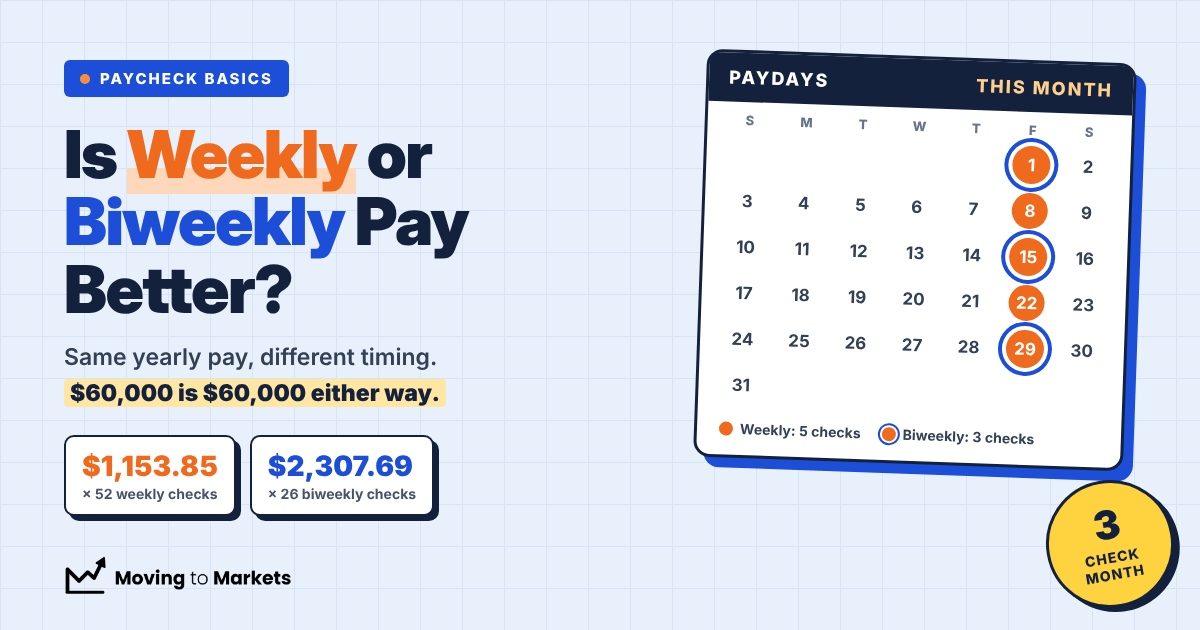
No. Your yearly pay is the same on both schedules. A $60,000 salary pays $1,153.85 a week or $2,307.69 every two weeks, and both add up to $60,000. An hourly worker earning $20 for 40 hours gets $800 a week or $1,600 every two weeks, which is $41,600 a year either way.
Here is how the same pay looks on each schedule. All figures are gross pay, before taxes and deductions.
| Pay schedule | Paychecks a year | Per check on a $60,000 salary | Per check at $20/hour, 40 hours a week |
|---|---|---|---|
| Weekly | 52 | $1,153.85 | $800 |
| Biweekly (every other week) | 26 | $2,307.69 | $1,600 |
| Semimonthly (twice a month, like the 15th and last day) | 24 | $2,500.00 | About $1,733 (varies by hours in each period) |
| Monthly | 12 | $5,000.00 | About $3,467 (varies by hours in the month) |
The only small money difference is interest. On a biweekly schedule your employer holds, on average, half a week more of your earned pay than on a weekly schedule. On $60,000 that’s about $577. If that money sat in a savings account paying 4.40% APY, the top rate we found on November 13, 2026, it would earn about $25 a year. So weekly pay is worth around $25 a year more, in theory. That’s not enough to pick a job over.
If you want that $25 working for you anyway, see how a high-yield savings account works (link).
How many paychecks do you get a year with each schedule?
Weekly pay gives you 52 paychecks a year and biweekly pay gives you 26. In some years, weekly payers get 53 and biweekly payers get 27, because a year has 365 days and 52 weeks only cover 364. That extra day piles up until one payday cycle fits in a 53rd week.
A quick way to remember it:
- Weekly: 52 checks, sometimes 53
- Biweekly: 26 checks, sometimes 27
- Semimonthly: always 24
- Monthly: always 12
Semimonthly and monthly pay are tied to dates on the calendar, so they never get an extra check. Weekly and biweekly pay are tied to days of the week, so they drift.
What are 3-paycheck months, and does weekly pay have them too?
A 3-paycheck month happens on biweekly pay when three paydays fall in the same month, which usually happens twice a year. Weekly pay has the same thing as 5-paycheck months, usually four times a year. On a $60,000 salary, both schedules give you $4,615.38 a year above a normal month’s budget.
This is the part people miss. Biweekly workers love their “two free paychecks,” but weekly workers get the exact same extra money. It just comes in four smaller pieces.
| Weekly | Biweekly | |
|---|---|---|
| Normal month | 4 checks | 2 checks |
| Normal month’s pay on $60,000 | $4,615.38 | $4,615.38 |
| Extra checks a year | 4 (in 5-check months) | 2 (in 3-check months) |
| Size of each extra check | $1,153.85 | $2,307.69 |
| Total extra above normal months | $4,615.38 | $4,615.38 |
There is a catch hiding in that table. A normal month on either schedule pays $4,615.38, but $60,000 divided by 12 is $5,000. If you build your budget on $5,000 a month, you will come up $384.62 short in 10 months of the year and only catch up in the extra-check months. Budget on your normal month, not your yearly salary divided by 12.
Will you get 27 paychecks in 2027?
Many people will. January 1, 2027 is a Friday and 2027 isn’t a leap year, so 2027 has 53 Fridays. If your biweekly Friday paydays fall on January 1, 15 and 29, you get 27 paydays in 2027. Weekly Friday payers get 53. The other biweekly Friday cycle gets the usual 26.
There are two biweekly Friday cycles, and you are on one of them:
| Your first Friday payday in January 2027 | Paydays in 2027 | 3-paycheck months |
|---|---|---|
| January 1 | 27 | January, July, December |
| January 8 | 26 | April, October |
One thing can change this. January 1 is a federal holiday, and a lot of employers move that payday to Thursday, December 31, 2026. If yours does, the extra check counts in 2026 instead, and 2027 goes back to 26 (or 52 for weekly). Look at your employer’s holiday payroll calendar, usually posted on the HR portal, to see which one applies to you.
If you’re hourly, a 27th check is just pay for hours you worked. If you’re salaried, your employer has two choices:
- Keep your check the same and pay 27 times: $2,307.69 x 27 = $62,307.69 for 2027
- Spread your salary over 27 checks: $60,000 / 27 = $2,222.22 per check, which is $85.47 less than usual on every check
The second one surprises people in January. If your check looks smaller and nobody told you why, ask HR whether they re-divided your salary for a 27-pay year.
Is weekly pay better if you live paycheck to paycheck?
Yes, usually. With weekly pay you are never more than 7 days from your next check, so a short week costs less to get through. One overdraft fee at Chase ($34) or Wells Fargo ($35), or one $15-per-$100 payday loan, costs more than any interest you’d earn from biweekly pay all year.
Here is what running short looks like in dollars:
- Overdraft: a $6 lunch that overdraws your account can cost $34 to $35 at the big banks, up to three times a day. See overdraft coverage vs overdraft protection (link) for how to turn that off.
- Payday loan: a common fee on a two-week payday loan is $15 for every $100. Borrow $300 to get to Friday and you pay $45. Over a year that works out to a 390% APR (15% x 26 two-week periods).
- Late fee: miss a credit card due date because your check landed the day after, and you can get a late fee plus interest. See when to pay your credit card to avoid interest (link).
Weekly pay cuts how long you have to stretch. If you get paid on Friday and your money runs out on Tuesday, you wait 3 days on weekly pay and up to 10 days on biweekly pay.
Weekly pay also helps hourly and shift workers whose hours change a lot. A slow week shows up in your next check right away instead of hiding inside a two-week total, so you see the problem sooner.
Is biweekly pay easier for budgeting?
For most monthly bills, yes. One biweekly check of $2,307.69 can cover a $1,600 rent payment on its own, while weekly pay means saving part of two checks. You also get two extra checks a year to put straight into savings or debt, and fewer paydays to track.
Say your rent is $1,600 and due on the 1st. Here’s how each schedule handles it (gross pay, $60,000 salary):
- Biweekly: the check before the 1st covers rent and leaves about $700. The second check of the month handles everything else.
- Weekly: each check is $1,153.85, so no single check pays rent. You set aside $400 from each of the four checks before the 1st.
Neither is hard. Biweekly just has fewer moving parts. That’s also why people on biweekly pay find it easier to treat the two 3-check months as found money: two checks of $2,307.69 that weren’t part of the budget at all. Put both into an emergency fund and you have $4,615.38 saved by December without changing anything else.
If your rent is the bill that never lines up with payday, it is worth asking your landlord for a different due date. Our guide on how to negotiate rent (link) covers how to ask.
Does pay frequency change your overtime or taxes?
No. Federal overtime is counted by the workweek, so working 44 hours one week and 36 the next still earns 4 hours of overtime on a biweekly check. Your yearly tax is also the same; your employer withholds a smaller amount from each weekly check and a bigger amount from each biweekly check.
The overtime rule comes from the Fair Labor Standards Act regulation 29 CFR 778.104, titled “Each workweek stands alone.” Your employer can’t average two weeks together. At $20 an hour:
| Week | Hours | Straight pay | Overtime pay (time and a half) | Week total |
|---|---|---|---|---|
| Week 1 | 44 | 40 x $20 = $800 | 4 x $30 = $120 | $920 |
| Week 2 | 36 | 36 x $20 = $720 | $0 | $720 |
| Biweekly check | 80 | $1,640 |
If your employer paid you $1,600 for those 80 hours, you were shorted $40. California goes further and also requires overtime for hours over 8 in a single day.
Taxes work the same way on a smaller scale. The IRS withholding tables are built per pay period, so a weekly check has about half the withholding of a biweekly one. Your W-2 total at the end of the year doesn’t change. The same goes for retirement contributions: putting the full 2026 401(k) limit of $24,500 in means $471.15 per weekly check or $942.31 per biweekly check. If you are weighing where that money goes, see 401(k) vs Roth 401(k) (link).
Which is more common, weekly or biweekly pay?
Biweekly. In the BLS’s February 2023 survey, 43.0% of private businesses paid biweekly, 27.0% weekly, 19.8% semimonthly and 10.3% monthly. Construction is the big exception, where 65.4% of businesses pay weekly. These are shares of businesses, not workers, so the share of workers on biweekly pay is likely higher.
Bigger employers lean hard toward biweekly. Among businesses with 1,000 or more workers, 66.6% pay biweekly and 26.3% pay weekly. Among businesses with 1 to 9 workers, it’s 39.0% biweekly and 24.1% weekly.
Here’s the industry breakdown from the same BLS release:
| Industry | Weekly | Biweekly | Semimonthly | Monthly |
|---|---|---|---|---|
| Construction | 65.4% | 22.3% | 6.5% | 5.9% |
| Manufacturing | 43.4% | 46.6% | 8.6% | 1.5% |
| Trade, transportation and utilities | 30.5% | 44.1% | 16.0% | 9.5% |
| Leisure and hospitality | 25.6% | 54.9% | 14.1% | 5.5% |
| Education and health services | 9.9% | 63.6% | 18.4% | 8.1% |
| Professional and business services | 16.0% | 42.2% | 29.4% | 12.4% |
| Financial activities | 14.0% | 37.4% | 30.2% | 18.4% |
| Information | 4.4% | 47.2% | 37.5% | 10.9% |
So if you want weekly pay, construction and manufacturing jobs are where you are most likely to find it. Information businesses (tech, publishing, telecom) almost never pay weekly, at 4.4%.
Some pages online quote this 43% figure as “February 2020 data,” and others quote 36% from an older 2013 BLS study. February 2023 is the latest the BLS has published.
Can your employer choose any pay schedule?
Mostly yes, within state law. Federal law sets no pay frequency, so each state sets its own minimum. A few states push employers toward weekly pay, including Connecticut, New York for manual workers, Rhode Island and Massachusetts for hourly workers. Alabama and Florida have no rule at all.
This is the U.S. Department of Labor’s summary, last revised January 1, 2023. Check your state labor department’s website for any change since then.
| State | What the DOL table says |
|---|---|
| Connecticut | Weekly, unless the labor commissioner approves a longer period |
| New York | Weekly for manual workers; semimonthly for clerical and other workers |
| Rhode Island | Weekly for most employers, with some exceptions |
| Massachusetts | Hourly workers weekly or biweekly; salaried workers can be semimonthly |
| New Hampshire | Weekly or biweekly; less often only with written state permission |
| Vermont | Weekly; biweekly or semimonthly with written notice to workers |
| California | Generally at least twice a month, with different rules by job type |
| Texas | At least twice a month for nonexempt workers; monthly for exempt workers |
| Alabama, Florida | No pay frequency rule |
| Nebraska, North Carolina, Pennsylvania, South Carolina | No set frequency in the DOL table; employer sets payday |
One correction on a claim you will see online: Maine does not require weekly pay. The DOL table lists Maine as twice a month with no more than 16 days between paydays.
Read More: How to Get Rid of PMI: 7 Ways to Drop Private Mortgage Insurance
What this means for you: you rarely get to pick. Your employer picks a schedule and runs it for everyone in your role. If weekly pay matters a lot to you, ask about the pay schedule in the job interview, before you accept the offer.
How do you budget on weekly or biweekly pay?
Build your budget on a normal month, which is 4 checks on weekly pay or 2 checks on biweekly pay. Assign each bill to a specific check, move due dates so they land after payday, and send every extra check straight to savings or debt before you can spend it.
Here’s the method step by step:
- Find your normal month. Take-home pay per check x 4 (weekly) or x 2 (biweekly). Use that number, not your salary divided by 12.
- List bills by due date. Rent, car, phone, insurance, card payments. Write the date next to each.
- Assign each bill to a check. On biweekly pay, the first check of the month usually takes rent and the second takes everything else. On weekly pay, split big bills across checks, like $400 a week toward $1,600 rent.
- Move due dates that don’t fit. Most credit card companies, car lenders and phone carriers let you change your due date online or with one call. Pick a date 2 to 3 days after a payday.
- Split your direct deposit. Most employers let you send a fixed amount to a second account. Send your rent share or your savings there so it never sits in checking.
- Plan the extra checks now. Mark your 3-check months (or 5-check months) on the calendar and decide in advance where that money goes.
- Keep a one-week buffer. Build one week of bills in checking, about $1,154 on a $60,000 salary. After that, the length of your pay cycle stops mattering much.
So which one is better for you?
Weekly pay is better if you are hourly, work variable shifts, or often run out before payday. Biweekly pay is better if you are salaried, have big fixed monthly bills, and like having two extra checks to save. On a yearly basis, the money is the same.
| Your situation | Better fit |
|---|---|
| You often run out of money before payday | Weekly |
| You are hourly and your shifts change week to week | Weekly |
| You just started a new job and need cash fast | Weekly (biweekly can mean up to 3 weeks before your first check) |
| Your biggest bill is rent or a mortgage due on the 1st | Biweekly |
| You want fewer paydays to track | Biweekly |
| You want a planned savings boost twice a year | Biweekly |
| You already keep a one-week cash buffer | Either one |
If your employer only offers one schedule, the budgeting steps above make either one work. And if you want to see how close you are to running short each month, start by writing down how many days your money lasts after payday. If the answer is fewer than 7, a buffer will help you more than any pay schedule.
Got a question about your own pay schedule or a 27-paycheck year? Send it to us through the Contact Us page and we will try to answer it in a future update.
Frequently asked questions
Is it better to get paid weekly or biweekly?
Neither pays more over a year. Weekly is better if money runs short before payday because you’re never more than 7 days from a check. Biweekly is better for paying big monthly bills like rent, and it gives you two extra checks a year.
Do you get more money if you get paid weekly?
No. A $60,000 salary is $60,000 on any schedule: $1,153.85 a week or $2,307.69 every two weeks. Getting paid sooner is worth about $25 a year in savings interest at a 4.40% APY.
How many paychecks do you get a year if you’re paid biweekly?
Usually 26. In some years you get 27, when the calendar lets one more two-week cycle fit. For many Friday payers, 2027 is a 27-paycheck year.
Which months have 3 paychecks in 2027?
It depends on your cycle. If your Friday paydays fall on January 1, 15 and 29, your 3-check months are January, July and December. If they fall on January 8 and 22, your 3-check months are April and October.
Does weekly pay have extra paychecks too?
Yes. Weekly pay has four months a year with 5 paychecks, and five in a 53-Friday year like 2027. On the same salary, the extra money adds up to the same total as biweekly’s two 3-check months.
Is biweekly the same as semimonthly?
No. Biweekly is every other week, 26 checks a year, always on the same weekday. Semimonthly is twice a month on set dates like the 15th and the last day, 24 checks a year. Semimonthly checks are a bit bigger and never give you a 3-check month.
Does getting paid biweekly change how overtime works?
No. Federal law counts overtime week by week. If you work 44 hours one week and 36 the next, you are owed 4 hours of overtime even though the two weeks total 80 hours.
Can I ask my employer to pay me weekly?
You can ask, but most employers run one schedule for everyone in a role and won’t change it for one person. A few states, like Connecticut and Rhode Island, require weekly pay for most workers. Elsewhere, ask about pay frequency before you accept a job.