If you’ve ever walked through Manhattan, Boston or Philadelphia, you’ve walked past a green TD branch. Most Americans who bank there have no idea it’s Canadian. Same goes for BMO in Chicago, which bought the city’s Harris Bank back in 1984. Canadian banks are a lot bigger than people think, and a lot more of them sit on US main streets than you’d guess.
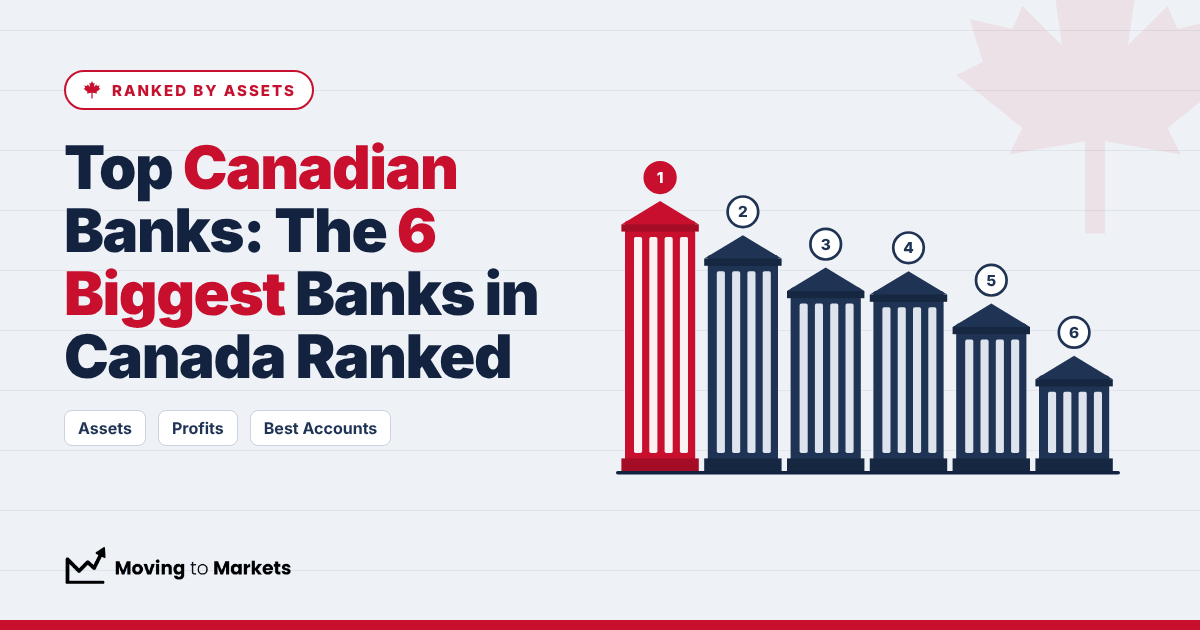
At home they’re even bigger. Six banks hold about 93% of all banking assets in Canada, and the largest one, Royal Bank of Canada, had $2.50 trillion in total assets at the end of July 2026. In fiscal 2025 RBC became the first Canadian bank to earn more than $20 billion in one year. The Big Six together made close to $70 billion.
Below you’ll find the top Canadian banks by total assets, what each one does, its latest numbers and the one thing worth knowing about it. You also get the deals that changed the list (HSBC Canada, Canadian Western Bank and Laurentian Bank are all gone), the October 2026 rate hike, TD’s trouble in the US, and which banks are cheapest if you just want an account.
Not financial advice. This article is for general information only. It isn’t a recommendation to buy or sell any stock. Bank shares can fall fast when rates or the economy turn. Do your own research and, if you can, talk to a licensed financial advisor before you invest.
A quick note on dates. Canadian banks end their year on 31 October. So “fiscal 2025” means November 2024 to October 2025, and the latest quarter, “Q3 2026”, covers May to July 2026. All dollar figures are Canadian unless we say US$.
The Top Canadian Banks at a Glance
| # | Bank (ticker) | HQ | Founded | Total assets (31 Jul 2026) | Net income, May to Jul 2026 | Fiscal 2025 net income |
|---|---|---|---|---|---|---|
| 1 | Royal Bank of Canada (RY) | Toronto | 1864 | $2,499B | $6.02B | $20.37B |
| 2 | TD Bank Group (TD) | Toronto | 1855 | $2,112B | $4.62B | $20.54B* |
| 3 | Scotiabank (BNS) | Toronto | 1832 | $1,548B | $2.95B | $7.76B |
| 4 | Bank of Montreal, BMO (BMO) | Toronto / Montreal | 1817 | $1,539B | $1.75B ($2.86B adjusted) | $8.73B |
| 5 | CIBC (CM) | Toronto | 1867 | $1,178B | $2.40B | $8.45B |
| 6 | National Bank of Canada (NA) | Montreal | 1859 | $635B | $1.31B | $4.02B |
*TD’s fiscal 2025 figure includes a one-time gain from selling its Charles Schwab shares, so it isn’t comparable with the others.
The first five trade on both the Toronto Stock Exchange and the New York Stock Exchange, so you can buy them from a regular US brokerage account. National Bank trades only in Toronto.
Big Five or Big Six?
You’ll see both terms online and it causes a lot of confusion. “Big Five” is the older name for RBC, TD, Scotiabank, BMO and CIBC. “Big Six” adds National Bank, which is much smaller but is one of the six banks Canada’s regulator, OSFI, names as systemically important, which means they have to hold extra capital. National Bank got bigger again when it bought Canadian Western Bank in 2025 and took over Laurentian Bank’s retail customers in November 2026. These days most Canadian news outlets say Big Six, and so do we.
Types of Banks in Canada, in Plain Words
Most “top banks” lists online mix very different businesses together, which is why you’ll see a credit union ranked next to a phone app. Here’s how they split:
- The Big Six. Full-service banks with branches across the country, wealth management, insurance and investment banking arms. Almost every Canadian has an account at one of them.
- Their online brands. Tangerine belongs to Scotiabank and Simplii Financial belongs to CIBC. No branches, no monthly fees, and they use the parent bank’s ATMs.
- Mid-size and online banks. EQ Bank (owned by EQB), plus smaller lenders. They compete on interest rates.
- Credit unions. Desjardins in Quebec is the big one. Credit unions are owned by their members and mostly regulated by the provinces, not Ottawa.
- Foreign bank units. Citibank, JPMorgan and others run Canadian branches, mostly for corporate clients. HSBC used to be the big foreign retail bank here until RBC bought it.
Banks are also sorted into schedules under the Bank Act. Schedule I banks are Canadian-owned (all of the Big Six). Schedule II banks are subsidiaries of foreign banks. Schedule III are branches of foreign banks.
1. Royal Bank of Canada (RBC)
RBC is the biggest bank in Canada and also the country’s largest company by market value. It started in 1864 as the Merchants Bank of Halifax and now has $2.50 trillion in total assets, about $390 billion more than TD. It runs 1,263 branches in Canada and employs roughly 96,600 people.
Fiscal 2025 was a record. Net income came in at $20.37 billion, the first time any Canadian bank passed $20 billion in a year. The fourth quarter alone made $5.4 billion, up 29%, with capital markets profit up 45% to $1.4 billion and wealth management up about a third. The streak kept going in 2026: May to July profit was $6.02 billion, up from $5.41 billion a year earlier.
A big piece of that growth came from buying HSBC Bank Canada. RBC paid $13.5 billion in cash and closed the deal on 28 March 2024. It shut 25 HSBC branches and reopened the rest under the RBC name on 1 April 2024. In the US, RBC owns City National Bank in Los Angeles, which it bought in 2015.
Good to know: RBC’s corporate head office is in Toronto, but its legal head office is still in Montreal. That’s why you’ll see both cities listed.
2. TD Bank Group
TD is Canada’s second-largest bank, with $2.11 trillion in total assets. The Toronto-Dominion Bank formed in 1955 when the Bank of Toronto (1855) merged with The Dominion Bank (1869). It has 1,060 branches in Canada and about 1,100 more in 15 US states and Washington, DC, through TD Bank, N.A. With roughly 102,000 employees, TD has the most staff of any Canadian bank.
TD’s US business is also its biggest headache. In October 2024 TD pleaded guilty to failing to stop money laundering through its US branches and agreed to pay about US$3 billion: US$1.8 billion to the Justice Department and US$1.3 billion to FinCEN, the largest FinCEN penalty against a bank. The Office of the Comptroller of the Currency also capped TD’s US retail bank at US$434 billion in assets. That means TD can’t grow its US bank until regulators lift the cap. TD spent $507 million fixing its anti-money-laundering systems in fiscal 2025 and expects to spend about the same in 2026. By February 2026 its US loans were down about 11% from a year earlier.
In February 2025 TD sold its entire 10.1% stake in Charles Schwab, about 184.7 million shares, at US$79.25 each. Canadian Press put the proceeds at about $20 billion. TD said it would use about $8 billion to buy back its own shares. That one-time gain is why TD’s fiscal 2025 profit ($20.54 billion) looks higher than RBC’s. Without it, RBC earned more.
The Canadian side is doing well. TD earned $4.62 billion in May to July 2026, up from $3.34 billion, with record results in its Canadian banking and wholesale businesses. It has also set aside $500 million for losses tied to US tariffs.
Good to know: TD says it plans to open 100 new US branches by the end of 2028, but only once the asset cap allows it to grow again.
3. Scotiabank (Bank of Nova Scotia)
Scotiabank is third, with $1.55 trillion in total assets. It was founded in Halifax in 1832, which is why some websites say its head office is in Halifax. It isn’t. The executive offices have been in Toronto for decades. The bank has about 86,400 employees.
Scotiabank used to be the most international of the Big Six, with big operations in Mexico, Peru, Chile and Colombia. Over the past two years it has pulled back from parts of Latin America and turned toward North America. In August 2024 it agreed to buy a 14.9% stake in KeyCorp, the Cleveland-based US bank, for about US$2.8 billion.
Fiscal 2025 net income was $7.76 billion, the lowest of the Big Five, partly because of restructuring charges in the fourth quarter. The May to July 2026 quarter was stronger: $2.95 billion, up from $2.53 billion, with record earnings in wealth management and in its global banking and markets unit.
Good to know: Tangerine, one of Canada’s best-known no-fee online banks, is owned by Scotiabank.
4. Bank of Montreal (BMO)
BMO is Canada’s oldest bank. It opened in Montreal in 1817, 50 years before Canada itself existed. It has $1.54 trillion in total assets, just $9 billion behind Scotiabank, so these two could swap places any quarter. Its legal head office is in Montreal and its operating head office in Toronto. It has about 53,200 employees.
BMO has the deepest US roots of any Canadian bank. It bought Chicago’s Harris Bank in 1984 and in February 2023 completed its US$16.3 billion purchase of Bank of the West from BNP Paribas, which gave it branches across California and the western states.
Fiscal 2025 net income was $8.73 billion. In May to July 2026, reported profit fell to $1.75 billion from $2.33 billion because BMO took a charge of about $1.1 billion on selling its transportation and vendor finance businesses. Strip that out and adjusted profit was $2.86 billion, up 19%.
Good to know: BMO has paid a dividend every year since 1829, the longest run of any company in Canada.
5. CIBC (Canadian Imperial Bank of Commerce)
CIBC is fifth, with $1.18 trillion in total assets. The current bank formed in 1961 when the Canadian Bank of Commerce (1867) merged with the Imperial Bank of Canada (1875). Its head office is CIBC Square in downtown Toronto, and it has about 49,800 employees.
CIBC had a record fiscal 2025, with net income of $8.45 billion, up from $7.2 billion in 2024. It raised its quarterly dividend by 10 cents to $1.07 a share. May to July 2026 profit was $2.4 billion, up 15% from a year earlier.
CIBC leans more on Canadian mortgages and personal banking than its rivals, so it tends to feel housing slowdowns first. Its chief risk officer said business loans most exposed to US tariffs make up less than 1% of the bank’s loans.
Good to know: Simplii Financial, CIBC’s online bank, charges no monthly fee on chequing and uses CIBC’s ATM network.
6. National Bank of Canada
National Bank is the smallest of the Big Six, with $635 billion in total assets, but it has grown fast. Its roots go back to 1859 in Quebec, and the current bank formed in a 1979 merger. Its head office is in Montreal and it has about 33,200 employees. Most of its branches are in Quebec.
Two deals made it bigger. On 3 February 2025 it completed its purchase of Canadian Western Bank, an Edmonton lender, in an all-share deal worth about $5.6 billion. That gave it a real presence in Western Canada for the first time. Then on 1 November 2026 it took over Laurentian Bank’s retail and small business customers (more on that below).
Fiscal 2025 net income was $4.02 billion. May to July 2026 profit was $1.31 billion, up from $1.07 billion.
Good to know: National Bank is the only Big Six bank you can’t buy in New York. Its shares trade only in Toronto under NA.
The Next Tier: Other Banks Worth Knowing
These aren’t in the same league as the Big Six by size, but they come up a lot when people search for top Canadian banks:
- Desjardins Group. A federation of credit unions founded in Lévis, Quebec, in 1900. It’s the biggest credit union group in Canada and would rank right behind National Bank if you counted it as a bank. Its last reported total on Wikipedia was $397 billion (2021).
- EQ Bank (EQB). Toronto-based, with $53.2 billion in total assets at the end of 2024 and 607,000 EQ Bank customers by December 2025. It has no branches and pays some of the best savings rates in Canada. In December 2025 EQB agreed to buy PC Financial from Loblaw for about $800 million.
- Tangerine. Scotiabank’s online bank. No-fee chequing and savings.
- Simplii Financial. CIBC’s online bank. No-fee chequing.
- ATB Financial. A bank owned by the Alberta government, with branches only in Alberta.
Banks That Dropped Off the List
A lot of older “top Canadian banks” lists still include banks that don’t exist anymore as separate companies. Here’s what happened to them:
- HSBC Bank Canada. Bought by RBC for $13.5 billion. Closed 28 March 2024. HSBC accounts are now RBC accounts.
- Canadian Western Bank. Bought by National Bank in an all-share deal. Closed 3 February 2025.
- Laurentian Bank. Announced 2 December 2025. Fairstone Bank bought all of Laurentian’s shares at $40.50 each, about $1.9 billion in total, and National Bank took over its personal and small business accounts. The deal closed on 1 November 2026, and accounts moved to National Bank between 6 and 8 November. Laurentian is closing its Quebec branches and keeps its commercial lending, B2B Bank and capital markets units under Fairstone. That ends roughly 180 years as a listed bank.
The October 2026 Rate Hike and What It Means
On 28 October 2026 the Bank of Canada raised its policy rate by 0.25 percentage points to 2.5%. It was the first hike in more than three years. The rate had sat at 2.25% for about a year after a run of cuts. The bank said it moved because high energy prices risked pushing up the price of everything else. Inflation has run around 3% since April and the bank expects about 3.5% by the end of 2026.
For the banks, a higher rate usually means more money on loans, but it also means more customers struggling with mortgage and credit card payments. You can already see the banks preparing for that. In May to July 2026 they set aside money for bad loans: RBC $1.00 billion, Scotiabank $1.08 billion, TD $917 million, BMO $722 million, CIBC about $600 million and National Bank $246 million. In June 2026 OSFI also cut the extra capital buffer big banks must hold, to 3% from 3.5%, which gives them more room to lend.
The next rate decision is on 9 December 2026, a few days after the banks report their full-year results.
Open Banking Is Coming to Canada
Canada still doesn’t have open banking in force. That’s the system that lets you share your bank data safely with apps like budgeting tools or other banks. That’s changing. The federal government released draft rules under the Consumer-Driven Banking Act on 27 June 2026, with the Bank of Canada in charge of oversight. Under the draft, a bank or app that breaks the rules could face fines of up to $10 million. Once it’s live, switching from a Big Six bank to an online bank should get a lot easier, which is one reason the big banks are spending heavily on their apps.
Best Canadian Banks to Open an Account With
The biggest bank isn’t always the cheapest one for your everyday account. Hardbacon’s 2026 comparison puts the Big Six chequing accounts at roughly $4 to $30 a month, while the online banks charge nothing:
| Bank | Monthly chequing fee | Why people pick it |
|---|---|---|
| EQ Bank | $0 | 1.00% base rate, 2.75% with $2,000 a month in direct deposits (Aug 2026) |
| Tangerine | $0 | Scotiabank ATMs, frequent welcome offers |
| Simplii Financial | $0 | CIBC ATMs, simple app |
| RBC | $4 to $30 | Most branches, huge ATM network |
| TD | $3.95 to $25 | Long branch hours, cross-border banking with TD US |
| BMO | $4 to $30 | Good if you also bank in the US with BMO |
| National Bank | $12.95 to $30 | Best branch coverage in Quebec |
| CIBC | $4 to $29.95 | Strong newcomer packages |
| Scotiabank | $3.95 to $25.95 | Scene+ rewards points |
Fees come from Hardbacon’s July and August 2026 data. The Big Six usually waive the monthly fee if you keep a minimum balance, often $3,000 to $4,000, and most of them waive it for the first year if you’re new to Canada. Check each bank’s own fee page before you apply, because these change all the time.
Your money is protected either way. CDIC insures up to $100,000 per person, per member bank, in each of nine categories: savings in your own name, joint accounts, RRSPs, RRIFs, TFSAs, RDSPs, RESPs, FHSAs and trust accounts. So you could have far more than $100,000 covered at one bank if it’s spread across categories.
Frequently Asked Questions
What is the biggest bank in Canada?
Royal Bank of Canada (RBC), with $2.50 trillion in total assets at 31 July 2026. TD is second with $2.11 trillion and Scotiabank third with $1.55 trillion.
What are the Big Six banks in Canada?
RBC, TD, Scotiabank, BMO, CIBC and National Bank of Canada. Together they hold about 93% of Canadian banking assets and made about $19.1 billion in net income in May to July 2026 alone.
Is TD bigger than RBC?
No. TD was neck and neck with RBC in 2017, but RBC is now about $390 billion ahead on total assets. TD’s US asset cap has kept it from growing south of the border since 2024.
What happened to HSBC Bank Canada?
RBC bought it for $13.5 billion and closed the deal on 28 March 2024. HSBC branches either closed or became RBC branches on 1 April 2024.
Are Canadian banks safe?
Canadian banks are among the most heavily regulated in the world, and no Big Six bank failed or had to be taken over in the 2008 financial crisis. Deposits at member banks are insured by CDIC up to $100,000 per category, across nine categories.
Which Canadian bank is the oldest?
Bank of Montreal, founded in 1817. Scotiabank followed in 1832.
Can I buy Canadian bank stocks from the US?
Yes. RBC (RY), TD (TD), Scotiabank (BNS), BMO (BMO) and CIBC (CM) all trade on the New York Stock Exchange. National Bank (NA) trades only in Toronto.
Which Canadian bank is best for newcomers?
Most of the Big Six offer newcomer packages that waive fees for a year or more and help you get a credit card without a Canadian credit history. If you want to avoid fees long term, an online bank like EQ Bank, Tangerine or Simplii is the cheaper choice.
So Which Canadian Bank Should You Pick?
If you’re an investor, RBC is the biggest and most profitable, TD is the recovery story if its US cap ever lifts, and BMO and Scotiabank give you the most US exposure. If you just need an account, the best bank is the one that doesn’t charge you $17 a month to hold your own money, which usually means an online bank or a Big Six account where you can keep the minimum balance.