Next time you sit at an airport gate, look out the window for a minute. The plane has GE or Pratt & Whitney engines on it, and some of the turbine blades inside may well have been cast by Howmet. The fuel truck, the baggage cart, the air conditioning in the terminal, the train that brought the jet fuel, every one of these has a company behind it that you can buy shares of. That’s the industrial sector. It’s not flashy and most people never think about it, but in 2026 some of these companies are growing faster than a lot of tech names.
Two things are pushing them. Airlines can’t get enough new planes and engines, so the ones they already fly need more parts and repairs. And data centers need huge amounts of electricity, which means gas turbines, transformers, switchgear and cooling. GE Vernova took $29.3 billion of orders in the third quarter alone, and its power segment orders nearly tripled. Defense spending is the third piece. Lockheed Martin and RTX ended the quarter with record backlogs, and General Dynamics’ backlog doubled in a year.
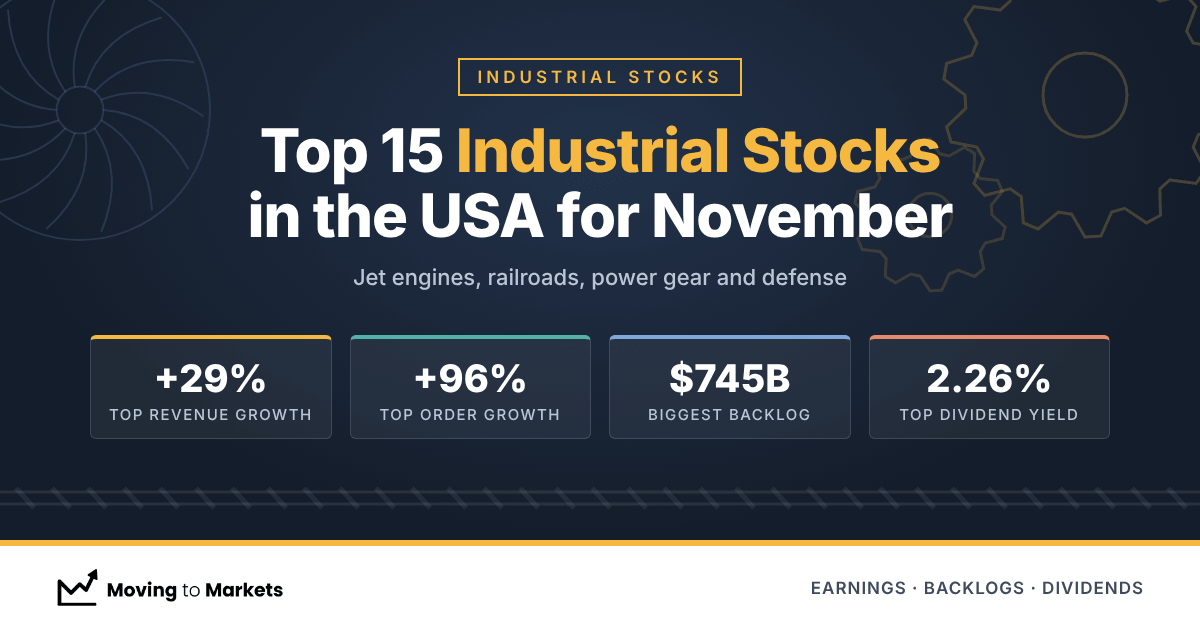
Below are the top 15 industrial stocks in the USA, ordered by market cap. For each one you get what the company does, how its last quarter went, how much work it has lined up, and what could go wrong. Earnings numbers come from the companies’ own results, mostly for the quarter ended September 30, 2026.
Not financial advice. This article is for general information only. It isn’t a recommendation to buy or sell any stock. Stocks can lose value, and a few of these have dropped more than 30% from their highs this year. Do your own research and, if you can, talk to a licensed financial advisor before you invest.
Top 15 US Industrial Stocks at a Glance
Market cap is from CompaniesMarketCap (CMC) or StockAnalysis (SA) on the date shown. Revenue is for the latest reported quarter, compared with the same quarter a year earlier. Dividend yield is from StockAnalysis on the same price date.
| # | Company (ticker) | What it does | Market cap (source, date) | Latest quarter revenue | Backlog | Dividend yield |
|---|---|---|---|---|---|---|
| 1 | GE Aerospace (GE) | Jet engines and engine repairs | $350.6B (CMC, Nov 10) | $14.12B (+16%) | $170B+ services | 0.56% |
| 2 | RTX (RTX) | Pratt & Whitney engines, Collins parts, Raytheon missiles | $264.9B (CMC, Nov 9) | $24.97B (+11%) | $340B | 1.48% |
| 3 | GE Vernova (GEV) | Gas turbines, grid equipment, wind turbines | $219.5B (CMC, Nov 9)* | $12.64B (+27%) | $197B | 0.26% |
| 4 | Union Pacific (UNP) | Freight railroad across the western US | $176.5B (SA, Oct 26) | $7.20B (+15%) | n/a | 1.91% |
| 5 | Deere (DE) | Tractors, combines, construction machines | $172.9B (SA, Oct 26) | $12.61B (+5%)** | n/a | 1.01% |
| 6 | Lockheed Martin (LMT) | F-35 jets, missiles, space systems | $147.1B (SA, Oct 30) | $20.71B (+11%) | $292.0B | 2.26% |
| 7 | Boeing (BA) | Commercial jets, defense, space | $137.4B (SA, Nov 6) | $24.19B (+4%) | $745B | None |
| 8 | Eaton (ETN) | Electrical gear for data centers and buildings | $132.8B (SA, Nov 6) | $8.95B (+28%) | Up 46% (Electrical) | 1.29% |
| 9 | Parker-Hannifin (PH) | Hydraulics, filters, aircraft parts | $115.7B (SA, Nov 6) | $5.99B (+18%) | $13.7B | 0.87% |
| 10 | Trane Technologies (TT) | Commercial HVAC and chillers | $100.1B (SA, Oct 26) | $6.76B (+18%) | $12.5B | 0.92% |
| 11 | General Dynamics (GD) | Submarines, Gulfstream jets, tanks | $96.5B (SA, Oct 26) | $14.57B (+13%) | $220.3B | 1.78% |
| 12 | WM (WM) | Trash pickup, landfills, medical waste | $94.0B (SA, Nov 6) | $6.85B (+6%) | n/a | 1.60% |
| 13 | 3M (MMM) | Tapes, filters, safety and industrial products | $89.3B (SA, Oct 26) | $6.6B (+1%) | n/a | 1.81% |
| 14 | Howmet Aerospace (HWM) | Engine blades, fasteners, truck wheels | $77.7B (SA, Oct 27) | $2.70B (+29%) | n/a | 0.29% |
| 15 | Honeywell (HON) | Building automation, process controls | $69.8B (SA, Nov 6) | About $5B (+1%)* | $19B | 1.27%* |
* Single source or conflicting sources, see the notes under each stock. ** Deere’s fiscal third quarter, which ended August 2, 2026.
One more thing before the list. If you are looking for Caterpillar, Quanta Services or EMCOR, we covered them in our top 10 construction stocks in the USA article. Caterpillar would sit at number two here by size, at about $274 billion.
1. GE Aerospace (GE)
GE Aerospace builds engines on its own and through CFM, its joint venture with Safran, which makes the LEAP engine on newer Boeing 737 and Airbus A320 jets. GE makes money twice from each engine. Once when it sells it, and again for the next 20 or 30 years when that engine comes in for parts and overhaul. The second part is where most of the profit is.
Third-quarter revenue was $14.12 billion, up 16% from $12.18 billion. Adjusted earnings per share jumped 36% to $2.25. Orders came in at $19.0 billion, up 49%, and the commercial engines and services side alone was up 58%. CEO Larry Culp said the company has an “over $170 billion commercial services backlog.”
GE raised its 2026 guidance “across the board”. It now expects adjusted EPS of $8.00 to $8.10, up from $7.65 to $7.85, and free cash flow of $9.1 billion to $9.4 billion.
Good for: Investors who believe people will keep flying more and want the company that gets paid every time an engine needs work. The catch: It’s priced like it. StockAnalysis showed a forward P/E near 38 on November 9, the highest on this list after Boeing. Third-quarter free cash flow also fell 14% to $2.04 billion, even with sales growing.
2. RTX (RTX)
RTX is three businesses in one. Pratt & Whitney makes jet engines, including the geared turbofan on many Airbus A320neo jets. Collins Aerospace makes cockpit electronics, landing gear and cabin seats. Raytheon makes missiles like the Patriot and Stinger.
Sales in the third quarter were $24.97 billion, up 11%. Adjusted EPS rose to $2.26 from $1.70, though $0.25 of that came from recovered tariff costs. The backlog hit a record $340 billion, split $176 billion commercial and $164 billion defense. CEO Chris Calio said the company booked “over $81 billion of new commercial and defense awards” in the quarter.
RTX raised its 2026 outlook again, to $97.0 billion to $97.5 billion of adjusted sales and $7.65 to $7.75 of adjusted EPS.
Good for: People who want commercial aviation and defense in one stock, with a dividend near 1.5%. The catch: Pratt & Whitney had a rough quarter. Its operating profit fell 19% to $608 million after a $363 million charge “related to a customer bankruptcy.” The powder metal problem in its GTF engines also still means extra inspections and engine removals. Free cash flow dropped 47% to $2.12 billion.
3. GE Vernova (GEV)
GE Vernova was spun out of General Electric in 2024. It makes the gas turbines that power plants use, the grid equipment that moves electricity around, and wind turbines. Data centers need a lot of new power, fast, and a gas turbine is one of the quickest ways to get it.
The third-quarter numbers are huge. Revenue rose 27% to $12.64 billion. Orders hit $29.3 billion, up 96% on an organic basis. Power segment orders were $21.78 billion against $7.83 billion a year earlier. Backlog reached $197 billion, up $20 billion in just three months. Free cash flow was $5.41 billion, compared with $732 million a year ago.
The company raised its 2026 free cash flow forecast to $16 billion to $17 billion, up from $11.5 billion to $12.5 billion. It also agreed to buy Trench Group, a high-voltage grid equipment maker, for about $9.0 billion, and doubled its buyback authorization to $20 billion.
Good for: Investors who want the most direct play on electricity demand from AI and data centers. The catch: Wind is still losing money, about $585 million of segment EBITDA losses in the first nine months. The stock is also volatile. StockAnalysis lists a 52-week range of $530.16 to $1,195.94, and its November 6 close of $774.11 was about 35% below that high. Market cap numbers don’t agree either: $219.5B (CMC, Nov 9), $208.1B (CMC, undated) and $203.8B (SA, Nov 6).
4. Union Pacific (UNP)
Union Pacific runs the biggest railroad in the western half of the country, with tracks from the West Coast ports to Chicago, New Orleans and the Mexican border. Coal, grain, chemicals, cars, and those long stacks of shipping containers you see crossing the desert all ride on its trains.
Third-quarter operating revenue was a record $7.20 billion, up 15% from $6.24 billion. Diluted EPS rose 16% to $3.49. Carloads grew 6%, and intermodal (the shipping containers) grew 11%. The operating ratio, the railroad measure where lower is better, was 59.1% against 59.2%. Part of the revenue jump came from higher fuel surcharges. UP paid $4.21 a gallon for fuel against $2.56 a year earlier, which cost the operating ratio 1.4 points.
The bigger story is the plan to buy Norfolk Southern and form what UP calls “America’s first transcontinental railroad.” In September the Surface Transportation Board denied requests to dismiss the merger application, and the two companies expect to close in the second half of 2027.
Good for: Income investors. UP raised its quarterly dividend to $1.42 and yields about 1.9%. The catch: It has basically stopped buying back stock, $26 million year to date against $2.68 billion a year earlier, to save cash for the merger. If regulators block or delay the deal, expect a messy year.
5. Deere (DE)
The green and yellow tractors. Deere also makes combines, sprayers, lawn mowers, and a big line of construction machines like excavators and wheel loaders. Its fiscal year runs a little ahead of the calendar, so its latest results are for the quarter that ended August 2, 2026.
Net sales and revenues were $12.61 billion, up 5%. Net income rose 7% to $1.38 billion, or $5.10 a share. The split inside the company tells the story. Large farm equipment sales fell 6% and profit there fell 9%, because crop prices and farm incomes are weak. Construction and Forestry sales rose 18% and its operating profit almost doubled, up 84% to $436 million. Small Ag and Turf was up 12%.
CEO John May said “we continue to believe 2026 will mark the bottom of the current ag equipment cycle.” Deere expects full-year net income of $4.75 billion to $5.00 billion.
Good for: Patient investors who want to buy a farm equipment leader near what management calls the bottom of the cycle. The catch: It’s not cheap for a company with shrinking farm profits. StockAnalysis showed a forward P/E around 30 on October 26 prices. Tariffs are also messing with its costs, and Deere hasn’t reported its fiscal fourth quarter yet, so check for new numbers before you buy.
6. Lockheed Martin (LMT)
Lockheed builds the F-35 fighter jet, the PAC-3 missiles used with the Patriot system, Black Hawk helicopters, and a lot of satellites and space hardware. Its main customer is the US government, plus allies buying through it.
Sales in the third quarter were $20.71 billion, up 11%. Diluted EPS was $7.97 against $6.95. Free cash flow was about $3.0 billion. The backlog hit a record $292.0 billion, up 27% since the end of June, and $52.5 billion of that is one multi-year order for PAC-3 MSE interceptors.
Lockheed raised its 2026 forecast to $80 billion to $82 billion in sales and $30.35 to $30.75 in EPS. CEO Jim Taiclet said the company will “raise our dividend for the 24th year in a row.”
Good for: Income investors. At 2.26% on StockAnalysis, it has the highest yield on this list. The catch: The F-35 is a big part of the business, and the release says costs on the Lot 20 contract “began to exceed the current contractual authorization and funding” in the quarter. If more funding doesn’t come, Lockheed warns its results will be hurt. It also hasn’t bought back any stock this year.
7. Boeing (BA)
Boeing is the only big US maker of passenger jets, so you have probably flown on one of their 737s or 787s. It also builds military aircraft and space systems. After years of safety problems, strikes and production limits, it is slowly getting back on its feet.
Third-quarter revenue was $24.19 billion, up 4%. It delivered 161 commercial planes, about the same as the 160 a year earlier. The net loss was $116 million, compared with a $5.34 billion loss a year ago. Core loss per share was $0.34. Free cash flow turned positive at $464 million. The total backlog is a record $745 billion, including more than 6,300 commercial airplanes.
Production is steadier. The 737 is at 47 a month and the 787 at 8. The 737-10 was certified in October, which opens up deliveries of the biggest 737 model.
Good for: Investors who think Boeing’s turnaround has a long way to go up and can wait years for it. The catch: It still loses money. The Commercial Airplanes unit lost $697 million in the quarter. There is no dividend, and StockAnalysis shows a forward P/E above 250, which mostly tells you expected earnings are still tiny. The stock was about 32% below its 52-week high on November 6.
8. Eaton (ETN)
Eaton makes the electrical gear between the power line and the plug: switchgear, circuit breakers, power distribution units and backup power systems. Data centers buy a lot of it. It also has an aerospace business and a vehicle parts business that it is spinning off.
Third-quarter sales were a record $8.95 billion, up 28%, with 19% of that growth organic. Adjusted EPS rose to $3.68 from $3.07. In Electrical Americas, its biggest segment, sales were $4.17 billion, rolling 12-month orders were up 39%, and backlog was up 33%. Electrical Global backlog more than doubled, up 121%.
Eaton expects 2026 adjusted EPS of $13.70 to $13.80. It agreed to buy COL Group for about $921 million and plans to merge its Mobility business with Dana in a deal expected to close in early 2027.
Good for: Investors who want data center power exposure at a lower multiple than GE Vernova. StockAnalysis showed a forward P/E near 21. The catch: Interest costs have tripled, from $67 million to $198 million in the quarter, after recent acquisitions. The stock was also about 28% below its 52-week high on November 6.
9. Parker-Hannifin (PH)
Parker makes the parts that make machines move: hydraulic pumps, cylinders, valves, seals and filters. You find them in forklifts, excavators and fighter jets. If something pushes, lifts or squeezes fluid, there is a fair chance Parker made a piece of it.
In its fiscal first quarter, ended September 30, sales reached a record $5.99 billion, up 18%. Organic growth was 11.5% and acquisitions added 7%. GAAP EPS was $6.92 against $6.29. Adjusted EPS was $8.90 against $7.22, per the part of the release we read through a summary. Backlog reached a record $13.7 billion, and orders grew 13% on a rolling 12-month basis.
Parker closed its purchase of Filtration Group in the quarter and raised its fiscal 2027 outlook to adjusted EPS of $36.45 to $37.25. It also raised the quarterly dividend to $2.00 from $1.80.
Good for: People who want one company that sells into factories, planes and trucks at the same time. The catch: Debt roughly doubled to pay for Filtration Group, from about $8.5 billion to about $17.5 billion by our count of the balance sheet. Operating cash flow fell about 4%.
10. Trane Technologies (TT)
Trane makes the heating and cooling systems for big buildings: offices, hospitals, schools, factories, and the large chillers used in data centers. It also owns Thermo King, which makes refrigeration units for trucks and trailers.
Third-quarter revenue was $6.76 billion, up 18%, with 16% organic growth. Bookings were $7.25 billion, up 21%. Backlog reached $12.5 billion, up 73% in a year, and the Americas Commercial HVAC backlog was up about 80%. Adjusted EPS was $4.86 against $3.88, up 25%.
Trane raised its 2026 revenue forecast to about 13.5% growth and kept adjusted EPS at $15.20 to $15.30. It has deployed about $3.4 billion this year on dividends, buybacks and acquisitions.
Good for: Investors who want the cooling side of the building and data center boom. The catch: Europe is flat. EMEA revenue grew only 1%, and its margin fell 2.5 points. The release doesn’t break out data center sales, so you can’t see exactly how much of the growth comes from them.
11. General Dynamics (GD)
General Dynamics builds nuclear submarines through Electric Boat, warships at Bath Iron Works, Abrams tanks, and Gulfstream business jets. That last one makes it a mix of defense and luxury travel.
Third-quarter revenue was $14.57 billion, up 12.9%, with growth in all four segments. EPS was $4.49 against $3.88. Gulfstream delivered 40 jets. The number that jumps out is the backlog: $220.3 billion, up from $109.9 billion a year ago. Almost all of that came from Marine Systems, where backlog went to $146.9 billion from $53.6 billion. The company’s book-to-bill was 6.8 to 1, meaning it signed $6.80 of new orders for every dollar it billed.
Good for: Investors who want long-term defense contracts with a decent dividend, about 1.8%. The catch: Free cash flow fell about 35% to $1.23 billion because capital spending more than doubled. Shipbuilding margins are thin, and building that much more will take years and a lot of workers.
12. WM (WM)
WM, formerly Waste Management, is the biggest trash company in the US. The green trucks on your street every week, the landfills, the recycling plants. In 2024 it bought Stericycle, which handles medical waste and paper shredding.
Third-quarter revenue was $6.85 billion, up 6.3%. Adjusted EPS was $2.15 against $1.98. Free cash flow was $985 million, up from $821 million. The medical waste business, now called Healthcare Solutions, grew revenue 3.7% and its adjusted EBITDA more than 30%. WM affirmed its full-year guidance and expects to buy back $2 billion of stock in 2026.
Good for: Investors who want a steady, recession-resistant business. People make trash in good years and bad. The catch: Collection and disposal volume fell 0.4%, so growth is coming from price hikes. Fuel costs pushed operating expenses up to 59.8% of revenue. StockAnalysis shows a forward P/E near 28, which is high for a slow grower.
13. 3M (MMM)
3M makes Post-it notes and Scotch tape, but most of its money comes from industrial products like abrasives, adhesives, filters, and safety gear. It spun off its healthcare business as Solventum in 2024 and has spent the past two years cutting costs.
Third-quarter sales were $6.6 billion, up 1.0%. Adjusted organic growth was 3.3%. Adjusted EPS rose 12% to $2.50, and GAAP EPS was $2.63, up 70%. Adjusted free cash flow was $1.2 billion. 3M raised its 2026 adjusted EPS guidance to $9.10 to $9.15.
Good for: Value investors. StockAnalysis showed a forward P/E near 18, the lowest here, and a yield of 1.81%. The catch: Sales barely grow. Organic growth on a GAAP basis was 0.2%. PFAS “forever chemicals” litigation still cost $0.19 a share in the quarter, and the company lists it as a major risk.
14. Howmet Aerospace (HWM)
Howmet makes the parts inside a jet engine that have to survive the worst heat: turbine blades, vanes and rings. It also makes aerospace fasteners and the aluminum wheels on many big trucks. The same blade know-how goes into industrial gas turbines, which data centers now want.
Third-quarter revenue rose 29% to $2.70 billion, with 25% organic growth. Adjusted EPS was $1.46, up 54%. Engine Products sales grew 33%, and revenue from gas turbines was up 45%. Free cash flow was $562 million, up 33%. Howmet raised its 2026 guidance and gave a first look at 2027: revenue of about $11.5 billion, up roughly 12%. It also raised the dividend 17% and added $5 billion to its buyback plan.
Good for: Investors who want a supplier to both the airplane and power markets, with fast growth. The catch: It’s expensive and the stock has already been hit hard. StockAnalysis showed a forward P/E of 33 and an October 27 price of $194.90, about 37% below its 52-week high of $310. The yield is under 0.3%.
15. Honeywell (HON)
Honeywell changed a lot this year. On June 29, 2026, it spun off its aerospace business as Honeywell Aerospace, which trades on Nasdaq as HONA. The company that kept the HON ticker now focuses on building automation, industrial controls and process technology for refineries and chemical plants.
Manufacturing Dive reported third-quarter sales of about $5 billion, up 1%, with organic growth of 7%. Data center orders were “up over 100%” and backlog was $19 billion. Honeywell raised its 2026 sales forecast to $20.0 billion to $20.1 billion and plans to cut gross debt from $18 billion to under $13 billion by year end. CEO Vimal Kapur said “We surpassed our expectations across most metrics.”
If you want the aerospace side instead, HONA reported $4.64 billion of sales, a $19.3 billion backlog, and declared its first dividend of $0.40 a share.
Good for: Investors who like a cleaner, smaller company after a breakup and want a dividend. The catch: Net income fell 64%, partly from the spin-off accounting. The HON figures here come from one news report only, and the dividend yield shown may not match the new post-spin payout yet.
How to Pick an Industrial Stock That Fits You
You don’t need all 15. Here is a simple way to narrow it down:
- Pick the trend you are betting on. Air travel points to GE Aerospace, Howmet, RTX and Boeing. Data center power points to GE Vernova, Eaton, Trane and Honeywell. Defense points to Lockheed, General Dynamics and RTX. Steady everyday demand points to WM and Union Pacific.
- Look at backlog and orders. Backlog is work already signed. General Dynamics doubled its backlog in a year. Trane’s grew 73%. Companies like WM and Union Pacific don’t have a backlog, so look at volumes instead.
- Check what you pay. A forward P/E near 38, like GE Aerospace, means the market expects a lot. 3M near 18 means it expects much less. Both can be wrong.
- Decide if you want income. Lockheed, Union Pacific, 3M and General Dynamics yield 1.8% or more. Boeing pays nothing, and GE Vernova and Howmet pay under 0.3%.
- Keep each stock small. GE Vernova, Howmet and Boeing were all more than 30% below their 52-week highs in late October or early November. A common rule is to keep any single stock under 5% of your portfolio.
If you would rather not pick single stocks, a low-cost index fund holds most of these for you. Our top 10 mutual funds comparison lists the cheapest ones. For companies building roads, power lines and data centers, see our top 10 construction stocks in the USA. If you’re worried the AI rally has gone too far, read our piece on defensive stocks during the AI bull market. And for a completely different sector, check our list of top clothing stocks in the USA.
Frequently Asked Questions
What is the biggest industrial stock in the USA?
GE Aerospace, with a market cap of about $350.6 billion on November 10, 2026, according to CompaniesMarketCap. Caterpillar and RTX come next at around $265 billion to $274 billion.
Which industrial stock grew the fastest in 2026?
Among these 15, Howmet grew revenue 29% in the third quarter, Eaton 28% and GE Vernova 27%. GE Vernova’s orders grew the fastest, up 96% organically.
Which industrial stocks pay the best dividends?
Lockheed Martin had the highest yield at 2.26% on StockAnalysis, then Union Pacific at 1.91%, 3M at 1.81% and General Dynamics at 1.78%. Boeing pays no dividend. Howmet, Parker and Union Pacific raised their dividends this year, and Lockheed says it will raise its payout for a 24th straight year.
Are industrial stocks a good investment right now?
Order books say demand is strong. RTX, Lockheed, Boeing and Parker all reported record backlogs in their latest quarter, General Dynamics’ backlog doubled, and Trane’s grew 73%. The risk is price. Several of these trade at forward P/E ratios above 30, and some have already fallen hard from their highs. No one can tell you if now is the right time.
How are data centers connected to industrial stocks?
A data center needs power and cooling. GE Vernova sells gas turbines and grid equipment, Eaton sells switchgear and backup power, Trane sells chillers, Howmet makes parts for gas turbines, and Honeywell said its data center orders more than doubled in the quarter.
What is the difference between industrial and construction stocks?
Construction stocks build things on a site: roads, buildings, power lines. Industrial stocks make the machines, parts and systems, or move goods around, like railroads and trash haulers. Some companies sit in both. Caterpillar is the best example, which is why it’s in our construction stocks list instead.
Start With the One You Understand
Every plane you board, every package that gets to your door, and every server running your apps depends on some of these companies. Pick the part you understand best, whether that’s jet engines, trains, power or defense, and start with one stock there.