We all know that one friend who has a closet so full the door won’t close, and still says “I have nothing to wear.” Every few weeks there is a new bag from TJ Maxx, a box from Abercrombie, or another pair of HOKAs by the front door. You probably roll your eyes. But somebody is making money from all that shopping, and you can own a piece of it.
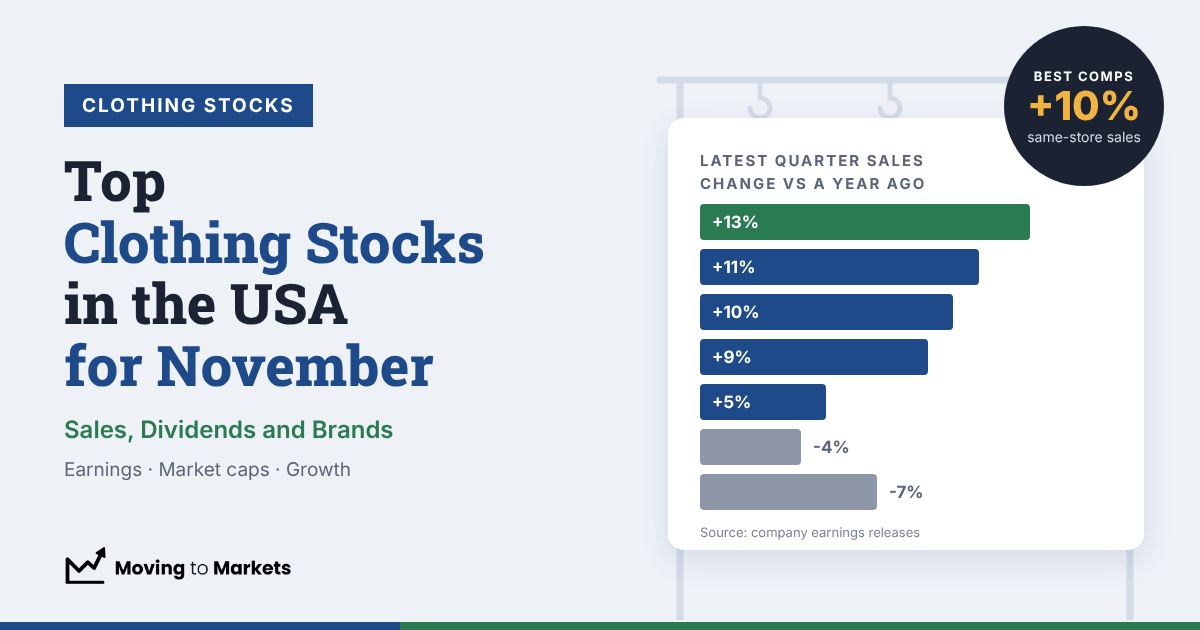
Clothing stocks had a strange 2026. Some of the biggest names are struggling hard. Nike’s stock closed at $38.59 on November 6, down from a 52-week high of $69.14, according to StockAnalysis. Lululemon cut its full-year forecast and now expects sales to fall 5% to 7%. At the same time, the discount stores are doing great. Ross Stores grew sales 13% last quarter and TJX now has 5,285 stores and says it wants 7,500 one day.
Below are the top clothing stocks in the USA, 18 of them, ordered by market cap. For each one you get what the company sells, how its last quarter went, whether it pays a dividend, and what could go wrong. All earnings figures come from the companies’ own latest quarterly results.
Not financial advice. This article is for general information only. It isn’t a recommendation to buy or sell any stock. Stocks can lose value, and fashion stocks can drop fast when a trend fades. Do your own research and, if you can, talk to a licensed financial advisor before you invest.
Top 18 US Clothing Stocks at a Glance
Market cap is the end-of-day figure from CompaniesMarketCap on the date shown, unless marked. Revenue is for the latest reported quarter, compared with the same quarter a year earlier. Dividend yield is from StockAnalysis on late October or early November prices.
| # | Company (ticker) | What it sells | Market cap (date) | Latest quarter revenue | Dividend yield |
|---|---|---|---|---|---|
| 1 | TJX Companies (TJX) | TJ Maxx, Marshalls, HomeGoods off-price stores | $150.6B (Nov 10) | $15.18B (+5%) | 1.34% |
| 2 | Ross Stores (ROST) | Ross Dress for Less and dd’s DISCOUNTS | $76.7B (Nov 10) | $6.26B (+13%) | 0.76% |
| 3 | Nike (NKE) | Sports shoes and clothing, Jordan, Converse | $57.4B (Nov 10) | $11.2B (-4%) | 4.25%* |
| 4 | Tapestry (TPR) | Coach and Kate Spade bags and clothing | $26.4B (Nov 7) | $1.89B (+11%) | 1.66% |
| 5 | Ralph Lauren (RL) | Polo shirts, suits, luxury clothing | $24.6B (Nov 4) | $2.19B (+9%) | 1.03% |
| 6 | Burlington Stores (BURL) | Off-price clothing and home stores | $15.5B (Nov 6) | $3.00B (+11%) | None |
| 7 | Lululemon (LULU) | Yoga pants and athletic wear | $12.8B (Nov 10) | $2.42B (-4%) | None |
| 8 | Deckers Brands (DECK) | HOKA running shoes and UGG boots | $12.0B (Nov 10) | $1.48B (+3.5%) | None |
| 9 | Levi Strauss (LEVI) | Levi’s jeans and Beyond Yoga | $8.7B (Oct 29) | $1.61B (+4%) | 2.93% |
| 10 | Gap Inc. (GAP) | Old Navy, Gap, Banana Republic, Athleta | $7.5B (Nov 6) | $3.65B (-2%) | 3.18% |
| 11 | Urban Outfitters (URBN) | Anthropologie, Free People, Urban Outfitters, Nuuly | About $7.5B (Oct) | $1.66B (+10%) | None |
| 12 | VF Corp (VFC) | The North Face, Vans, Timberland | $6.7B (Oct 26) | About $2.70B (-4%)* | 2.12% |
| 13 | Abercrombie & Fitch (ANF) | Abercrombie and Hollister | $6.6B (Oct 25) | $1.27B (+5%) | None |
| 14 | Kontoor Brands (KTB) | Wrangler jeans and Helly Hansen outdoor wear | $4.1B (Oct 29) | $685M (+3%) | 2.86% |
| 15 | PVH Corp (PVH) | Calvin Klein and Tommy Hilfiger | $4.0B (Oct 26) | $2.10B (-3%) | 0.17% |
| 16 | American Eagle Outfitters (AEO) | American Eagle jeans and Aerie | $3.3B (Nov 7) | $1.38B (+8%) | 2.79% |
| 17 | Columbia Sportswear (COLM) | Columbia jackets, Sorel boots | $3.1B (Oct 25) | $963M (+2%) | 1.98% |
| 18 | Under Armour (UAA) | Sports clothing and shoes | About $2.0B (Oct 26)* | $1.24B (-7%) | None |
* Single source, see the notes for each stock below.
One thing to know before you read on, because it shows up in almost every company below. In February 2026 the Supreme Court rejected the blanket tariffs that were put in place under the International Emergency Economic Powers Act (IEEPA). Importers have been getting that money back since. Clothing companies import a lot, so the refunds made many profits this year look bigger than they really are. TJX got $331 million back in one quarter. Ross said refunds added about $0.60 to its earnings per share. When a company gives you an “adjusted” number that strips the refund out, look at that one. It tells you how the actual business did.
1. TJX Companies (TJX)
If you have ever spent an hour digging through the racks at TJ Maxx or Marshalls and walked out with a $30 jacket that should have cost $120, you already know how TJX works. It buys extra stock from brands and department stores and sells it for less. It also owns HomeGoods, Sierra, Winners in Canada, and TK Maxx in Europe and Australia.
In the second quarter of fiscal 2027, which ended August 1, 2026, net sales were $15.18 billion, up 5% from $14.40 billion. Comparable sales grew 4%. Diluted EPS was $1.36, up from $1.10, but $0.14 of that came from tariff refunds. Without it, EPS was $1.22, up 11%. HomeGoods was the strongest division with comparable sales up 7%. Marmaxx, the US TJ Maxx and Marshalls business, only grew comps 1%, and the CEO admitted sales there “were below our expectations.”
TJX expects adjusted EPS of $5.15 to $5.20 for the full year and plans to buy back about $2.75 billion to $3.0 billion of its own stock. It ended the quarter with 5,285 stores and raised its long-term target to 7,500.
Good for: People who want the biggest and steadiest name on this list, with a small but growing dividend. The catch: You pay for that steadiness. StockAnalysis showed a forward P/E of about 26.6 in late October. Marmaxx, the biggest part of the business, is growing slowly.
2. Ross Stores (ROST)
Ross is the other big off-price chain. Its stores are a bit more no-frills than TJ Maxx, and it also runs dd’s DISCOUNTS, which goes after shoppers on tighter budgets.
This was the best quarter on the list for traffic. Second-quarter sales rose 13% to $6.26 billion, and comparable store sales jumped 10%. The company said that was “primarily driven by customer traffic,” which means more people walking through the door. Diluted EPS was $2.66 against $1.56 a year ago, with about $0.60 of that from tariff refunds. Even without the refund, EPS beat the company’s own guidance of $1.85 to $1.93.
Ross now expects full-year EPS of $8.61 to $8.77. It ended the quarter with 2,328 stores and plans to open 115 new ones in 2026. It’s on track to buy back $1.275 billion of stock this year.
Good for: Investors who think shoppers will keep hunting for deals. The catch: The next two quarters face much tougher comparisons, as the CEO said himself. Forward P/E was about 27.4 on StockAnalysis in late October, so the stock already prices in a lot of good news.
3. Nike (NKE)
You know Nike. Swoosh on your sneakers, Jordans, Converse Chuck Taylors. It’s still the biggest sportswear brand in the world, but the stock has had a rough two years.
First-quarter fiscal 2027 revenue, for the three months to August 31, 2026, was $11.2 billion, down 4%. Nike Direct sales fell 8% and Nike’s digital sales fell 13%. Converse had a bad quarter, down 28% to $263 million. Wholesale held up better, down only 1%. On the positive side, gross margin improved 0.6 points to 42.8%, and North America grew. Diluted EPS was $0.48.
Nike expects revenue to fall high-single digits for the full year and adjusted EPS of $1.15 to $1.35. It has a cost-cutting plan called Pace that it says will save about $2.5 billion through fiscal 2031. CEO Elliott Hill said, “We have more work to do in NIKE Sportswear, Jordan Brand and Greater China.”
Good for: Patient investors who believe the brand will come back and want a high dividend while they wait. StockAnalysis shows a 4.25% yield on the November 6 close, the highest on this list. That figure is from StockAnalysis only. The catch: Sales are still shrinking and the company says they will keep shrinking this year. A forward P/E near 30 is not cheap for a business in that position.
4. Tapestry (TPR)
Tapestry owns Coach and Kate Spade. Right now Coach is doing almost all the work.
In the first quarter of fiscal 2027, revenue rose 11% to $1.89 billion. Coach alone grew 16% to $1.66 billion. Kate Spade went the other way, down 10% to $233 million. Sales in Greater China jumped 43%, and Europe grew 20%. Gross margin was 78.6%, which means Tapestry keeps almost 79 cents of every sales dollar after the cost of making the product. Non-GAAP EPS was $1.82, up 32%.
Tapestry raised its full-year forecast to $8.5 billion to $8.6 billion in revenue and $8.25 to $8.35 in EPS. It plans to return about $2.0 billion to shareholders this year, with $1.7 billion of that in buybacks. The annual dividend is $1.85 a share.
Good for: People who want a fashion company that is growing fast and still trades at a reasonable price. StockAnalysis showed a forward P/E of about 14 on October 26 prices. The catch: Almost all the growth is Coach. If Coach cools off, there is not much else to carry the company, since Kate Spade is shrinking.
5. Ralph Lauren (RL)
Ralph Lauren is the polo shirt with the little horse on it. It sells clothing, home goods and fragrances.
The last quarter went well.
Second-quarter fiscal 2027 revenue grew 9% to $2.19 billion. Asia was the star, up 28%, and China grew more than 35%. North America grew 6%. Europe was nearly flat. Adjusted EPS was $4.64, up 22%, and adjusted gross margin rose to 70.5%. The company raised its full-year outlook for constant-currency revenue growth to 6% to 7%.
Ralph Lauren pays $1.00 a share each quarter, up from $0.9125 a year ago, and it has already bought back $500 million of stock this fiscal year.
Good for: Investors who want a premium brand with growing sales and a rising dividend. The catch: Europe is barely growing and the stock was in the upper part of its range. StockAnalysis showed a 52-week range of $306.55 to $421.60 and a forward P/E around 19.8.
6. Burlington Stores (BURL)
Burlington is the third big off-price chain, after TJX and Ross. It used to be called Burlington Coat Factory, and it still sells a lot of coats, but you’ll find clothes for the whole family, shoes and home stuff too.
Second-quarter sales grew 11% to $3.00 billion. Comparable store sales grew only 2%, so most of the growth came from new stores. Burlington ended the quarter with 1,287 stores, 149 more than a year before. Adjusted EPS was $2.37, up 38%, and the company called it its “15th consecutive quarter of double digit EPS growth.”
For the full year, Burlington expects sales up 10% to 11%, about 115 net new stores, and adjusted EPS of $11.77 to $11.97.
Good for: People who want off-price growth from a company that is still opening a lot of stores. The catch: No dividend, and the stock has lagged. It closed at $246.76 on November 6, near the bottom of its 52-week range of $226.85 to $378.33, according to StockAnalysis. Third-quarter guidance calls for EPS of $1.60 to $1.70, below last year’s $1.80.
7. Lululemon (LULU)
Lululemon made $100 yoga pants normal. It’s still popular, but weaker US sales have hurt it badly in 2026.
Second-quarter revenue fell 4% to $2.42 billion. Comparable sales dropped 9%, and the Americas were down 12%. International sales grew 4%. Diluted EPS was $2.92 against $3.10, and $0.86 of this year’s figure came from tariff refunds. The company cut its full-year forecast and now expects revenue of $10.35 billion to $10.50 billion, down 5% to 7%. Interim co-CEOs are running the company until the new CEO, Heidi O’Neill, starts.
Good for: Bargain hunters who think the brand will recover. StockAnalysis showed a forward P/E of about 13 on November 6, very low for a company that used to trade at much higher multiples. The catch: The stock closed at $110.79 on November 6, down from a 52-week high of $225.98. Third-quarter revenue is expected to fall 10% to 11%. No dividend.
8. Deckers Brands (DECK)
Deckers owns two brands most people know: HOKA, the chunky running shoes, and UGG, the sheepskin boots. Footwear more than clothing, but it sells in the same stores and to the same shoppers, so it belongs here.
Second-quarter fiscal 2027 sales rose 3.5% to $1.48 billion. HOKA grew 6.8% to $677 million and UGG grew 3.5% to $786 million. For a brand that was the company’s growth story, that’s slow. Direct-to-consumer sales fell 1.8%. Diluted EPS was $2.31 against $1.82, including a $0.28 tariff refund benefit.
Deckers expects full-year sales of $5.700 billion to $5.725 billion and EPS of $7.80 to $7.95. It’s buying back a lot of stock: $637.5 million in the first six months of the fiscal year, with about $4.4 billion left on its plan.
Good for: Investors who want a cheap stock with heavy buybacks. StockAnalysis showed a forward P/E of about 11 on November 6. The catch: HOKA growth has slowed a lot, and the stock price shows it. It closed at $86.71 on November 6, against a 52-week range of $77.20 to $122.29. No dividend.
9. Levi Strauss (LEVI)
Levi’s has made jeans since the 1870s. Today it also sells tops, jackets and Beyond Yoga activewear, and it’s trying to sell more through its own stores and website.
Third-quarter revenue rose 4% to $1.61 billion. Adjusted EPS was $0.48, up from $0.34. Gross margin was 66.2%, but about 4.9 points of that came from tariff refunds. Direct-to-consumer made up 45% of revenue, though its comparable sales were basically flat. CEO Michelle Gass said DTC “fell short of our internal expectations.” International and wholesale did better, and US sales were down 1%.
Levi raised its full-year adjusted EPS outlook to $1.54 to $1.56. It also raised the quarterly dividend 14% to $0.16 a share and plans a $100 million accelerated share buyback.
Good for: People who want a famous brand with a decent dividend. StockAnalysis showed a 2.93% yield in late October. The catch: Its own stores and website, which the company is betting on, aren’t growing right now. US sales slipped.
10. Gap Inc. (GAP)
Gap Inc. owns four brands you have walked past at the mall: Old Navy, Gap, Banana Republic and Athleta. Old Navy is by far the biggest and it’s the one having trouble.
Second-quarter net sales fell 2% to $3.65 billion. Comparable sales dropped 1%. The brands went in very different directions. The Gap brand grew comps 10%, a real turnaround. Banana Republic was up 3%. Old Navy was down 4% and Athleta fell 12%. Adjusted EPS, without tariff refunds, was $0.52. CEO Richard Dickson said, “We have work to do at Old Navy.”
Gap expects full-year adjusted EPS of about $2.35 to $2.45. It pays $0.175 a share every quarter, up 6% from a year earlier, and bought back $601 million of stock in the first half of the year.
Good for: Value investors. StockAnalysis showed a forward P/E of about 8.7 and a dividend yield of 3.18% in late October, among the cheapest on this list. The catch: Old Navy makes more than half of sales, and it’s shrinking. Athleta is shrinking faster.
11. Urban Outfitters (URBN)
Urban Outfitters Inc. owns three store brands, Anthropologie, Free People and Urban Outfitters, plus Nuuly, a clothing rental service where you pay a monthly fee and get six pieces to wear.
Second-quarter fiscal 2027 sales rose 10% to $1.66 billion. Retail comparable sales grew 6%. Every brand grew. Free People was up 15%, with its FP Movement activewear line up 26%. Nuuly grew 29% to $179 million, and its average subscriber count rose 30%. Adjusted EPS, without tariff refunds, was $1.72 against $1.58.
Good for: Investors who want growth across several brands, including a subscription business that is now making a profit. StockAnalysis showed a forward P/E of about 14 in late October. The catch: The stock was near the top of its 52-week range ($59.54 to $91.87) in late October, so a lot of good news is already in the price. No dividend, and the results file we read didn’t include full-year guidance. Market cap is about $7.5 billion, from CompaniesMarketCap’s October figures.
12. VF Corp (VFC)
VF owns The North Face, Vans and Timberland. It has spent the last few years selling off smaller brands, including Dickies, and paying down debt.
Second-quarter fiscal 2027 revenue was about $2.70 billion, down 4%. Without Dickies, which VF sold, revenue grew 1%. The North Face grew 4% to $1.21 billion and Timberland grew 4% to $526 million. Vans is still the problem, down 10% to $548 million. Adjusted EPS was $0.70, up from $0.49, and net debt fell $1.1 billion from a year earlier. These figures come from FashionUnited, World Footwear and Zacks reports of VF’s release, which agree with each other.
VF expects full-year revenue growth of at least 2% in constant currency, excluding Dickies, and an adjusted operating margin of about 8%.
Good for: Turnaround investors who like The North Face and think Vans can recover. The catch: Vans keeps shrinking. The stock closed at $16.95 on October 26, below its 52-week high of $22.27. The dividend yield was 2.12% on StockAnalysis.
13. Abercrombie & Fitch (ANF)
If you remember Abercrombie from the 2000s, with the dark stores and loud music, the company you would find today is very different. It rebuilt itself around clothes for people in their twenties and thirties and it’s been growing for years. It also owns Hollister, for younger teens.
Second-quarter net sales rose 5% to a record $1.27 billion. That was the company’s “15th consecutive quarter of growth.” The Abercrombie brands grew 8%, while Hollister grew 2% and its comps fell 3%. Overall comparable sales were flat. Diluted EPS was $4.17, with about $1.75 of that from roughly $100 million in tariff refunds.
Abercrombie raised its full-year EPS outlook to $13.10 to $13.60 and plans to buy back at least $500 million of stock.
Good for: Growth investors who want a fashion turnaround that is already working. The catch: Comparable sales were flat and Hollister is slowing. The stock closed at $164.73 on October 26, right at the top of its 52-week range of $65.45 to $166.40. No dividend.
14. Kontoor Brands (KTB)
Kontoor owns Wrangler jeans and Helly Hansen, the Norwegian outdoor and workwear brand. It used to own Lee jeans too, but it sold Lee in 2026 and got $698 million of net proceeds.
Third-quarter revenue from the businesses it kept rose 3% to $685 million. Wrangler grew 3% to $485 million and Helly Hansen grew 3% to $191 million. Adjusted EPS was $1.50, up 40%. On a GAAP basis it lost $0.62 a share, mostly because of a $1.73 per share non-cash tax charge.
Kontoor expects full-year adjusted EPS of $5.40 and at least $6.60 in 2027. It’s using the Lee money for a $400 million accelerated buyback. The quarterly dividend is $0.54 a share.
Good for: Income investors. StockAnalysis showed a 2.86% yield and a forward P/E of about 12.9 in late October. The catch: Wrangler is most of the business, and it only grew 3%. A big chunk of the earnings growth comes from buying back shares, not from selling more jeans.
15. PVH Corp (PVH)
PVH owns Calvin Klein and Tommy Hilfiger, two brands you have probably seen on underwear waistbands and jeans for decades.
Second-quarter revenue fell 3% to $2.10 billion. Calvin Klein was down 7% and Tommy Hilfiger was about flat. Non-GAAP EPS was $3.70, up from $2.52. On a GAAP basis PVH lost $2.23 a share because of a $439 million goodwill impairment, an accounting write-down that says some past acquisitions are worth less than PVH paid.
PVH reaffirmed its full-year non-GAAP EPS outlook of $11.80 to $12.10, with revenue about flat. It expects to buy back at least $300 million of stock this year.
Good for: Deep value investors. StockAnalysis showed a forward P/E of about 7.8 in late October, the lowest on this list. The catch: Revenue is falling and Europe was down 6%. The dividend is tiny, about 0.17%.
16. American Eagle Outfitters (AEO)
American Eagle sells jeans and casual clothing. Aerie, its underwear, loungewear and activewear brand, has become the growth engine of the company.
Second-quarter revenue rose 8% to $1.38 billion and comparable sales grew 6%. Aerie’s comps jumped 19%, while the American Eagle brand was down 1%. Diluted EPS was $0.79 against $0.45, with a $179 million net tariff refund behind a lot of that. The company expects full-year operating income of $540 million to $550 million, including the refunds.
AEO pays $0.125 a share each quarter.
Good for: People who believe in Aerie and want a cheaper stock with a dividend. StockAnalysis showed a 2.79% yield and a forward P/E of about 10 in late October. The catch: The main American Eagle brand isn’t growing. Merchandise margins fell 3.3 points in the quarter, so without the refund the profit picture is weaker.
17. Columbia Sportswear (COLM)
Columbia makes jackets, fleeces and outdoor gear, and it owns Sorel boots, prAna and Mountain Hardwear. It’s still run by Tim Boyle, whose family has run it for decades.
Third-quarter sales rose 2% to $963 million. The Columbia brand grew 3%. US sales fell 1%, but international markets grew, with Latin America and Asia Pacific up 11% and Europe, the Middle East and Africa up 7%. Diluted EPS was $1.66 against $0.95 a year ago, when impairment charges cut $0.46 off EPS.
Columbia expects full-year sales of $3.46 billion to $3.50 billion and EPS of $4.65 to $4.90. It pays $0.30 a share every quarter and bought back $200 million of stock in the first nine months of the year.
Good for: Steady, low-drama investors who want a family-run company with a 1.98% yield. The catch: Growth is slow and the US, its biggest market, is shrinking. Mountain Hardwear fell 17%.
18. Under Armour (UAA)
Under Armour was the hot sports brand of the 2010s. Today it’s in the middle of a long restructuring under founder Kevin Plank, who came back as CEO.
Second-quarter fiscal 2027 revenue fell 7% to $1.24 billion. Every region except Latin America shrank, and footwear dropped 11%. EPS was $0.00, flat on the year. The company expects full-year revenue to decline mid-single digits and adjusted EPS of $0.08 to $0.12. Its restructuring will cost about $305 million in total and should be mostly done by December 31, 2026.
Good for: High-risk turnaround investors only. The catch: Revenue keeps falling, there is no dividend, and it bought back no stock in the first half of the year. StockAnalysis showed a forward P/E near 60, very high for a company that barely makes a profit. The stock closed at $4.60 on October 26. Market cap of about $2.0 billion is from StockAnalysis only.
How to Pick a Clothing Stock That Fits You
You don’t need to buy all 18. Here is a simple way to narrow it down:
- Decide what kind of shopper you are betting on. If you think people will keep hunting for deals, look at TJX, Ross and Burlington. If you think people will pay up for brands, look at Ralph Lauren, Tapestry and Abercrombie. Athletic wear means Nike, Lululemon, Deckers and Under Armour.
- Strip out the tariff refunds. Many companies had a one-time boost from IEEPA refunds this year. Use the adjusted EPS when the company gives one. Abercrombie’s $4.17 EPS included about $1.75 from refunds, which is a big piece.
- Look at comparable sales. Comps tell you if existing stores are selling more. Ross grew comps 10%. Lululemon’s fell 9%. That gap says more than total sales do.
- Check what you pay. A forward P/E of 27 (Ross) means the market expects a lot. A forward P/E of 8 (PVH, Gap) means it expects very little. Either one can be wrong.
- Decide if you want income. Nike, Gap, Levi, Kontoor and American Eagle had yields between about 2.8% and 4.3% on StockAnalysis. Lululemon, Deckers, Burlington, Abercrombie, Urban Outfitters and Under Armour pay nothing.
- Keep each stock small. Fashion trends change fast. Lululemon closed about 51% below its 52-week high on November 6, and Nike about 44% below. A common rule is to keep any one stock under 5% of your portfolio.
If you would rather not pick single stocks, a low-cost index fund holds most of the big ones for you. Our top 10 mutual funds comparison lays out the cheapest options. You can also read our top 10 construction stocks in the USA to see a sector that is growing for very different reasons, or our piece on defensive stocks during the AI bull market.
Frequently Asked Questions
What is the biggest clothing stock in the USA?
TJX Companies, the owner of TJ Maxx, Marshalls and HomeGoods, with a market cap of about $150.6 billion on November 10, 2026, according to CompaniesMarketCap. Ross Stores is second at about $76.7 billion and Nike third at about $57.4 billion.
Which clothing stock grew the fastest in 2026?
Among these 18, Ross Stores had the strongest latest quarter, with sales up 13% and comparable sales up 10%. Tapestry grew 11%, with its Coach brand up 16%. Burlington grew 11%, mostly from new stores. Urban Outfitters grew 10%.
Which clothing stocks pay dividends?
Twelve of the 18 do. Nike had the highest yield at 4.25% on StockAnalysis, followed by Gap at 3.18%, Levi at 2.93%, Kontoor at 2.86% and American Eagle at 2.79%. Ralph Lauren, Levi and Gap all raised their dividends in the past year.
Why is Nike stock down so much?
Sales are falling. Nike’s revenue dropped 4% last quarter, digital sales fell 13% and Converse fell 28%. The company expects full-year revenue to decline high-single digits. The stock closed at $38.59 on November 6, 2026, compared with a 52-week high of $69.14.
Are off-price retailers better than brand stocks right now?
In 2026, they have been. TJX, Ross and Burlington all grew sales between 5% and 13% in their latest quarters, while Nike, Lululemon, PVH and Under Armour all saw sales fall. That could change if shoppers start spending more freely again.
How did tariff refunds affect clothing stocks?
After the Supreme Court rejected the IEEPA tariffs in February 2026, importers started getting that money back. TJX received $331 million in its second quarter, American Eagle reported a $179 million net benefit, and Ross said refunds added about $0.60 to EPS. These are one-time gains, so compare adjusted figures when you can.
Start With the Store You Already Shop At
That friend with the overflowing closet is probably shopping at two or three of the companies on this list right now. Think about where you and the people around you actually spend money on clothes, whether that’s the TJ Maxx down the street, the Nike outlet or the Aerie at the mall. Start your research with the one you understand best.