We all know that one friend who bought Nvidia in 2023 and hasn’t stopped talking about it since. Lately they have gone a bit quiet. Since early October a lot of big investors have been selling AI and tech shares and buying the stuff nobody brags about at dinner: Walmart, Coca-Cola, Procter & Gamble, drug makers, power companies.
These are called defensive stocks. People buy toothpaste, groceries and medicine whether the economy is booming or not, so these companies tend to hold up when the market gets nervous. And right now the market is nervous about AI.
How big is the shift?
Pretty big, by the numbers.
According to Financial Times reporting on 10 November, as summarised by Startup Fortune and BigGo Finance:
- The MSCI global consumer staples index rose 10.6% in October, its best month since 1998.
- The MSCI global healthcare index rose 9.8% in October, the second-biggest monthly gain this century. Only the early weeks of Covid in 2020 beat it.
- The MSCI global technology index has fallen about 13% since early October.
- Since the Nasdaq 100 peaked on 6 October, Walmart is up about 15%, and Procter & Gamble and Coca-Cola are each up about 10%.
- So far in November, the Nasdaq 100 is down more than 2% while Europe’s Stoxx 600 is up about 1.5%.
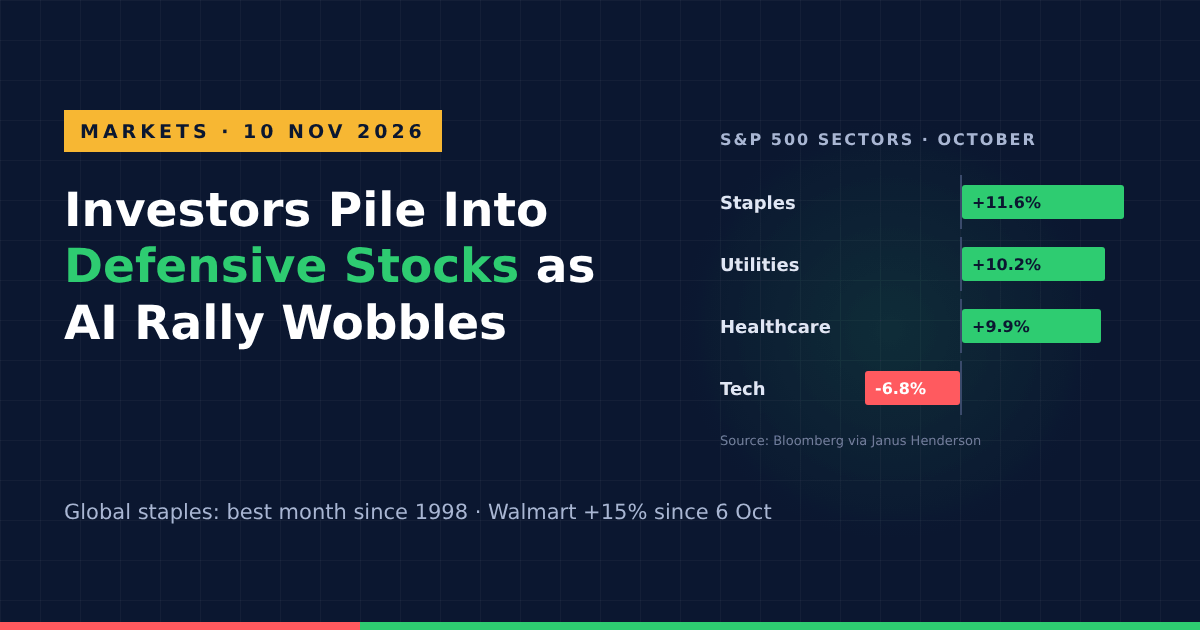
The US sector numbers for October tell the same story. Janus Henderson’s October market review, using Bloomberg data, shows these S&P 500 sector returns for the month:
| S&P 500 sector | October 2026 return |
|---|---|
| Energy | +14.0% |
| Consumer staples | +11.6% |
| Utilities | +10.2% |
| Healthcare | +9.9% |
| Information technology | -6.8% |
| Communication services | -15.1% |
Tech and communication services were the only two sectors that fell. The S&P 500 itself lost just 0.9%, but the equal-weight version of the index, where Walmart counts as much as Nvidia, gained 5.0%. That was its biggest lead over the regular index since April 2009, per Janus Henderson. The Nasdaq Composite dropped 5.3%, its worst month since March 2025, and the Philadelphia Semiconductor Index fell 15.3%.
So the lower your exposure to chips and AI, the better your October probably went.
Why investors are getting out of AI stocks
Nobody is saying AI is going away. The worry is about price and about who pays for all those data centres.
Citi turned cooler on tech. Citigroup cut US and global technology stocks to neutral from overweight. Beata Manthey, Citi’s head of European equity strategy, gave three reasons in a note to clients: wider credit spreads, weaker momentum in earnings upgrades, and a sharp drop in AI sentiment after the US midterm elections. Citi called it a “violent rotation,” according to BigGo Finance. (This detail comes from one source, which cites the FT. Check it before you publish.)
The midterms spooked AI trades. When Democrats won Congress on 3 November, AI stocks took a hit on fears that new rules or local pushback could slow data centre building, especially in Texas. The Nasdaq briefly fell into correction territory on 4 November, CNBC reported.
Rates and inflation are sticky. Matthias Scheiber, head of multi-asset investments at Allspring Investments, said tighter monetary policy and stubborn inflation pushed him to cut high-risk tech and add defensive stocks. Luca Paolini, chief strategist at Pictet Asset Management, pointed to worries about how AI spending is being financed, plus rising rates, as his reason for moving into healthcare. (Both views come from the BigGo Finance summary of the FT report.)
Great tech doesn’t always mean great returns. Matthew McLennan, head of global value at First Eagle Investments, said the sell-off shows that a big new technology does not automatically make money for the people who own the shares.
Ordinary investors were selling too. In the week to 16 October, Bank of America clients sold a record $14.8 billion of individual US stocks, and tech was the second-largest outflow on record, according to a Benzinga report reposted by KuCoin. Consumer staples were one of the few sectors they bought.
Wait, what about defence stocks?
You might have seen headlines and thought “defensive” meant weapons makers. It doesn’t, and in fact defence stocks have had a rough few weeks.
On 4 November, the day after the midterms, Reuters reported that Lockheed Martin fell 6.9%, L3Harris fell 6.9%, Huntington Ingalls dropped 4.9% and RTX slipped 3.1%. Investors expect a Democratic Congress to push back on President Trump’s call for a $1.5 trillion military budget in 2027, up from the $901 billion approved now. Jefferies analysts said they expect the final number closer to the House’s proposal of roughly $1.15 trillion. Roman Schweizer, an analyst at TD Cowen, put it bluntly in a note: “Trump ‘branded’ programs are dead,” meaning projects such as the Golden Dome missile shield.
Europe didn’t help. On 5 November, Rheinmetall, Germany’s biggest arms maker, cut its 2026 sales forecast to about €13.2 billion from €13.7 to 14.2 billion after delays to a German army vehicle order and ammunition deliveries. The shares fell more than 17% that morning, Euronews reported, and BAE Systems, Saab and Leonardo all dropped between 2.7% and 4%. Rheinmetall stock is down more than 48% this year.
So if you were hoping to read that investors are fleeing AI for tanks and missiles, the data doesn’t show that. The money is going into groceries, soap and medicine.
Is the AI trade really over?
Not according to Monday. On 9 November, the S&P 500 jumped 2.35% to 7,549.94, its best day since April, and tech was one of the top sectors, up 3.73%. Every one of the 11 S&P sectors rose. Nvidia was the odd one out, falling 4.27% to $178.67 as its board opened an investigation into reports that CEO Jensen Huang was targeted by a foreign intelligence effort.
And there is a catch with the defensive trade. Scheiber at Allspring said “long defensive, short tech” has worked, but defensive stocks are now expensive too. Walmart and Coca-Cola don’t usually jump 10% to 15% in a month. When everyone piles into the same safe trade, it stops being that safe.
Guy Miller, chief market strategist at Zurich, said tech had lost some of its appeal as investors look to spread their money around, per Startup Fortune. That’s probably the most useful way to read all of this. Most of these fund managers aren’t dumping AI completely. They’re making sure one sector isn’t half their portfolio.
What this means for you
If you own an S&P 500 index fund, about a third of your money sits in tech, so you’ve felt this already. A few practical things to think about:
- Check how much of your portfolio is AI. Add up what you hold in Nvidia, Microsoft, Broadcom, Meta and any tech or semiconductor ETFs. If it’s more than you could stand to see drop 15% in a month, that’s your answer.
- Don’t chase the move. Staples just had their best month in 28 years. Buying after a run like that means you’re paying the higher price.
- Know what you’re buying. “Defensive” and “defence” sound alike but they’re different trades, and right now they’re moving in opposite directions.
None of this is financial advice. If you’re not sure what to do, talk to a licensed adviser before moving your money.