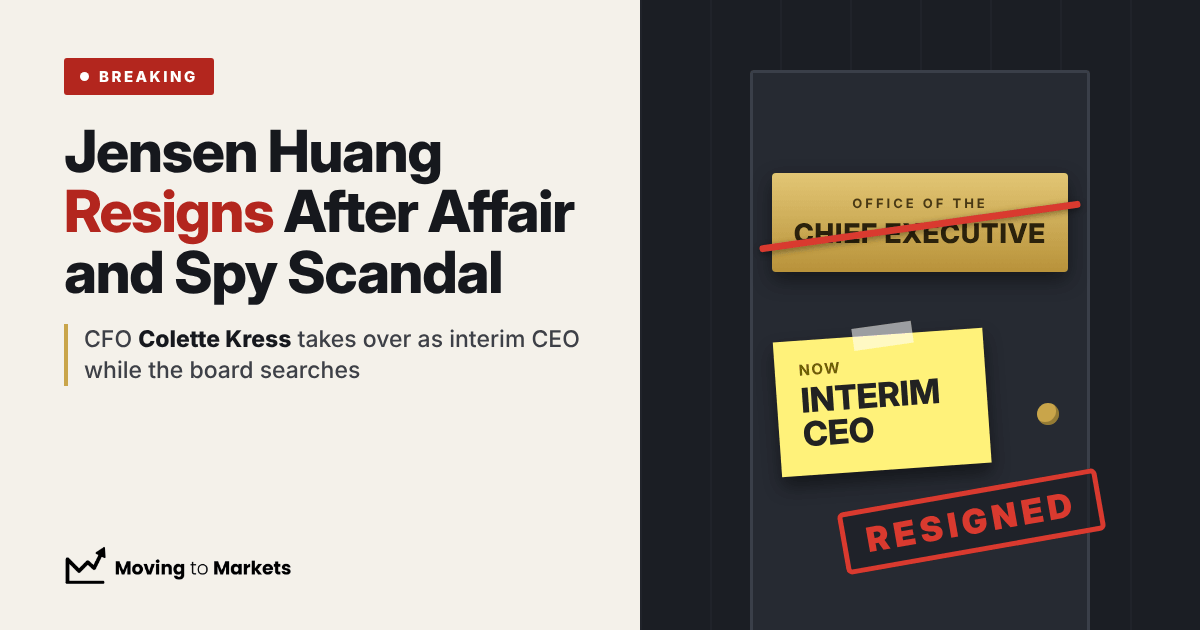
Five days ago almost nobody thought this would happen. Jensen Huang started Nvidia 33 years ago, wore the same leather jacket on every stage, and built a company that started with graphics cards for gamers into the main supplier of AI chips. On Thursday morning, 12 November 2026, Nvidia said he is gone.
The company’s release went out at 8:48 a.m. Eastern. It says Huang “has resigned as President, Chief Executive Officer, and a member of the Board, effective immediately.” So he hasn’t stepped back to chairman or some adviser role. He is out of the company’s leadership completely.
Here’s what we know, what Nvidia actually said, and what to watch next.
Who runs Nvidia now
Colette Kress, Nvidia’s chief financial officer, is the interim CEO. She keeps her CFO job too, until the board names a permanent replacement.
Kress joined Nvidia in September 2013. Before that she spent close to 25 years in finance jobs at Cisco and Microsoft, among other tech companies. If you’ve listened to an Nvidia earnings call in the last decade, you’ve heard her walk through the numbers before Huang took the questions.
Her statement in the release was short: “I am committed to building on the extraordinary foundation Jensen created over the last 33 years.”
The board also made another change people might miss. Harvey C. Jones is now Nvidia’s first-ever Chair of the Board. Jones is a longtime venture investor and was CEO and executive chairman of Synopsys, the chip design software company. Nvidia never had a separate chair before, which says a lot about how much of the company ran through one person.
“The Board has full confidence in Colette and the leadership team,” Jones said.
The board says it will look at internal and external candidates for the permanent CEO job. Bloomberg had reported earlier, as cited by Yahoo Finance, that directors were already working with an outside search firm.
Did he resign or was he pushed?
Nvidia’s word is “resigned.” But the reporting before the announcement pointed the other way.
On Wednesday night the Wall Street Journal reported the board was meeting to decide whether to oust Huang, according to Yahoo Finance’s live coverage. Analyst Dan Ives wrote that Huang “will likely be removed by the board over the next 24 hours.” Bloomberg’s headline on Thursday describes him as “ousted by Nvidia board.”
So the official version is a resignation, and the reporting suggests the board made it clear he had to go. Both can be true. Nvidia hasn’t said more than what’s in the release, which doesn’t mention the affair, the spy allegations or the investigation at all.
How we got here in one week
If you missed the last few days, here’s the short version. We’ve covered parts of this already in our articles on the alleged spy’s AI chip pitch to investors and why analysts expect harsh scrutiny for Nvidia.
- Late October and 6 November: The New York Times and then the Financial Times reported that US officials believed Alice Huang (no relation), a former executive at Singapore data centre firm Megaspeed, was working for China’s Ministry of State Security. Megaspeed is under scrutiny over Nvidia chips allegedly ending up in China.
- Sunday, 8 November: Jensen Huang admitted to an affair in a memo to staff. “I was unfaithful to my wife. My actions hurt her and our children. There is no excuse for what I did. I am deeply sorry.” The board opened an independent investigation the same day.
- Monday, 9 November: President Trump called Huang “an honorable guy” but said the FBI was looking into the relationship.
- Tuesday, 10 November: The board’s independent directors hired Joon H. Kim, former acting US Attorney for the Southern District of New York, and his firm to run the probe. The Information reported Alice Huang is believed to be linked to a network of Chinese companies behind $7.5 billion in chip sales to China. That figure comes from one outlet only.
- Wednesday, 11 November: The New York Times reported a second affair, with Kimberly Powell, Nvidia’s vice president of health care, who reported directly to Huang. The board met that night.
- Thursday, 12 November: Nvidia announced the resignation.
None of the spy claims have been proven in public. No charges have been filed. Beijing has denied that Alice Huang is a spy.
On the Powell story, details differ a bit. Tom’s Hardware says the two were filmed being affectionate at a San Jose hotel during Nvidia’s GTC conference, and that a bystander was allegedly offered a non-disclosure agreement. Yahoo’s summary of the Times report says it happened “during a company conference in March.” GTC usually runs in March, so these probably describe the same event, but we haven’t seen the original report confirm it. The NDA detail comes from Tom’s Hardware alone.
What happened to Nvidia stock
Nvidia shares dropped more than 10% in early trading on Thursday, according to both Tom’s Hardware and Yahoo Finance. Tom’s Hardware puts the stock down more than 23% over the past month.
To give you a sense of scale, Nvidia set a record close on 6 October. After this week the stock sits well over a third below that level, based on Yahoo Finance’s figures. We’d treat any exact price from today with care, because the stock was still moving when we checked.
Analysts were already cutting before the news. A few of the calls this week:
- Dan Ives: cut his price target from $300 to $225.
- Rich Schafer, Oppenheimer: downgraded the stock and dropped his price target. “We see massive shoes to fill and no obvious successor.”
- Ruben Roy, Stifel: said “what matters for the stock from here is less whether a change occurs than how it is executed.”
- Bernstein: downgraded to Market-Perform and cut its target from $400 to $200, per Yahoo Finance’s summary. We couldn’t see this one in the full text, so check it before you quote it.
Schafer’s line is the one most people are repeating. Huang reportedly had around 60 direct reports. There was no named number two, which is why the board went to the CFO instead of an operating executive.
What changes for Nvidia day to day
Probably less than the stock move suggests, at least for now. Nvidia’s customers buy its chips for what the chips do, and the products already shipping or in the pipeline were planned long before this week. A new name at the top doesn’t change what’s in a server rack next quarter.
What does change is who answers the hard questions. Three things to watch:
- Earnings on Tuesday, 17 November. Nvidia reports third-quarter fiscal 2027 results that afternoon, with the call at 2 p.m. Pacific. This will be Kress’s first call as interim CEO, and she’ll likely get as many questions about the investigation as about revenue.
- Congress. House Republicans had asked Huang to a closed-door briefing on 18 November about Nvidia’s security protocols. It isn’t clear yet whether that goes ahead with Kress, with Huang as a private citizen, or not at all.
- The board’s investigation. Joon Kim’s team is still working. Its findings on whether any company secrets were exposed matter more to the export control fight than Huang’s departure does.
What we still don’t know
A fair amount. We don’t know whether Huang gets any severance or what happens to his large personal stake in Nvidia. Nvidia hasn’t said whether the investigation will be made public. We also don’t know who is on the CEO shortlist, and no outlet we read has named a frontrunner.
We’ll update this page when Nvidia files more details with the SEC, after the 17 November earnings call, and when the board names a permanent CEO.